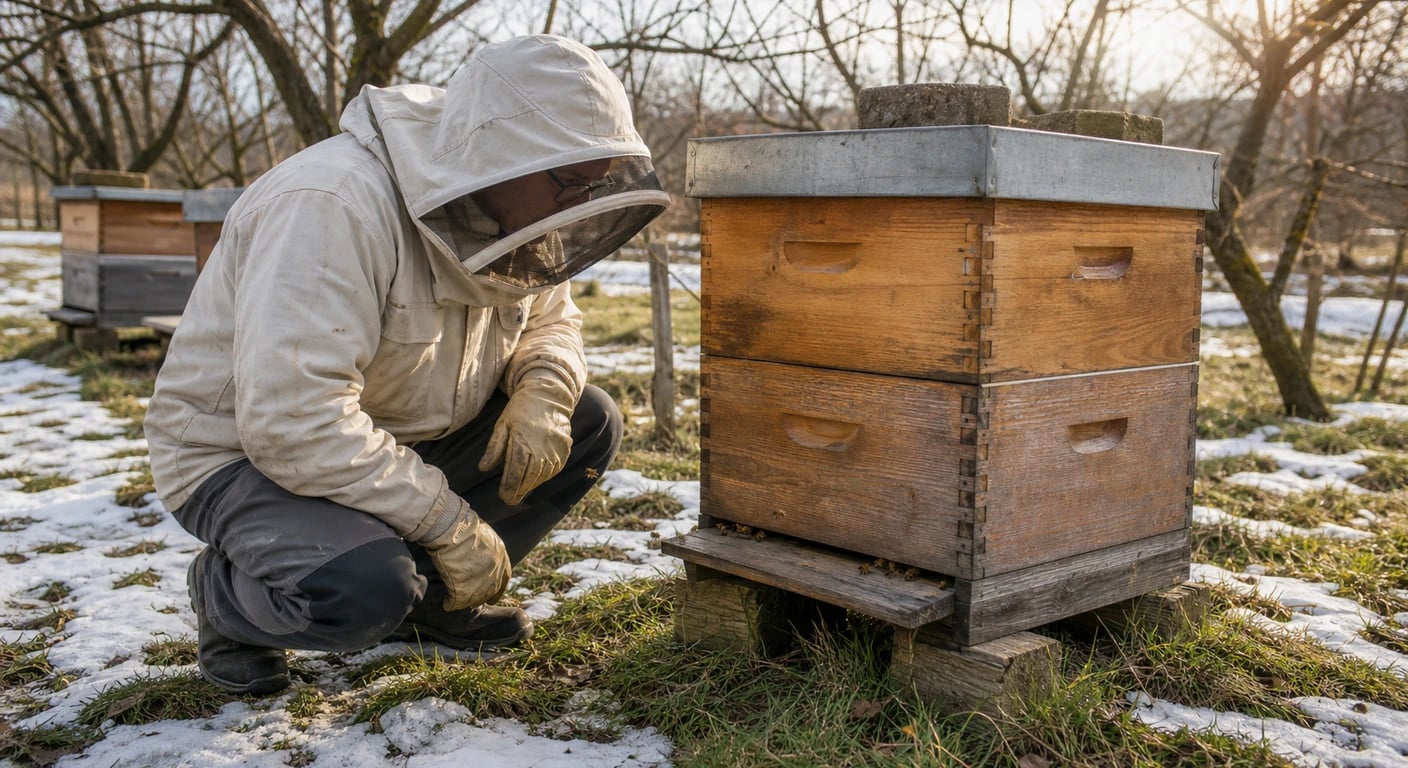
Beehive in March — What to Do Now
March is the starting signal for the beekeeping year: first inspection, checking food reserves, assessing colony strength. This guide shows you step by step what to do at the hive right now.
March marks the turning point of the beekeeping year. The days grow longer, the first crocuses and pussy willows bloom, and inside the hive there is a mood of awakening. For you as a beekeeper, this means the passive winter period is over — it is time to get active again. But be careful: intervening too early or too hastily can disrupt the delicate spring development. In this article you will learn what really matters in March and how to approach the first tasks at the hive in a structured way.
Flight Entrance Observation: The First Check Without Opening
Before you lift the lid, the flight entrance provides valuable information. On sunny days above 10 degrees Celsius you can observe a great deal without disturbing the colony:
- Pollen carriers: Bees returning with thick pollen loads on their legs are the best sign. It means the queen is laying, there is brood, and the colony is active. Pay attention to the pollen colour — yellow suggests willow or hazel, grey indicates alder.
- Flight activity: Lively flight activity in good weather is normal. Absent flight activity when neighbouring colonies are active is an alarm signal.
- Dead bees: A few dead bees in front of the entrance are normal (cleansing flight). Many dead bees, wet clumps, or a sweet odour point to problems.
- Faecal stains: Faecal traces at the entrance or on the hive wall can indicate nosemosis. Isolated spots after the cleansing flight, however, are perfectly normal.
The goat willow (Salix caprea) is the first significant nectar source of the year. As soon as it blooms — usually early to mid-March — the actual spring development begins. Note the date: it is a valuable phenological marker for your region.
When Is the Right Time for the First Inspection?
The answer does not depend on the calendar but on three factors:
- Temperature: At least 12 degrees Celsius, ideally 15 degrees. Below 12 degrees the brood cools down too quickly.
- Weather: Calm and dry. No inspection in rain, gusty wind, or ahead of a cold snap.
- Forage availability: When the bees are already actively bringing in pollen (willow, hazel, crocus), it is a good time.
In northern regions this is often not until late March or early April. In milder areas the timing can be as early as early March. Follow local conditions, not the calendar date.
The phenological markers mentioned — goat willow, hazel, crocus — apply broadly across Central Europe. In other climates, substitute with your local early-spring indicators. The principles remain the same: watch for pollen income and sustained temperatures above 12 degrees Celsius before opening the hive.
The First Inspection: Five Points in Five Minutes
The first spring inspection should be short and focused. No prolonged rummaging through frames — the colony needs its warmth. Concentrate on these five points:
1. Assess Colony Strength
How many frame spaces are occupied? Do not pull out a frame — look down into the hive from above:
- 6+ frame spaces occupied: Strong colony, good starting position
- 4–5 frame spaces: Medium colony, monitor closely
- Under 3 frame spaces: Weak colony — consider merging with a stronger colony
A weak colony in March rarely becomes strong enough on its own for the season. It is better to merge early than to lose it late.
2. Check Food Reserves
After winter, food reserves can become dangerously low — especially in colonies that started brood rearing early. A brooding colony consumes significantly more food than a dormant one.
- Lift frames: Heavy, full frames = sufficient food. Light frames = alarm.
- Rule of thumb: At least 5 kg (11 lbs) of food should still be present
- Emergency feeding: If reserves are low, place fondant (such as Apifonda or equivalent) on top immediately — do not liquid-feed, as this triggers robbing behaviour
Statistically, most colonies do not starve in December or January, but in March. The reason: the brood nest grows, food consumption increases three- to fivefold, yet the nectar flow has not started. Check food reserves once too often rather than once too few.
3. Confirm the Colony Is Queenright
You do not need to see the queen. Look for reliable signs instead:
- Eggs: Small, white sticks standing upright in the cells — the best evidence
- Young open brood: Larvae in royal jelly show that the queen was laying just days ago
- Compact brood nest: A coherent, closed brood pattern indicates a good queen
If you find neither eggs nor young brood, give the colony a frame of young brood from another colony. If it starts building queen cells on that frame, the colony is queenless.
4. Assess Brood Nest Quality
- Solid brood pattern: Capped brood without large gaps is ideal
- Spotty brood pattern: Isolated gaps are normal (inbreeding lethal alleles). Many gaps can indicate disease (chalkbrood, foulbrood)
- Drone brood in worker cells: Raised, dome-shaped cell caps on worker comb suggest a drone-laying queen or a laying-worker colony
5. Check the Debris Board
Pull out the debris board and interpret the signs:
- Light wax crumbs: Normal — the bees are uncapping food cells
- Dark crumbs, evenly distributed: The colony is sitting broadly, a good sign
- Varroa mites: Count the mites on the board. More than 5 mites per day in March is a warning signal
- Chalkbrood mummies: White or grey, hard lumps indicate chalkbrood
Super Up: When to Add the First Honey Super?
Not in March. Adding the honey super comes at the earliest when:
- The colony occupies at least 8 frame spaces
- The cherry blossom begins (phenological marker)
- The bees start building white wax comb along the frame edges (building impulse)
Adding a super too early chills the brood nest. Adding too late provokes swarming. The cherry blossom works as a reliable guide in most regions.
For more on swarm prevention, see the article Preventing Swarming — Methods and Strategies.
Housekeeping: Other March Tasks
Besides the inspection, several tasks should be taken care of now:
- Insert the bottom board slider: Open mesh floor or solid bottom? From March onward, insert the slider to retain warmth in the hive.
- Adjust the entrance: For weak colonies, reduce the entrance size to prevent robbing.
- Mark old combs: Dark, old combs (3+ years) should be marked and moved to the edge during the next expansion — they will be extracted and melted down later.
- Remove mouse guards: When temperatures are consistently above freezing, the mouse guard at the entrance can be removed.
Documenting March Tasks
The first inspection of the year is the perfect time to start the season's documentation. What you record now becomes valuable later:
- Colony strength (frame spaces)
- Food reserves (estimated in kg)
- Brood nest quality (solid, spotty, no brood)
- Queen sighted or eggs present
- Anomalies (dead bees, debris, odour)
With the Quick-Check feature in Hivekraft you can capture these five points in under a minute per colony — right at the apiary, even with gloves on using swipe gestures. This way you have the spring baseline for each colony cleanly documented and can track development throughout the season.
Using Weather Data: No More Guesswork
When is it worth driving to the apiary? Instead of heading out on a hunch, check the weather data. With the weather features in Hivekraft you can see the current temperature and forecast for each of your apiaries — and get a recommendation on whether an inspection makes sense.
Common Mistakes in March
| Mistake | Consequence | Better Approach |
|---|---|---|
| Inspecting too early in cold weather | Brood chills, development is delayed | Wait for 12+ degrees, calm conditions |
| Inspecting too long | Heat loss, stress for the colony | Maximum 5 minutes per colony |
| Not checking food reserves | Colony starves in March | Check every colony, feed if in doubt |
| Leaving a weak colony alone | Colony will not become strong enough | Merge early, do not hope |
| Adding honey super too early | Brood nest chills | Wait for cherry blossom + 8 frame spaces |
Checklist: March at the Beehive
March Checklist for Beekeepers
Conclusion
March is not a month for major interventions but for targeted stock-taking. If you secure food reserves now, merge weak colonies decisively, and document colony strength, you lay the foundation for a successful season. Take five minutes per colony, no more — and you will have everything under control.
- Beekeeping for Beginners — Lesson 7: The First Inspection Step by Step
- Bee Health Complete Course — Recognising Signs of a Healthy Colony
Less paperwork. More time with your bees.
Hivekraft is free for up to 10 hives. Register in 30 seconds.