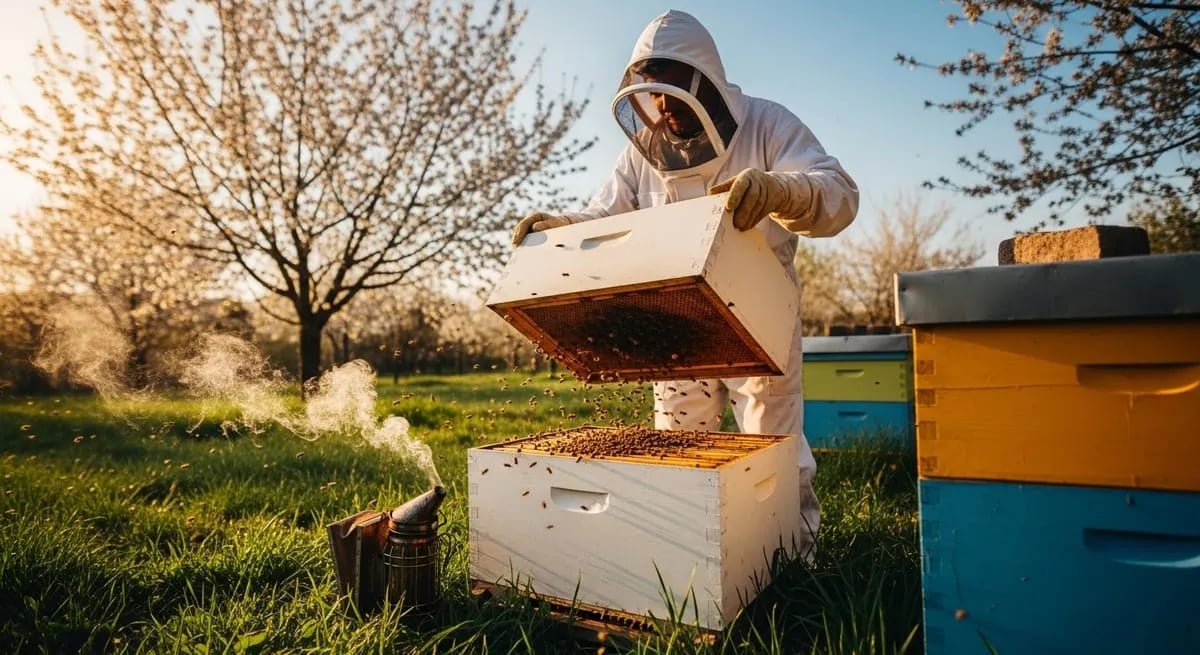
Swarm Control — Preventing and Managing Swarms
Recognizing swarm mood and responding correctly. Methods for swarm prevention, swarm catching, and how to use the swarming instinct for colony multiplication.
Swarming is the natural reproduction behavior of honey bees. For the beekeeper, however, an unwanted swarm means lost honey harvest and potential trouble with neighbors. With proper swarm control, you can prevent this — or deliberately use the swarming instinct for colony multiplication.
When Does Swarming Season Begin?
Swarming season varies by region and climate but generally spans from mid-April to late June in Central Europe:
- Southern regions: Late April to mid-June
- Northern regions: May to late June
- Higher elevations: June to early July
Triggering Factors
- Strong colony development in spring
- Lack of space in the brood nest
- Aging queen
- Warm weather with high humidity
- Lack of nectar flow (comb-building bees with nothing to do)
Recognizing Swarm Mood
Clear Signs
- Queen cells (play cups with larva and royal jelly)
- At the comb edges, usually at the bottom
- Distinguish: empty play cups vs. charged queen cells (containing eggs or larvae)
- Drone brood in large quantities
- Bees hanging as a beard at the entrance ("rehearsal")
- Reduced foraging activity despite nectar flow
- Queen becoming slimmer (egg-laying reduced in preparation for flight)
Swarm Mood During the Quick Check
A regular quick check helps you detect swarm mood early. Check weekly:
- Are there charged queen cells present?
- What is the colony strength? (bees between the frames)
- Is there enough space in the brood nest?
Tip: With the Hivekraft Quick Check, you can record swarm mood in 15 seconds digitally. The app reminds you of the next inspection, and the AI analysis automatically calculates the swarm risk from your data.
Methods of Swarm Prevention
1. Give Space
The simplest measure: expand in time.
- Add the honey super as soon as the first brood box is well occupied
- Provide drone frames (drone comb as a pressure valve)
- Expand the brood nest if necessary
2. Young Queens
Colonies with young queens (1st year) swarm significantly less often:
- Annual queen replacement for swarm-prone colonies
- Breeding from low-swarming lines
- Requeening in late summer
3. Making Splits (Preemptive Swarm)
The most effective method — you preempt the swarm:
- Create a nuc: 2-3 brood frames + bees + food in a new hive
- Open brood gives the bees the ability to raise a new queen
- The parent colony loses swarm mood due to reduced bee population
- You gain a new colony
4. Demaree Method / Vertical Split
A space-saving variant particularly suitable for beginners:
- The split is formed above the parent colony, separated by a divider board with its own entrance (facing the opposite direction)
- Brood frames with adhering bees and an open queen cell go on top; the queen stays below
- Uses the rising warmth of the parent colony for brood care
- After successful mating of the young queen (approximately 3-4 weeks), the split can be separated or reunited
When the Swarm Takes Off Anyway
Catching a Swarm
- Stay calm — a swarm is peaceful
- Locate the swarm cluster (usually on a branch)
- Hold a swarm catching box or cardboard box underneath
- Shake branches or brush bees inside
- The queen must be included (bees will then stay in the box)
- Place box in a shaded spot, open the entrance
- In the evening, transfer into a hive
After the Swarm
- Check the parent colony: Remove all queen cells except one
- Feed the swarm and observe
- Check both colonies for queenrightness after 3 weeks
Legal Aspects of Swarming
The following legal information applies to Germany (BGB, German Civil Code). Swarm ownership laws vary by country. Check your local regulations regarding ownership of escaped swarms.
In Germany, the Civil Code specifically addresses swarm rights in Sections 961-964 BGB:
- Section 961: If a bee swarm leaves, it becomes ownerless if the owner does not pursue it immediately
- Section 962: The owner may enter other people's property during pursuit. If the swarm has settled in another person's hive, the owner may remove the bees. Any damage caused must be compensated
- Section 963: If swarms from different owners merge, the owners become co-owners of the captured combined swarm
- Section 964: If the owner of a bee swarm is unknown, the finder may claim it
In Germany, you may enter other people's property to pursue your swarm under Section 962 BGB — but only under immediate pursuit. Inform the property owner beforehand if possible. Any damage caused (e.g., broken branches) must be compensated. In practice, it is advisable to inform neighbors about swarming season in advance.
Swarm Control Calendar
| Month | Action |
|---|---|
| March | Assess colony strength, plan space |
| April | Add honey super, provide drone frames |
| May | Start weekly swarm inspections |
| June | Inspect every 7 days, make splits if needed |
| July | Swarming season winds down, final inspection |
Summary
Swarm control is one of the most important skills for every beekeeper. The three pillars:
- Prevent: Give space, use young queens, expand in time
- Detect: Regular inspections for queen cells
- Act: Make splits before the swarm takes off
A controlled swarming instinct is not a defeat but an opportunity for colony multiplication.
Swarm management is a core skill for every beekeeper:
- Beekeeping for Beginners -- Lesson 8: Understanding and managing swarming season
- Advanced Beekeeping -- Lesson 3: Professional swarm management
Less paperwork. More time with your bees.
Hivekraft is free for up to 5 hives. Register in 30 seconds.