
Spring Awakening at the Beehive: What to Do Now
Spring is here - learn what needs to happen at the beehive now: first inspection, recognizing winter losses, giving space, and planning the season start.
Spring is the most exciting time of the beekeeping year for many beekeepers. After months of winter dormancy, the beehive comes to life, and with the first warm days, the new season begins. But before the joy of the first pollen flights takes over, important tasks await. In this article, you will learn what to do at the beehive in spring, how to recognize winter losses, and how to lead your colonies optimally into the season.
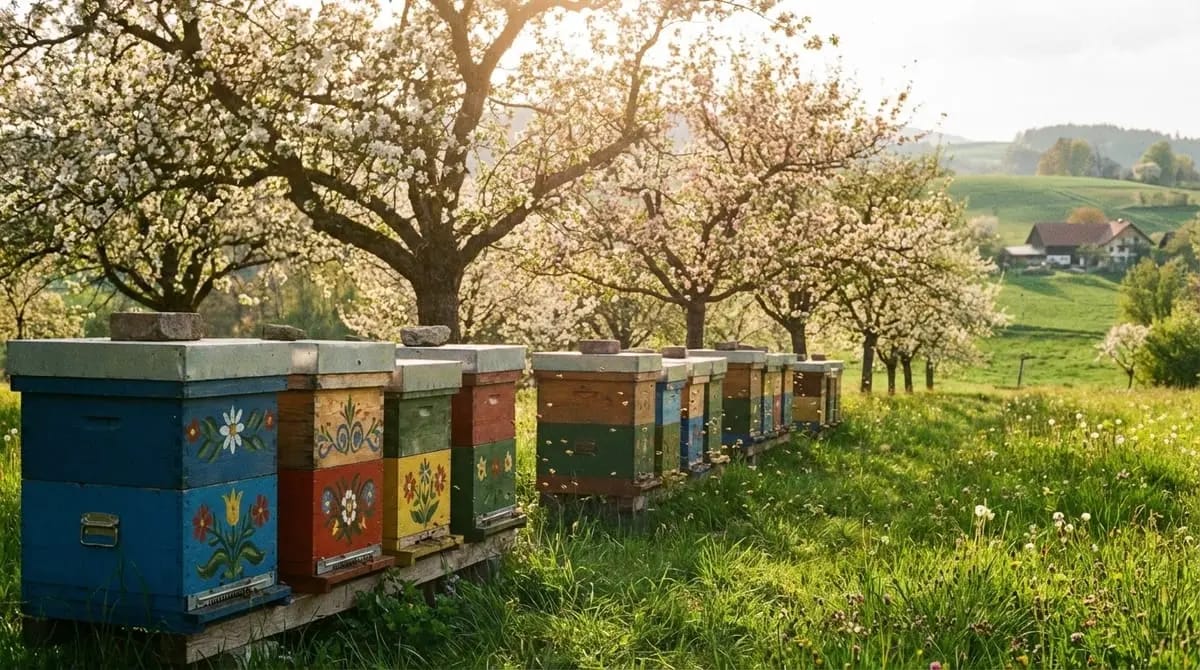
The First Signs: When Do the Bees Wake Up?
Nature gives clear signals when spring begins at the beehive. Already at temperatures from 10 to 12 degrees Celsius, bees undertake their first cleansing flight - they empty their waste, which has not been voided all winter. This flight is vital and an important sign that the colony survived the winter.
Phenological indicators help you gauge the right timing:
- Hazel bloom (February/March): First pollen source, bees fly on mild days
- Willow bloom (March): Massive pollen intake, bees truly start brood rearing
- Fruit tree bloom (April): Full spring development, colonies grow quickly
In southern Germany, spring awakening often begins 2 to 3 weeks earlier than in the north. Elevations above 500 meters are another 1 to 2 weeks behind. Always orient yourself by local vegetation, not the calendar.
Recognizing and Assessing Winter Losses
Not every colony survives the winter. On average, German beekeepers lose 15 to 20 percent of their colonies. In bad years, it can be 25 to 30 percent. The sooner you recognize losses, the better you can respond.
Signs of a Dead Colony
You can already get initial clues from outside:
- No flight activity on mild days while neighboring colonies are flying
- Dead bees in large numbers in front of the entrance
- Fecal spots on the hive (indication of Nosema)
- No buzzing when knocking on the hive
- Wax moths at the entrance (colony has been dead for some time)
Most Common Causes of Winter Losses
| Cause | Frequency | Signs | Prevention |
|---|---|---|---|
| Varroa damage | Very common | Deformed bees, small cluster | Consistent summer treatment |
| Feed shortage | Common | Bees with heads in cells | 15-20 kg winter feed |
| Queenlessness | Medium | Drone laying or no brood | Queen check in autumn |
| Nosema | Medium | Fecal spots, distended abdomen | Strong colonies, good feed |
| Moisture | Regional | Mold on combs | Good hive ventilation |
The First Inspection: Quick Check from Outside
Before you open the hive, do a quick check from outside. This already provides valuable information without disturbing the bees.
- 1
Observe the entrance
Stand beside the hive and observe flight activity. Are the bees carrying pollen? That is the best sign - it means the queen is laying and the colony is rearing brood. Note the color of the pollen loads: Yellow indicates hazel or willow, orange indicates crocus.
- 2
Check dead bee fall
Pull out the monitoring board and inspect the debris. Normal dead bee fall consists of wax cappings, few dead bees, and light debris. Many dead Varroa mites or deformed bee wings indicate a problem.
- 3
Estimate weight
Carefully lift the hive from the back. A well-supplied colony still feels heavy. If the hive feels noticeably light, emergency feeding is needed. Even better: Use a hive scale for exact data.
- 4
Document
Record your observations - flight activity, pollen intake, estimated weight. This gives you a starting point for the season and lets you track each colony's development.
The Spring Inspection: When and How?
The first complete inspection is the most important appointment in spring. Here you get an overview of each colony's condition and make initial decisions for the season.
The Right Timing
Only open your colonies when conditions are right:
- Stable temperatures above 15 degrees Celsius (better 18 degrees)
- Sunshine or at least overcast-warm
- No wind - cold wind quickly chills open brood nests
- Ideally at midday when many foragers are out
What to Check During the Inspection
During the first complete inspection, focus on five central points:
1. Queenrightness: Can you see eggs (freshly laid)? Then the queen is present and laying. You do not necessarily need to find the queen herself - eggs are sufficient proof.
2. Colony strength: How many frame spaces are occupied? A good overwintering result is 5 to 7 occupied spaces. Fewer than 3 spaces means the colony needs support.
3. Brood nest: Is the brood nest solid and compact? Patchy brood or mosaic brood patterns may indicate an old queen, inbreeding, or diseases.
4. Feed reserves: Estimate the remaining feed reserves. Per frame of feed, calculate about 2 to 2.5 kilograms. At least 5 kilograms should still be present.
5. Disease signs: Watch for chalky or mummified brood (chalkbrood), sunken cell cappings (American Foulbrood!), or unusual odor.
Sunken, perforated cell cappings with stringy, brownish mass are a warning sign for the notifiable American Foulbrood. If suspected: Immediately inform the veterinary office and do not change anything on the hive. AFB is a notifiable disease and must be reported.
After the Inspection: The Right Actions
Based on your observations, various measures are needed:
Strong Colonies (7+ Frame Spaces)
- Prepare expansion: As soon as 7 of 10 frames are occupied, it is time for the honey super or a second brood box
- Drone frame: Hang an empty frame as a building frame - serves for Varroa control and gives bees a building task
- Keep swarm control in mind from April
Medium-Strength Colonies (4-6 Frame Spaces)
- Replace old combs: Swap dark, heavy old combs for foundation sheets
- Tighter hive: Possibly restrict with a follower board so the colony can better maintain warmth
- Feed if stores are low (sugar water 1:1 in small portions)
Weak Colonies (Under 4 Frame Spaces)
- Merge with a medium-strength colony (newspaper method)
- No lone fighters: Nursing a weak colony alone costs resources and rarely produces a harvest
- Identify the cause: Queenless? Varroa-damaged? Old feed?
Checklist: First Spring Inspection
Giving Space: When to Expand?
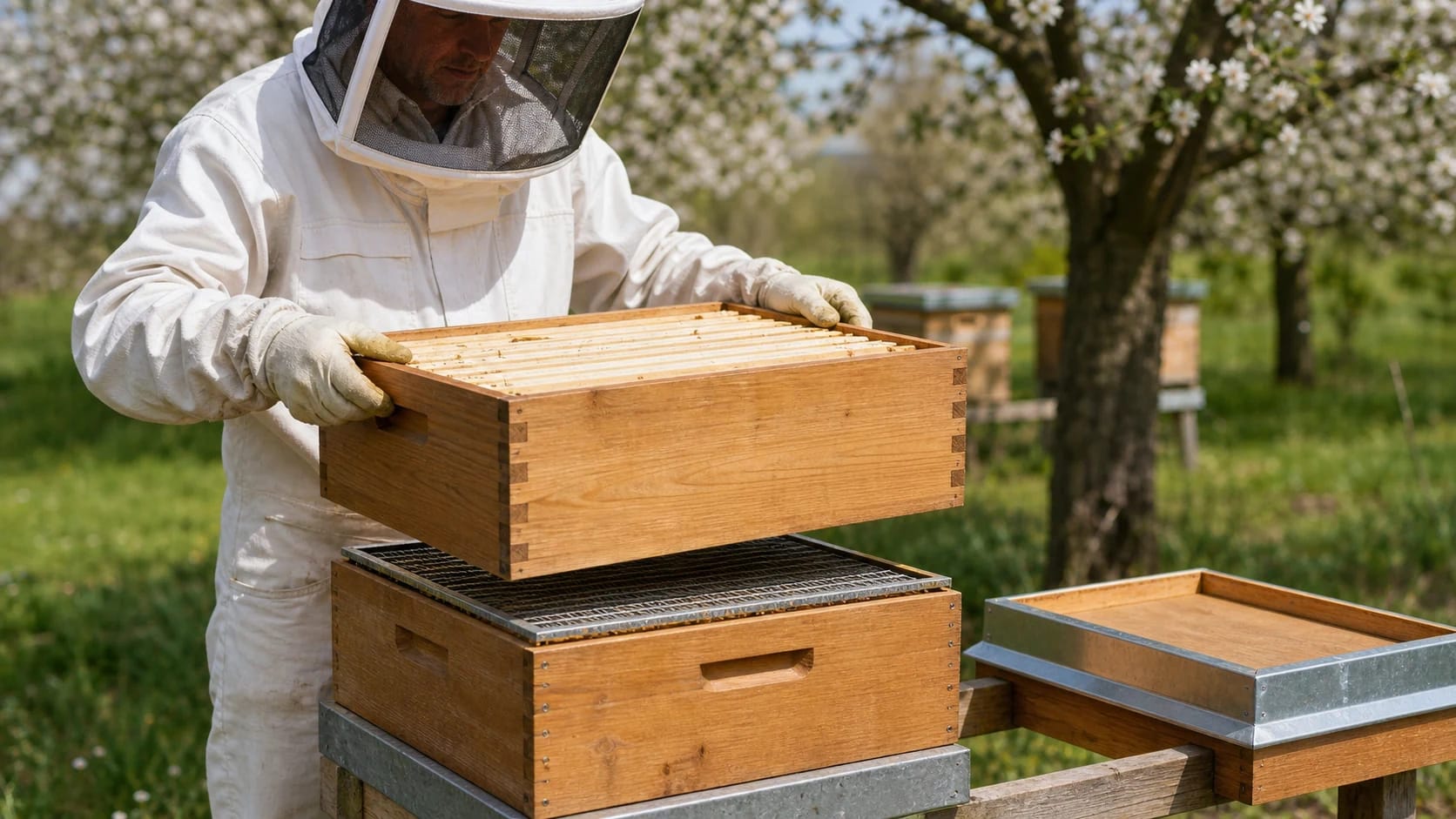
One of the most common mistakes in spring is expanding too late. Bees multiply explosively in spring - a colony can grow from 10,000 to 50,000 bees and more. If you do not give space in time, swarming mood develops.
Rule of thumb for the honey super: When 7 of 10 brood frames are occupied and the fruit tree bloom begins, it is time. Place the honey super with a queen excluder. Better one day too early than one week too late.
 AI-generated
Common Mistakes in Spring
Feed Reserves in Spring
Especially in late winter and early spring, feed shortage is the most common cause of loss. Colonies start brood rearing, consume significantly more energy - and reserves dwindle rapidly.
If you estimate fewer than 5 kilograms of feed in the colony in early March, you should act immediately:
- Fondant directly on the frames (works even at cool temperatures)
- Feed frame from a reserve
- Sugar water 1:1 in small amounts, as soon as temperatures allow
Summary: Your Spring Roadmap
Spring at the beehive follows a clear rhythm. Here is your roadmap for the first weeks:
| Period | Task | Priority |
|---|---|---|
| From 10°C | Observe cleansing flight, clear entrance | High |
| Anytime | Check monitoring board, estimate weight | High |
| From 15°C | Conduct first spring inspection | Very high |
| Fruit tree bloom | Add honey super, insert queen excluder | High |
| April | Insert drone frame, start comb hygiene | Medium |
| From May | Begin swarm checks in 7-day cycle | Very high |
Spring determines the season. Those who work cleanly during the spring inspection have fewer problems the rest of the year.
Spring is a time of new beginnings - for the bees and for you as a beekeeper. Take the time for a thorough spring inspection, document everything carefully, and act decisively on problems. This way you lay the foundation for a successful season.
Read also: Bee Health in Spring - 7 Important Checks Swarm season is coming: May - Managing Swarm Season Properly For the garden: 20 Simple Tips for Bee-Friendly Gardening- Beekeeping for Beginners -- 12 lessons from first colony to harvest
- Nectar Plants and Bee Forage -- Lesson 2: Understanding the spring bloom
Less paperwork. More time with your bees.
Hivekraft is free for up to 10 hives. Register in 30 seconds.