Spring Bloom: Willow, Fruit Blossom, and Rapeseed
The most important early forage plants for bees: hazel, willow, fruit blossom, dandelion, and rapeseed in detail with bloom calendar and honey yield.
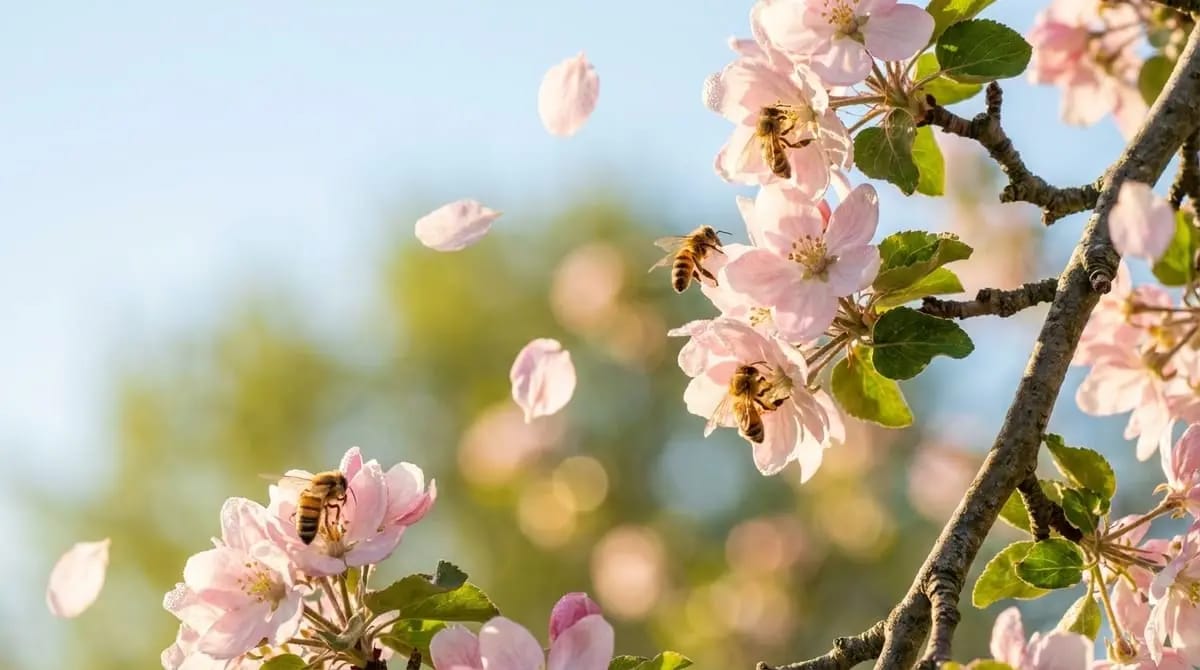
After winter dormancy, colonies must grow to 40,000-60,000 bees within just a few weeks. This is only possible with sufficient early spring forage. Here you will learn about the most important early forage plants.
Spring Calendar Overview
- Jan-FebHazel & SnowdropsFirst pollen sources on mild days (from 8-10°C). Hazel as the most important pre-spring bloomer. Crocus and winter aconite as nectar providers.
- MarchWillow, Cornelian Cherry, MapleWillow bloom as the first major forage! Cornelian cherry and Norway maple as important supplements. Coltsfoot along roadsides.
- AprilFruit Blossom & DandelionCherry, plum, pear, apple blooming. Dandelion mass bloom in meadows. Blackthorn and hawthorn in hedgerows. Maple bloom (field and sycamore maple).
- MayRapeseed & Late BloomersRapeseed bloom as the greatest spring mass forage! Horse chestnut and hawthorn begin. White clover starts. Transition to summer forage.
- Jun (early)Rapeseed End & Black LocustRapeseed bloom ends. Black locust (false acacia) begins. Viper's bugloss and clover in meadows. Transition to summer forage.
- Jan-Feb
Hazel & Snowdrops
First pollen sources on mild days (from 8-10°C). Hazel as the most important pre-spring bloomer. Crocus and winter aconite as nectar providers.
- March
Willow, Cornelian Cherry, Maple
Willow bloom as the first major forage! Cornelian cherry and Norway maple as important supplements. Coltsfoot along roadsides.
- April
Fruit Blossom & Dandelion
Cherry, plum, pear, apple blooming. Dandelion mass bloom in meadows. Blackthorn and hawthorn in hedgerows. Maple bloom (field and sycamore maple).
- May
Rapeseed & Late Bloomers
Rapeseed bloom as the greatest spring mass forage! Horse chestnut and hawthorn begin. White clover starts. Transition to summer forage.
- Jun (early)
Rapeseed End & Black Locust
Rapeseed bloom ends. Black locust (false acacia) begins. Viper's bugloss and clover in meadows. Transition to summer forage.
Hazel (Corylus avellana) -- The First Pollen Provider
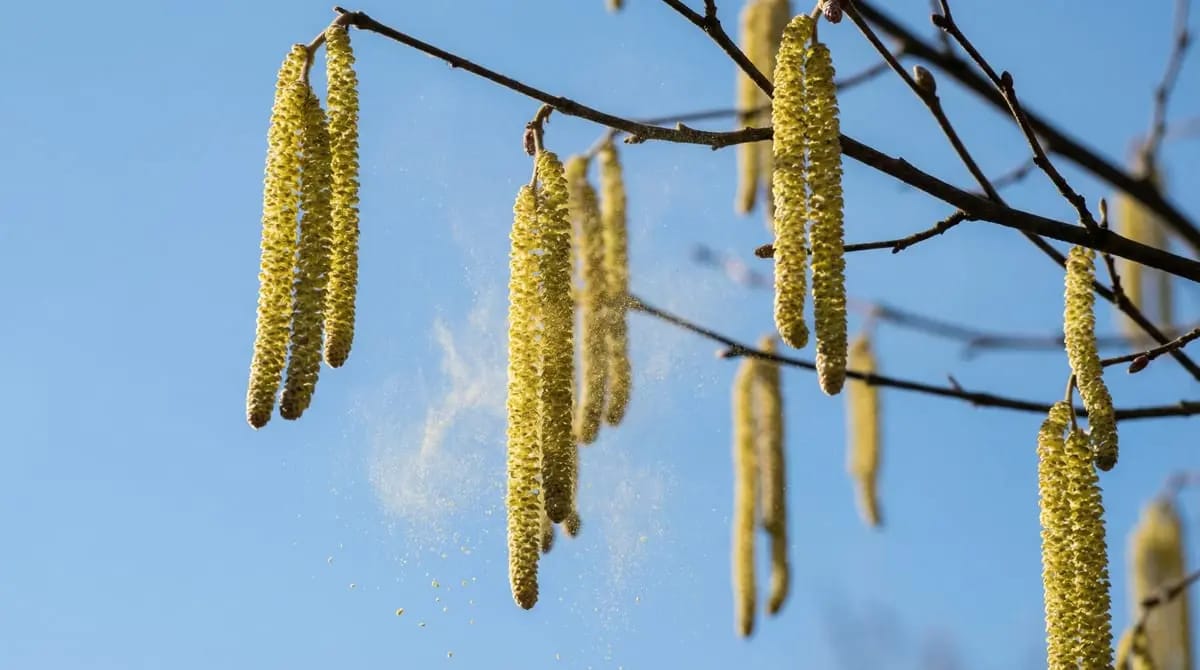
Hazel opens the forage year -- often as early as January or February when milder temperatures occur. It is a pure pollen source (wind-pollinated, no nectar), but this pollen is enormously important for the spring development of colonies.
Hazel Profile
| Characteristic | Data |
|---|---|
| Scientific name | Corylus avellana (Common hazel) |
| Bloom period | January to March (depending on region and weather) |
| Nectar value | 0 (no nectar -- wind-pollinated) |
| Pollen value | 4 (very good, overabundant) |
| Pollen color | Light yellow to lemon yellow |
| Protein content of pollen | approx. 20-24% |
| Pollination type | Wind-pollinated (anemophily) -- bees actively collect |
| Habitat | Throughout Central Europe, hedgerows, forest edges, gardens |
Hazel pollen signals to the colony: Spring is coming! The queen increases egg laying, the brood area expands. Without early pollen, the colony would have to use its own protein reserves (vitellogenin from winter bees) for brood rearing -- this significantly shortens the lifespan of the remaining winter bees.
Other Early Spring Bloomers
In addition to hazel, snowdrops and winter aconite (from February) as well as crocus and coltsfoot (March) provide early food -- particularly important in gardens, parks, and along road embankments.
Willow (Salix sp.) -- The First Major Forage
Willow bloom is to bee colonies what the first strength training after a break is to athletes: the starting signal for full performance. Willows are the first forage source that offers both abundant nectar and high-quality pollen.
Willow Profile
| Characteristic | Data |
|---|---|
| Scientific name | Salix sp. (over 30 species in Central Europe) |
| Key species | Goat willow (S. caprea), White willow (S. alba), Purple willow (S. purpurea) |
| Bloom period | March to April (depending on species and region) |
| Nectar value | 3-4 (good to very good) |
| Pollen value | 3-4 (good to very good) |
| Pollen color | Bright yellow to orange |
| Protein content of pollen | approx. 18-25% |
| Honey yield | Rarely monofloral, but important for buildup |
| Special feature | Dioecious -- only male plants provide pollen |
The goat willow (Salix caprea) is the single most important spring species for bees. Its large, fuzzy catkins (pussy willows) deliver enormous amounts of pollen and nectar. On warm March days, goat willows literally hum with bee activity. Anyone setting up an apiary should have goat willows nearby or plant them.
Beekeeping Significance of the Willow Bloom
The willow bloom marks the beginning of the active beekeeping season:
- Colony development: The protein-rich pollen supply enables intensive brood rearing
- Feed consumption: Caution! Right now a colony can quickly deplete its winter stores due to brood warmth -- feed checks are essential
- First inspection: The willow bloom is traditionally the time for the first thorough inspection of the year
- Restricting space: Weak colonies benefit when the brood chamber is reduced so that warmth can be better maintained
The goat willow bloom is the single most important event in the bee year. Those who have strong, healthy colonies at this point are on the best path to a successful year. Those who already see problems here must act immediately.
Fruit Blossom -- Pollination Service and Honey Harvest
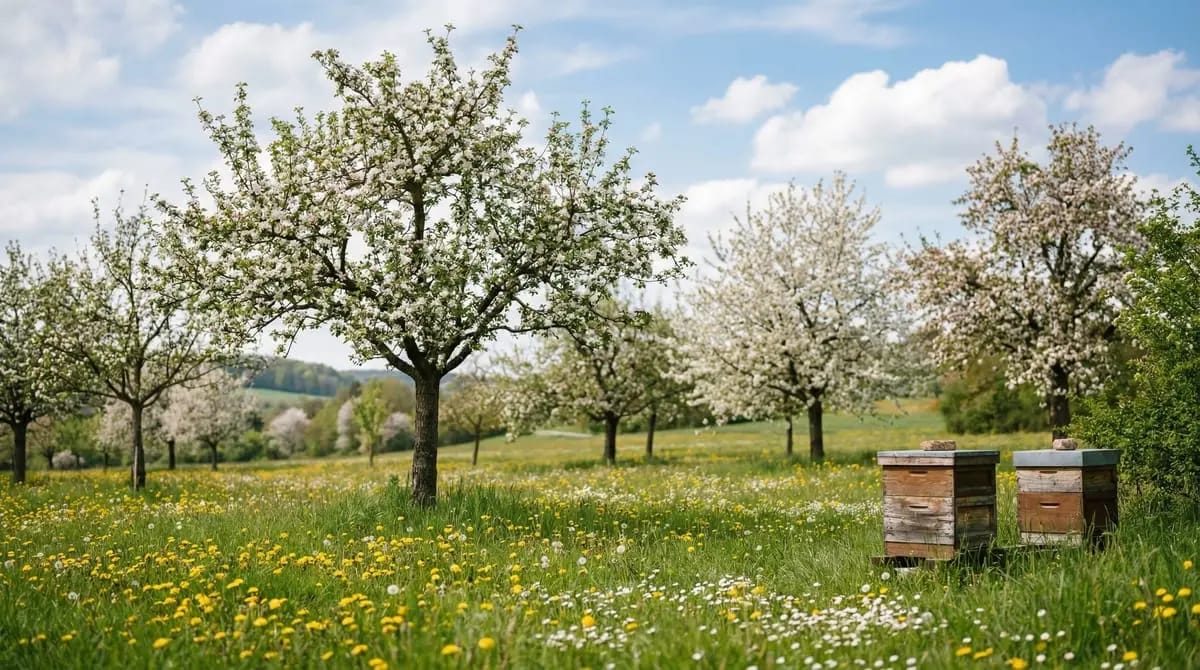
Fruit blossom (April-May) is one of the most important forage periods of the year. It provides both good nectar and high-quality pollen, and is simultaneously the phase when bees perform their crucial pollination service.
Fruit Blossom in Detail
| Fruit Type | Bloom Period | Nectar Value | Pollen Value | Special Feature |
|---|---|---|---|---|
| Sweet cherry (Prunus avium) | April | 2-3 | 2-3 | Early fruit blossom, important for colony development |
| Plum (Prunus domestica) | April | 2 | 2 | Short bloom duration, complements cherry blossom |
| Pear (Pyrus communis) | April-May | 2 | 1-2 | Lower-sugar nectar, less attractive to bees |
| Apple (Malus domestica) | April-May | 2-3 | 2-3 | Most important fruit blossom, largest areas, longest bloom |
| Sour cherry (Prunus cerasus) | May | 2 | 2 | Somewhat later than sweet cherry |
Fruit blossom often coincides with the use of crop protection products. Under Germany's Bee Protection Ordinance, bee-hazardous sprays must NOT be applied to blooming plants. Similar regulations exist across the EU. Despite this, poisoning incidents still occur. As a beekeeper, you should seek contact with fruit growers in your area and encourage bee-friendly spray times (evenings, after bee flight). Always report suspected poisoning to local authorities!
Honey from Fruit Blossom
Pure fruit blossom honey is rare because fruit varieties and other forage sources (dandelion, rapeseed) overlap. In fruit-tree-rich regions, an aromatic spring blossom honey can be harvested.
Dandelion (Taraxacum officinale) -- The Yellow Meadow
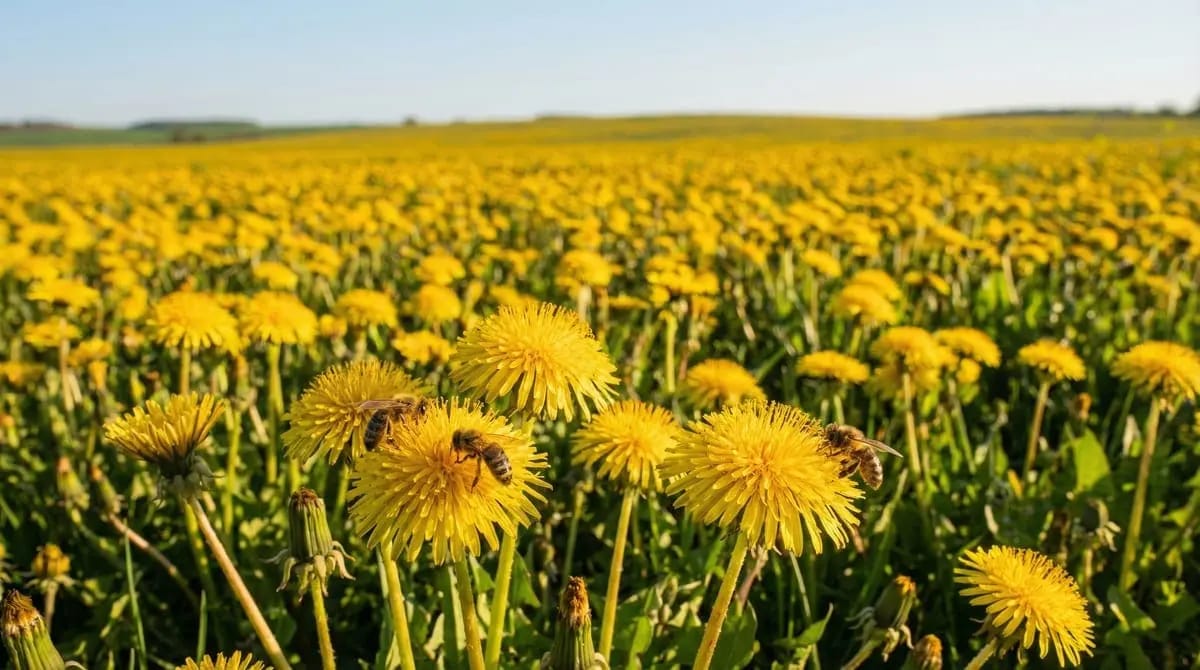
Dandelion is among the most faithful allies of the bee colony. It blooms reliably, abundantly, and over a long period.
Dandelion Profile
| Characteristic | Data |
|---|---|
| Scientific name | Taraxacum officinale (Common dandelion) |
| Bloom period | April to May (main bloom), sporadically until October |
| Nectar value | 2-3 (moderate to good) |
| Pollen value | 3 (good, abundant) |
| Pollen color | Dark yellow to orange |
| Sugar content of nectar | approx. 30-45% |
| Honey yield | Dandelion honey possible in extensive grassland areas (e.g., Alpine foothills) |
| Special feature | Flowers open in the morning and close in rain/cold -- bees must be quick |
Dandelion Honey
In extensive grassland regions (Alpine foothills, Eifel), monofloral dandelion honey is possible: intensely yellow, bold-spicy flavor, very rapid crystallization (high glucose content). A regional specialty commanding a premium price.
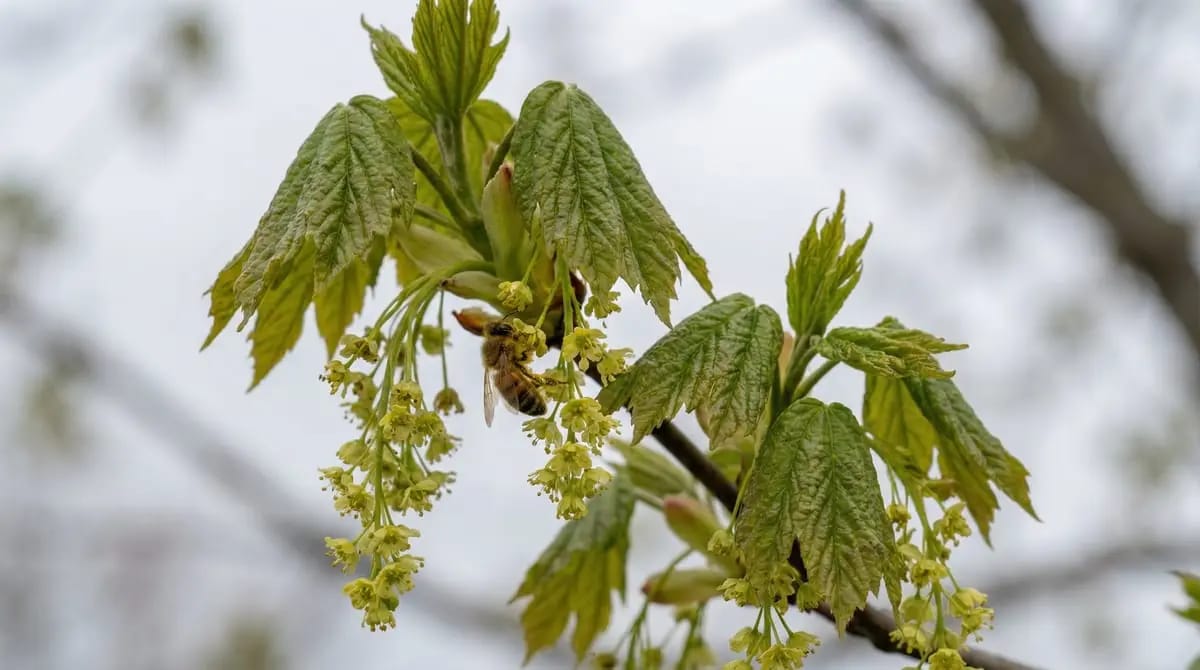
Maple (Acer sp.) -- The Inconspicuous Mass Provider
Maple is often underestimated as a forage plant but is one of the most reliable nectar providers of spring.
Maple Species Comparison
| Species | Bloom Period | Nectar Value | Pollen Value | Habitat |
|---|---|---|---|---|
| Norway maple (A. platanoides) | March-April | 3 | 2 | Widespread, including street trees |
| Sycamore maple (A. pseudoplatanus) | April-May | 3-4 | 2 | Mountain areas, mixed forest, parks |
| Field maple (A. campestre) | May | 2-3 | 2 | Hedgerows, forest edges, drier sites |
The sycamore maple (Acer pseudoplatanus) is one of the best nectar providers among native deciduous trees. In good years, its hanging blossoms can literally drip with nectar -- the so-called "honey rain" beneath sycamore maples is a well-known phenomenon. A single large sycamore maple can provide as much nectar as a small orchard.
Rapeseed (Brassica napus) -- The Mass Forage
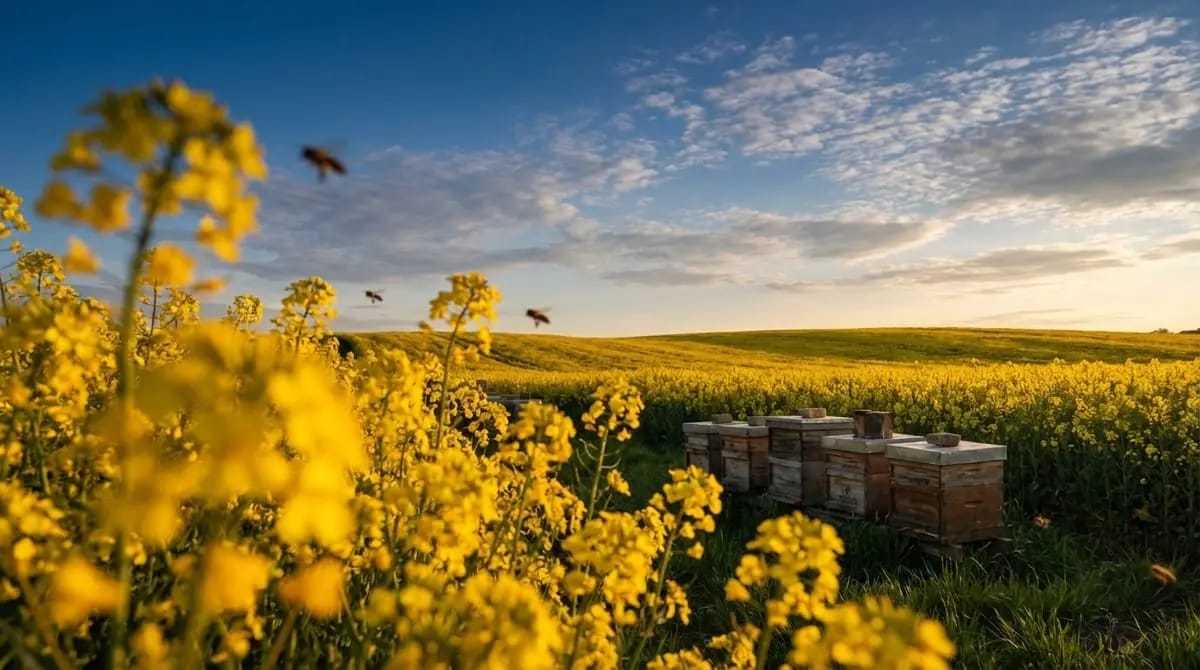
Rapeseed is the forage plant par excellence for beekeeping in Germany and much of Northern Europe. In no other forage flow are similar honey quantities brought in over such a short period. The intensive rapeseed bloom transforms entire landscapes into brilliant yellow -- and for bee colonies, it means peak performance.
Rapeseed Profile
| Characteristic | Data |
|---|---|
| Scientific name | Brassica napus (Winter rapeseed / Spring rapeseed) |
| Bloom period | April to June (winter rapeseed), June to August (spring rapeseed) |
| Bloom duration | 3-4 weeks per field |
| Nectar value | 4 (very good -- mass forage) |
| Pollen value | 3 (good, abundant) |
| Sugar content of nectar | 40-65% |
| Honey yield per hectare | 50-150 kg (depending on variety and weather) |
| Honey yield per colony | 15-40 kg when migrating to rapeseed |
| Cultivation area (Germany) | approx. 1.1 million hectares (largest oilseed crop) |
| Special feature | Glucose-rich nectar -- rapeseed honey crystallizes very quickly! |
The Challenge of Rapeseed Honey
Rapeseed honey is Germany's most popular honey -- mild, creamy, light. But its extraction requires vigilance:
- 1
Migrate to rapeseed
If your location is not already near rapeseed, migration to rapeseed fields is worthwhile. Place colonies 1-3 km from the rapeseed field. Do not forget the migration permit and health certificate (required in Germany and many EU countries)!
- 2
Add supers in time
The rapeseed flow is so strong that colonies quickly need space. Supers that are too tight lead to swarming impulse. Better one super too many than too few.
- 3
Extract early!
Rapeseed honey crystallizes extremely quickly (high glucose content). Extract at most 3-5 days after the end of the flow, otherwise the honey solidifies in the combs and can no longer be extracted. Many beekeepers extract twice during rapeseed flow.
- 4
Cream by stirring
After extraction, let the rapeseed honey develop fine crystals through controlled stirring. This produces the popular spreadable, creamy-white rapeseed honey.
Anyone who extracts too late risks the rapeseed honey solidifying in the combs. The only option then: melt down the combs (the finely crystallized cells can no longer be uncapped and extracted). This means: honey loss and comb loss. Better to extract once too early than once too late!
Rapeseed and Bee Protection
The relationship between rapeseed and bees is not entirely straightforward:
Other Important Early Bloomers
In addition to the main forage sources, these species provide valuable early forage:
- Cornelian cherry (Cornus mas): March, nectar value 2, often even before the willows
- Blackthorn (Prunus spinosa): March-April, nectar value 2-3, white clouds of blossom in hedgerows
- Hawthorn (Crataegus): May, nectar value 2-3, intensive forage in hedgerow landscapes
- Horse chestnut (Aesculus hippocastanum): May, nectar value 2-3, pollen value 3, nectar guides change color (yellow = fresh, red = empty)
Recognizing and Bridging the Spring Forage Gap
In some regions and years, a forage gap opens between the end of fruit blossom (mid-April) and the start of rapeseed bloom (late April/early May). During this time, colonies in the midst of their brood expansion can face acute food shortage. Regular feed checks -- ideally via hive scale -- are essential during this phase. In emergencies, hang feed combs or provide sugar syrup (1:1).
Signs of Forage Shortage in Spring
Warning Signs for Spring Forage Shortage
Regional Differences
Spring forage varies considerably by region. While the following examples focus on Germany, similar patterns apply across Central Europe with timing shifts based on latitude and altitude:
| Region | Typical Early Forage | Special Feature |
|---|---|---|
| Northern European lowlands | Rapeseed dominates, less fruit blossom | Very productive rapeseed flow, but uniform landscape |
| Low mountain ranges (e.g., Harz, Eifel, Black Forest) | Willow, fruit blossom, dandelion, maple | More diverse, but bloom times highly altitude-dependent |
| Alpine foothills | Dandelion mass bloom, fruit blossom | Purest dandelion honey possible |
| Warm river valleys (e.g., Rhine Valley) | Early fruit blossom (almond!), rapeseed | Warmest climate -- up to 2 weeks ahead |
| Northern coastal areas | Later early forage, willow, rapeseed | Cool coastal climate delays bloom times |
Summary
Core Knowledge: Spring Forage
Knowledge Check
In the next lesson, we continue with summer forage -- linden, black locust, phacelia, and the fascinating world of honeydew from the forest.