Know Your Enemy: Varroa destructor in Detail
Understanding the biology, life cycle, and damage caused by the Varroa mite. Why our honey bees are defenceless and how infestation grows exponentially.
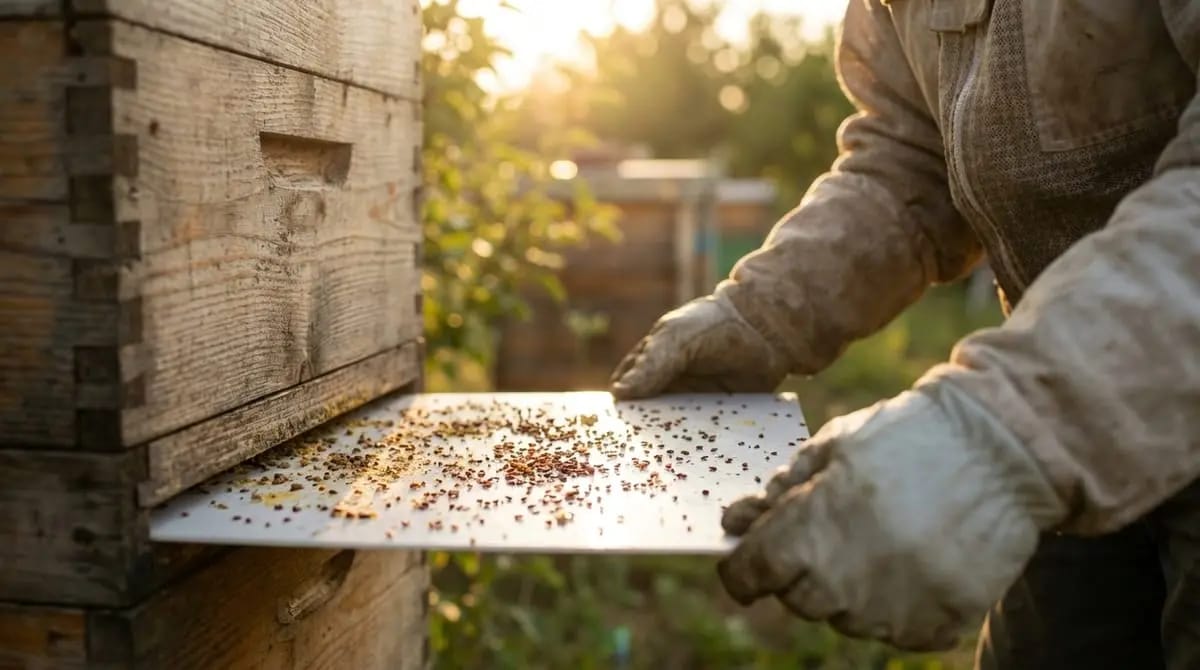
Before we discuss treatment methods, thresholds, and seasonal planning, we need to understand what we are actually dealing with. Varroa destructor is no ordinary parasite. It is a highly specialised brood parasite that co-evolved over millions of years with the Asian honey bee -- and one that has posed an existential threat to our Western honey bee within just a few decades.
In this first lesson of the Varroa Master Course, we lay the foundation for everything that follows: biology, life cycle, damage mechanisms, and the dynamics of infestation growth.
The Story of an Invasion
The Varroa mite was long unknown to European beekeeping. Originally, Varroa destructor lives on the Asian honey bee (Apis cerana), where it plays a relatively harmless role as a parasite of drone brood. Apis cerana has developed effective defence strategies over millions of years and keeps the mite population at a low level.
The Host Switch
In the 1950s and 1960s, the Western honey bee (Apis mellifera) was imported to Southeast Asia for commercial purposes. There, it came into contact with Varroa destructor for the first time -- and the mite found a new, defenceless host.
- 1
Origin (until the 1950s)
Varroa destructor lives exclusively on Apis cerana in Southeast Asia. The mite primarily parasitises drone brood; Apis cerana regulates the infestation through targeted brood removal and intensive grooming behaviour.
- 2
Host Switch (1950s-1960s)
European honey bees are imported to Asia. In contact zones, Varroa mites jump to Apis mellifera. The new host species has no defence mechanisms.
- 3
Spread Across Europe (1970s-1980s)
Via imported bees, the mite reaches Europe. In 1977 it is first detected in Germany. Within ten years, virtually every bee colony in Central Europe is infested.
- 4
Global Pandemic (from the 1990s)
Today, Varroa destructor is present on all continents -- with the exception of Australia, which was spared until recently (first detection 2022). There is no going back to Varroa-free beekeeping.
The Asian honey bee has developed at least three defence strategies against Varroa: (1) Infested brood cells are detected and removed (hygienic behaviour), (2) workers actively bite mites off infested bees (grooming), (3) the mite reproduces almost exclusively in drone brood, which is less abundant overall. Our Apis mellifera largely lacks these behaviours.
Anatomy of the Mite
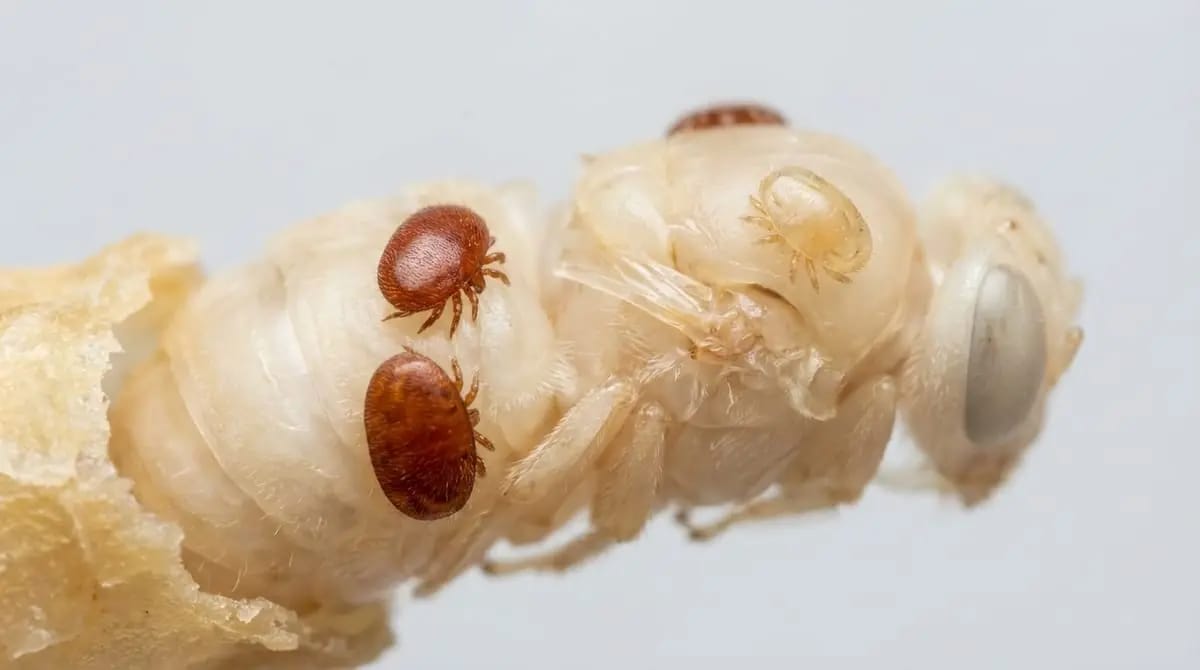
Varroa destructor belongs to the arachnids (Arachnida), specifically to the mites (Acari). The adult female mite is visible to the naked eye:
- Size: approx. 1.1 x 1.6 mm (oval, flat)
- Colour: Red-brown to dark brown
- Body shape: Shield-shaped, flat -- perfectly adapted to cling between the abdominal plates of the bee
- Mouthparts: Piercing-sucking chelicerae that bore through the bee's body wall
- Legs: 8 legs with adhesive pads (ambulacra) for gripping smooth surfaces
- Sensory organs: Highly sensitive chemoreceptive hairs (sensilla) that detect bee pheromones and brood scents
The male mite is significantly smaller (approx. 0.7 mm), whitish-yellow, and soft-bodied. It never leaves the brood cell and dies shortly after mating. You will only see male mites when opening infested brood cells.
The Life Cycle: Reproduction in the Brood Cell
Understanding the Varroa life cycle is crucial for any control strategy. The mite spends a large part of its life protected inside the capped brood cell -- where most treatment agents cannot reach it.
Phoretic Phase (on the bee)
Between reproductive cycles, the female mite sits on adult bees, preferably between the abdominal plates (sternites). There it feeds on the bee's fat body tissue. This phase lasts 5 to 11 days but can extend to several months during brood-free periods.
During the phoretic phase, the mite navigates purposefully towards brood cells. It recognises brood that is about to be capped by specific chemical signals.
Reproductive Phase (in the brood cell)
The actual reproductive cycle follows precisely timed steps:
- 1
Invasion (Day 0)
The mother mite (foundress) enters a brood cell approximately 20 hours before capping. She prefers drone brood (8-12 times more than worker brood), as the longer capping period yields more offspring.
- 2
First Egg (approx. 60 hours after capping)
The mother mite lays her first egg -- an unfertilised male egg. It develops into the only male of the clutch.
- 3
Further Eggs (every 30 hours)
At intervals of approximately 30 hours, fertilised female eggs are laid. In worker brood, typically 3-4 eggs; in drone brood, 4-6 eggs.
- 4
Development of Offspring
Each egg passes through the stages larva, protonymph, deutonymph, and adult mite. The entire development takes about 6-7 days.
- 5
Mating Inside the Cell
The male mates with his sisters as soon as they reach the adult stage -- still within the capped brood cell. The male then dies.
- 6
Emergence (Day 12 / Day 14-15)
When the young bee emerges, the mated daughter mites leave the cell together with the mother mite. In worker brood (12 days capped), typically 1-2 daughter mites complete their development. In drone brood (14-15 days), it can be 2-3.
The mite prefers drone brood not only because of the longer capping period (more offspring) but also due to stronger attractant substances. Removing drone brood specifically deprives the mite of its most productive nursery -- more on this in Lesson 3.
How the Mite Causes Damage: More Than Just a Blood Sucker
For a long time, it was believed that Varroa sucked haemolymph (bee blood). Recent research shows: the mite feeds primarily on the fat body tissue of the bee. The fat body is a vital organ comparable to the liver in mammals. It is central to:
- Immune defence of the bee
- Detoxification of pesticides and other harmful substances
- Protein production (vitellogenin, the "longevity protein" of winter bees)
- Energy storage for overwintering
| Type of Damage | Mechanism | Consequence for the Colony |
|---|---|---|
| Fat body damage | Direct piercing and consumption of fat body tissue | Shortened lifespan, weaker winter bees |
| Virus transmission (DWV) | Deformed Wing Virus is injected during feeding | Deformed wings, bees unable to fly |
| Virus transmission (ABPV) | Acute Bee Paralysis Virus is transmitted | Paralysis, rapid death, colony collapse |
| Immunosuppression | Weakened fat body reduces immune response | Higher susceptibility to secondary infections |
| Pupal weight loss | Nutrient extraction during development | Lighter, less developed emerging bees |
The Role of Viruses
Virus transmission is now recognised as the actual main danger. Without Varroa, bee viruses such as DWV (Deformed Wing Virus) and ABPV (Acute Bee Paralysis Virus) are present in small amounts but harmless. The mite changes the situation in two ways:
- Direct injection: During feeding, the mite transmits viruses directly into the bee -- bypassing the immune system
- Virus amplification: In heavily infested colonies, the viral load explodes because the mite acts as a "virus catapult"
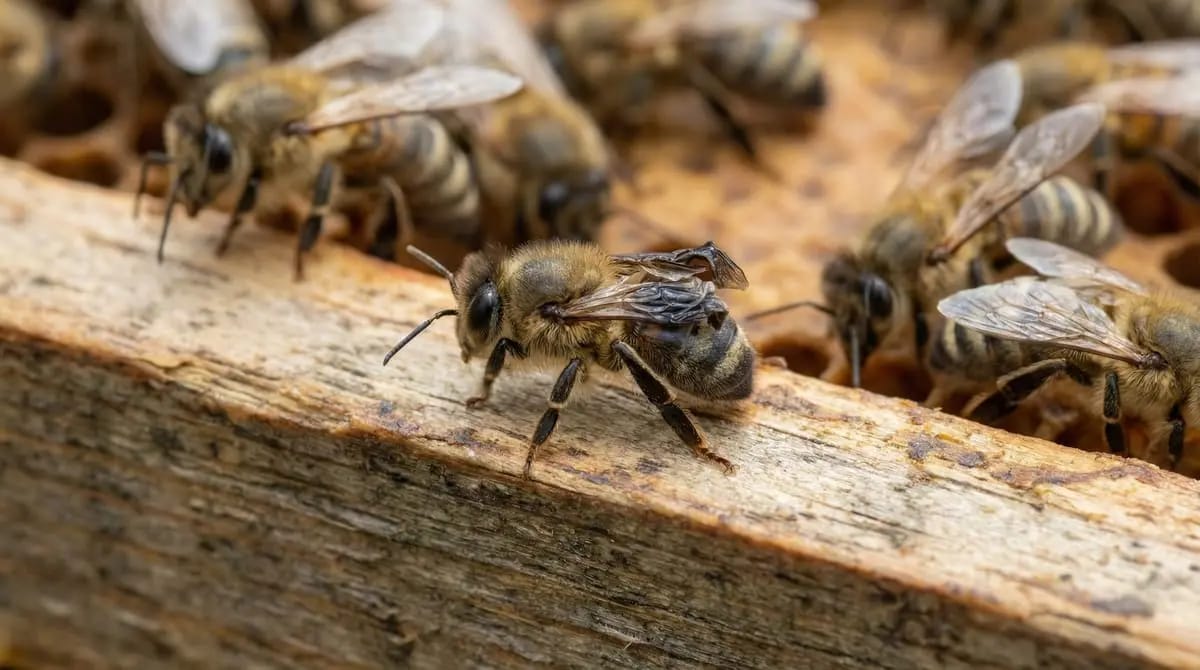
A colony with a high mite load often shows no visible symptoms for months. The collapse then comes suddenly -- usually in late autumn or early winter. By the time you see deformed bees at the entrance, it is often already too late. This is why regular monitoring (Lesson 2) is so important!
Exponential Growth: The Mathematics of Infestation
Understanding the infestation dynamics is crucial for choosing the right treatment timing. The Varroa population grows exponentially during the brood season.
The Numbers
Let us start with a typical spring scenario:
| Month | Estimated Mite Count | Comment |
|---|---|---|
| March | 50 | Residual infestation after winter treatment |
| May | 200 | Slow growth (little brood) |
| July | 1,000-2,000 | Accelerated growth with brood peak |
| August | 3,000-5,000 | Critical threshold is exceeded |
| October (without treatment) | 10,000+ | Colony collapse imminent |
The doubling time of the mite population during the brood season is approximately 3-4 weeks. This means: if you do not act at 1,000 mites in July, you will have 4,000-8,000 mites in September -- the point at which damage becomes irreversible.
At approximately 3,000-5,000 mites in a colony, the situation tips. The viral load rises sharply, winter bees are severely damaged, and the colony is lost without immediate intervention. An estimated 70-80 % of annual winter losses in Germany are attributed to late or insufficient Varroa treatment.
The Reinvasion Effect
Another critical factor: even perfectly treated colonies can be reinfested through reinvasion from the surrounding area. Mites transfer between colonies via drifting bees, robbing, and drifting drones. In areas with many bee colonies, 100-300 mites per week can be introduced into a treated colony.
Varroa is not a problem of individual colonies but a landscape-level problem. If you treat your colonies perfectly but there is an untreated colony nearby, you can still lose colonies. This is why coordinated treatment strategies within a region are so important.
The Seasonal Clock of Varroa
Mite development is closely linked to the brood cycle of the bee colony. The more brood available, the faster the mite reproduces:
- Jan-FebBrood-Free PhaseMinimal mite reproduction. Mites sit phoretically on bees in the winter cluster. Ideal time for oxalic acid treatment.
- Mar-AprBrood OnsetThe colony begins brood rearing. Mites enter the first brood cells. Slow population growth.
- May-JunBrood PeakMaximum brood area. Strong mite reproduction, especially in drone brood. Biotechnical measures (drone brood removal) are most effective now.
- Jul-AugCritical PhaseMite population reaches its maximum. Winter bees are being reared. Treatment MUST happen NOW -- every week counts!
- Sep-OctBrood DeclineBrood area decreases, proportion of mites on bees increases. Follow-up treatment if needed. Check treatment efficacy.
- Nov-DecBrood-FreeNo or minimal brood. All mites are on bees. Winter treatment with oxalic acid -- the most important treatment point of the year.
- Jan-Feb
Brood-Free Phase
Minimal mite reproduction. Mites sit phoretically on bees in the winter cluster. Ideal time for oxalic acid treatment.
- Mar-Apr
Brood Onset
The colony begins brood rearing. Mites enter the first brood cells. Slow population growth.
- May-Jun
Brood Peak
Maximum brood area. Strong mite reproduction, especially in drone brood. Biotechnical measures (drone brood removal) are most effective now.
- Jul-Aug
Critical Phase
Mite population reaches its maximum. Winter bees are being reared. Treatment MUST happen NOW -- every week counts!
- Sep-Oct
Brood Decline
Brood area decreases, proportion of mites on bees increases. Follow-up treatment if needed. Check treatment efficacy.
- Nov-Dec
Brood-Free
No or minimal brood. All mites are on bees. Winter treatment with oxalic acid -- the most important treatment point of the year.
Summary: What You Need to Remember
Core Knowledge: Varroa Biology
Knowledge Check
In the next lesson, you will learn how to reliably measure and document the Varroa infestation level in your colonies -- the foundation for every targeted treatment decision.