Biotechnical Methods: Drone Brood Removal & Brood Breaks
Fighting Varroa without chemicals: Drone brood removal, total brood removal, trapping comb method, and queen caging in a practical overview.
Biotechnical methods are procedures for Varroa control that work without chemical active substances. They use knowledge of the mite's biology to specifically deprive it of reproduction opportunities. The principle: if Varroa reproduces almost exclusively in capped brood, then we remove precisely that brood.
These methods are an indispensable building block in integrated Varroa management. They do not replace acid treatments, but they significantly reduce the infestation pressure during the season -- and thereby reduce the amount of chemical treatment needed.
Overview: Which Methods Exist?
| Method | Efficacy | Effort | Period | Recommended for |
|---|---|---|---|---|
| Drone brood removal (drone frame) | Repeated removal can roughly halve end-of-season infestation | Low | April-June | All beekeepers (supporting measure) |
| Total brood removal (TBR) | Removes a large share of mites in capped brood | High | Depends on season and nectar flow | After diagnosis and qualified planning |
| Trapping-comb method | Depends on completing the full trapping-comb sequence | High | According to the complete institute protocol | Experienced beekeepers |
| Queen caging | Depends on cage, brood status and follow-up concept | Medium | Depends on season and method | As a complete procedure |
Drone Brood Removal: The Standard Method
Drone brood removal is the simplest and most widely used biotechnical method. The principle is elegant: drone brood can be infested 8 to 10 times more heavily with Varroa than worker brood, so we deliberately provide drone comb and remove it with the mites once it is mostly capped.
Why It Works
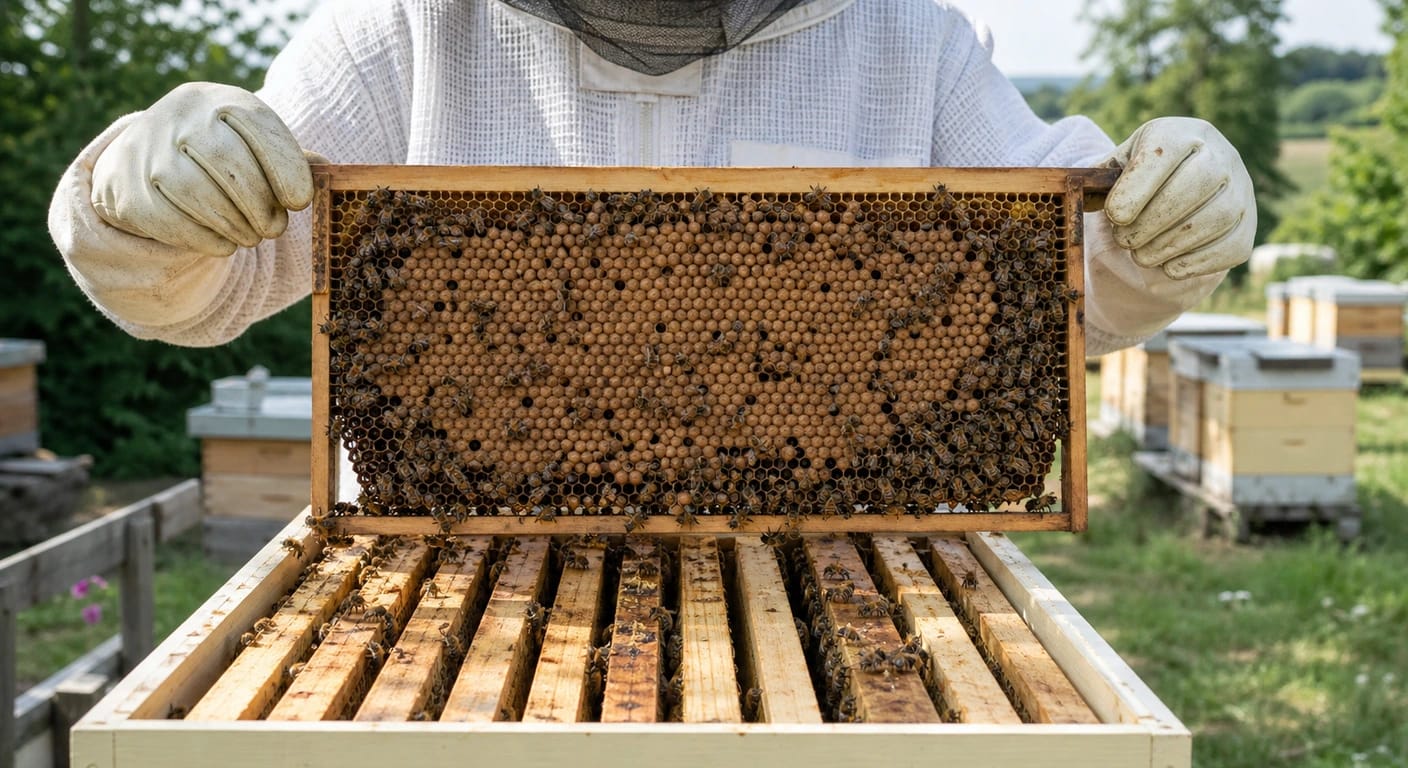
Drone cells offer the mite optimal conditions:
- Longer capping period (14-15 days versus 12 for workers) = more offspring
- Stronger attractant chemicals from drone larvae
- Larger cell = more space for the mite family
By providing an empty drone frame (a frame without foundation), we provoke the bees' natural building instinct -- they preferentially construct drone cells here. The mites concentrate in these brood cells -- and are removed with the capped drone comb.
Step-by-Step Instructions
- 1
Insert the Drone Frame (April)
Hang an empty frame (only top bar and side bars, no foundation) at position 2 or 3 in the brood box -- near the brood nest. The bees will build drone comb here within 1-2 weeks. Tip: A small starter strip (2 cm) helps the bees build straight comb.
- 2
Check the Comb (after 10-14 days)
From about day 10, check brood development regularly. Drone brood is easy to recognise by the distinctly domed, larger cell cappings. Remove the frame once capping is visible, ideally when more than half the area is capped, and always before emergence.
- 3
Cut Out the Capped Comb
Cut out the capped drone comb with a sharp knife. Work over a tray so no material falls into the colony. Melt the removed brood pieces as soon as possible; if that is not possible, freeze them until processing. Do not leave them exposed or offer them to birds.
- 4
Rehang the Drone Frame
Hang the empty drone frame back in immediately. The bees will start building again within a few days, creating a continuous cycle.
- 5
Maintain the Rhythm
Check the drone frame according to actual brood development and remove capped drone comb before emergence. A fixed calendar interval cannot replace this visual check.
Repeated removal of 2-3 well-built drone frames can roughly halve infestation by the end of the season. That is valuable, but not reliably sufficient control on its own. Combine drone brood removal with regular infestation monitoring and any measures required by the diagnosis, product authorization and regional Varroa concept.
Total Brood Removal (TBR)
Total Brood Removal is an intensive biotechnical method that removes a large share of the mites sitting in capped brood from the colony. Whether and when it is appropriate depends on diagnosis, season, colony condition and the regional Varroa concept.
When Is a TBR Appropriate?
- The result exceeds a current institute recommendation that matches the diagnostic method, sampling period, colony category, season and location
- Varroa collapse the previous year and uncertain winter treatment
- A qualified adviser recommends brood removal after assessing the colony and season
- If American foulbrood is suspected, do not carry out brood removal or remediation independently: contact the competent veterinary authority immediately and follow its instructions
Principle
The colony has all brood frames removed. The bees are placed on foundation or suitable empty drawn comb. Removing the capped brood also removes a large share of the mites residing in it from the production colony.
- 1
Preparation
Prepare a second brood box with foundation sheets or drawn empty combs. You also need a spare hive for the removed brood (brood bank) and feed frames or liquid feed.
- 2
Secure the Queen
Find the queen and place her in a cage or on an empty comb in the prepared brood box. The queen must NOT be removed with the brood frames!
- 3
Remove All Brood Frames
Remove all frames with capped and open brood from the colony. Brush the bees back into the colony. The mites remaining on adult bees require a subsequent approach matched to the actual brood status and regional concept.
- 4
Create an Artificial Swarm
Place the queen with the bees on the foundation together. The colony now sits brood-free on new combs. This is an artificial swarm -- it behaves like a natural swarm and immediately begins building comb.
- 5
Check Brood Status and Follow-up Measure
TBR may be prepared as a biotechnical measure before the end of the flow. Any subsequent medicinal treatment must wait until harvestable honey has been removed and must use an authorised product, route and timing after checking the colony's actual brood status.
- 6
Manage the Brood Bank
The removed brood frames go into a separate hive (brood bank). The emerging bees can later be added back to the colony or used as a nucleus. The mites in the brood bank are also treated after emergence.
With extremely high infestation, it is safer to melt down the removed brood frames rather than setting up a brood bank. This definitively destroys all mites. With moderate infestation, the brood bank is worthwhile -- the emerging bees are valuable for colony strength.
Trapping Comb Method
The trapping-comb method concentrates newly laid brood and incoming mites successively on three trapping combs. The standard LWG procedure takes considerably longer than three weeks and must be completed as a full sequence.
Procedure
- 1
Confine the Queen on the First Trapping Comb
Following the current institute protocol, confine the queen on the first suitable trapping comb so that egg laying is limited to that comb.
- 2
Move to the Second Comb after 9 Days
Move the queen to the second trapping comb. The first comb remains in the colony until its brood is capped; do not remove it at the first change.
- 3
Remove the First Comb after Another 9 Days
Remove the now-capped first trapping comb for melting and move the queen to the third trapping comb. The second comb remains until its brood is capped.
- 4
Remove the Second Comb and Release the Queen
After the next nine-day stage, remove the capped second trapping comb and release the queen. The third comb remains until capping.
- 5
Remove the Final Trapping Comb
Remove the third trapping comb after capping, at about day 36 in the standard sequence. A medicinal follow-up is not an automatic part of this summary; it depends on brood status, authorisation, product information and the regional concept.
| Aspect | Total Brood Removal | Trapping Comb Method |
|---|---|---|
| Duration | One main intervention plus controlled follow-up | About 36 days in the standard sequence |
| Stress on the colony | High (complete brood loss) | Medium (gradual loss) |
| Efficacy | Depends on complete execution and follow-up | Depends on an uninterrupted trapping-comb sequence |
| Labour | High (major intervention plus follow-up) | High (several time-critical interventions) |
| Experience needed | Yes (find queen, artificial swarm) | Yes (excluder management) |
| Colony recovery | Slower (all brood gone) | Faster (gradual) |
Queen Caging
Queen caging is a method for sharply limiting the colony's brood area for a defined period. The queen is placed in a cage attached to a comb and can still be tended by workers. In a Scalvini cage she can continue laying on the small embossed cell area. Workers remove some of this brood, but eggs or even capped cells may occasionally remain in the cage.
Principle
No new brood is established outside the cage while the previously existing brood emerges. Before any oxalic acid treatment, check the actual brood state and choose the timing according to the authorisation, product information and regional treatment concept; cage duration alone does not guarantee complete broodlessness.
Advantages
- Simple: Only one intervention (caging) + one intervention (release + treatment)
- Plannable: Can prepare a brood-reduced period; actual effectiveness depends on execution and the follow-up concept
- Gentle: No brood removal, colony remains intact
- Flexible: Can be carried out in July/August
Disadvantages
- Colony development: Strongly restricted brood production can reduce the later bee population
- Finding the queen: The queen must be found (challenging in large colonies)
- Swarming risk: During the swarming phase, caging can cause problems
- Timing: Must be precisely planned (brood-free state + OA treatment)
The strategy combines monitoring, biotechnical methods and, where required, authorised veterinary medicines. Which method is needed and when depends on diagnosis, colony, season, product information and the regional concept; a fixed acid calendar cannot replace that decision.
Advantages and Disadvantages of Biotechnical Methods
| Advantages | Disadvantages |
|---|---|
| No residues in wax or honey | More labour-intensive than pure acid treatment |
| No resistance development possible | Require experience and precise timing |
| Independent of temperature (except with OA combination) | Not sufficient alone (except TBR) |
| Promote understanding of bee biology | Some methods intervene heavily in the colony (TBR) |
| Reduce the need for chemical treatments | Drone brood removal also removes useful drones |
| Can be integrated into regular colony management | Not applicable in certain management systems |
Biotechnical measures are an important component, but they replace neither infestation monitoring nor any authorised measures that may be required.
Decision Aid: Which Method When?
Knowledge Check
In the next lesson, things get chemical: You will learn everything about formic acid treatment -- the centrepiece of summer Varroa treatment.