

Lesson 6 of 10
Thymol and Alternative Treatment Methods
18 min
Beyond formic and oxalic acid, there are further effective Varroa treatments. Thymol, lactic acid, and other approved products compared.
Formic acid and oxalic acid are the best-known weapons in the fight against the Varroa mite -- but they are far from the only ones. In this lesson, you will learn about thymol-based products, lactic acid, and other approved treatment methods. You will discover when each product is the best choice and what to watch out for during application.
Thymol: The Plant-Based Active Ingredient
Thymol is a natural active ingredient derived from the essential oil of thyme. It has an acaricidal (mite-killing) effect by damaging the nervous system of the Varroa mite. For bees, it is well tolerated at recommended dosages.
Mode of Action
Thymol evaporates in the warmth of the bee colony and distributes as a gas inside the hive. The mites take up the active ingredient through contact and respiration. Unlike formic acid, thymol does not penetrate into capped brood -- it only works on mites in the phoretic phase (sitting on bees). This is why longer treatment periods are needed to cover multiple brood cycles.
15-30 °Coptimal temperature range for thymol treatments
Approved Thymol Products in Germany
Three thymol-based veterinary medicines are approved in Germany:
Apiguard
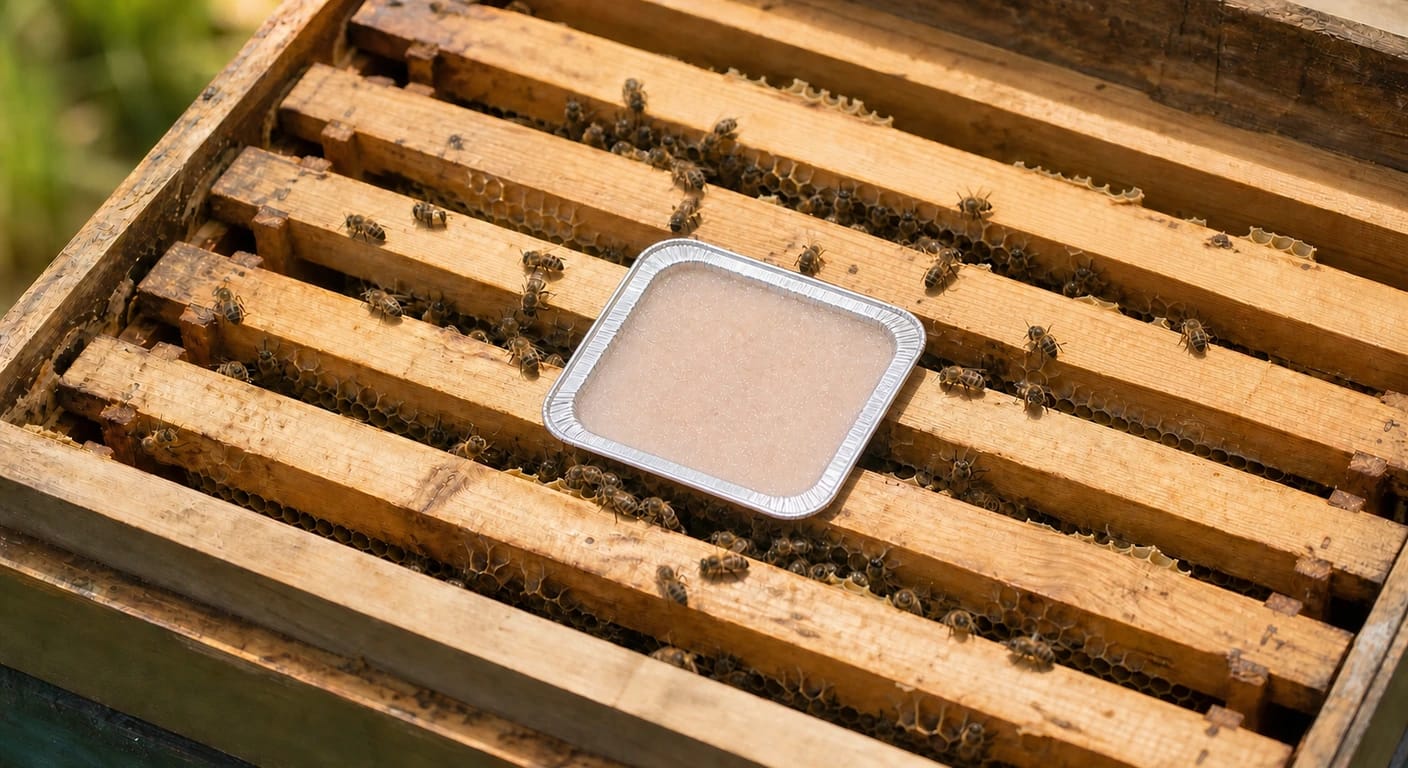
Apiguard is a gel-based thymol product in aluminium trays.
- Active ingredient: 12.5 g thymol per tray (25 % gel)
- Application: 2 trays at 14-day intervals placed on the top bars of the brood frames
- Treatment duration: 4-6 weeks (2 applications)
- Temperature: 15-30 °C maximum daytime temperature
- Efficacy: 85-95 % with correct application
- 1
Place the First Tray
Open the aluminium tray and place it with the open side up centrally on the top bars of the brood frames. The bees distribute the gel throughout the hive.
- 2
Wait 14 Days
Leave the tray in the colony for 14 days. The bees carry away the gel and thereby distribute the active ingredient throughout the hive.
- 3
Place the Second Tray
Remove the first (empty) tray and insert a fresh one. Leave for another 14 days.
- 4
Remove the Tray
After a total of 4 weeks, remove the second tray. Most of the thymol has evaporated.
Thymovar
Thymovar consists of cellulose pads soaked with thymol.
- Active ingredient: 15 g thymol per pad
- Application: 1-2 pads (depending on colony strength) placed on the top bars
- Treatment duration: 2 rounds of 3-4 weeks each
- Temperature: 15-30 °C
- Advantage: More even release than Apiguard, less temperature-dependent
ApiLife Var
ApiLife Var is a vermiculite tablet with a combination of several essential oils.
- Active ingredients: Thymol, eucalyptus oil, camphor, menthol
- Application: 3 treatments at 7-day intervals, tablet broken into 3-4 pieces and distributed on the top bars
- Treatment duration: 3-4 weeks
- Temperature: 18-35 °C (broader temperature range)
- Special feature: Combination of multiple active ingredients may hinder resistance development
Advantages and Disadvantages of Thymol
Advantages:
- Simple application (place tray/pad on top bars)
- No protective equipment needed (unlike formic acid)
- Well tolerated by bees at correct temperatures
- Approved veterinary medicine with documented efficacy
Disadvantages:
- Does not penetrate into capped brood
- Strongly temperature-dependent
- Can affect honey flavour (do not use during the nectar flow!)
- Lower single-treatment efficacy than formic acid (hence longer treatment)
Lactic Acid: The Specialist for Brood-Free Colonies
Lactic acid is a naturally occurring, body-own substance that is approved in 15 % concentration as a Varroa treatment (in Germany). It works through direct contact: the mites are sprayed and die.
Application and Use
Lactic acid is applied exclusively by spraying onto the bees. Each frame is individually removed and sprayed on both sides.
- Concentration: 15 % ad us. vet.
- Dosage: approx. 7-8 ml per occupied frame side
- Application: Spray each occupied frame on both sides
- Primary use: Artificial swarms and brood-free nucleus colonies
- Temperature: From 5 °C possible
Advantages and Disadvantages of Lactic Acid
Advantages:
- Natural, body-own substance
- No residues in wax
- Can be applied during the nectar flow (for brood-free units)
- Very well tolerated by bees
Disadvantages:
- Works only through direct contact (no depth effect into brood)
- Labour-intensive: each frame treated individually
- Only meaningful for brood-free or brood-poor colonies
- Insufficient efficacy for full-size colonies with brood
Further Approved Products
Oxuvar (Oxalic Acid Solution)
Oxuvar 5.7 % is a concentrate (oxalic acid dihydrate, ad us. vet.) that is mixed before application with sugar and water according to the package insert to make a 3.5 % working solution. It is primarily approved for winter treatment in the brood-free phase (trickling or spraying).
- Trickle method: 5 ml per occupied frame gap, maximum 50 ml per colony
- Treatment timing: November to December, during brood-free conditions
- Single application per winter (repetition damages the bees!)
VarroMed
VarroMed is a combination product of formic acid and oxalic acid dihydrate.
- Active ingredients: 44 mg/ml oxalic acid dihydrate + 5 mg/ml formic acid
- Special feature: Can also be applied when brood is present
- Application: Trickle into the frame gaps, 2-3 treatments at 6-day intervals
- Use: Summer treatment and winter treatment possible
The Grand Comparison: All Treatment Methods
| Method | Active Ingredient | Brood Effect | Temperature | Efficacy | Difficulty |
|---|---|---|---|---|---|
| Formic acid 60 % (long-term) | Formic acid | Yes (the only one!) | 15-25 °C | 85-95 % | Medium |
| Formic acid 60 % (short-term) | Formic acid | Yes | 15-25 °C | 80-90 % | Medium |
| Formic Pro (formerly MAQS) | Formic acid | Yes | 10-29.5 °C | 85-95 % | Easy |
| Oxalic acid (trickle) | Oxalic acid | No | From 0 °C (brood-free) | 90-95 % | Easy |
| Oxalic acid (vaporisation/Varroxal) | Oxalic acid | No | From 0 °C (brood-free) | 95-97 % | Medium |
| Apiguard | Thymol | No | 15-30 °C | 85-95 % | Easy |
| Thymovar | Thymol | No | 15-30 °C | 85-95 % | Easy |
| ApiLife Var | Thymol + essential oils | No | 18-35 °C | 85-93 % | Easy |
| Lactic acid 15 % | Lactic acid | No | From 5 °C | 90-95 % (brood-free) | Labour-intensive |
| VarroMed | Oxalic/formic acid | Partially | 5-35 °C | 80-90 % | Easy |
Choosing the Right Method
The choice of treatment method depends on several factors:
Summer treatment (after the harvest):
- Formic acid remains the gold standard because it is the only product that works inside capped brood
- Thymol is a good alternative when temperature conditions are right and you prefer not to use formic acid
- VarroMed as a further option when brood is present
Winter treatment (brood-free phase):
- Oxalic acid (trickle) is the standard method with the highest efficacy
- Apply once per winter
Artificial swarms and brood-free nucleus colonies:
- Lactic acid is the optimal choice here
- Simple single application with high efficacy
Documentation Requirements
Every treatment must be documented in the colony record book -- as required by EU Regulation 2019/6. The following details are mandatory:
- Date of treatment
- Treated colony (apiary, colony number)
- Veterinary medicine used (trade name)
- Batch number of the product
- Dosage and application method
- Withdrawal period (for honey: varies by product)
- Person performing the treatment
Knowledge Check
In the next lesson, we create your personal Varroa annual plan -- because in Varroa management, correct timing is the most important success factor.