Varroa Monitoring: Counting, Measuring, Documenting
Learn the most important methods for Varroa infestation monitoring: powdered sugar shake, debris board analysis, alcohol wash, and critical thresholds.
"Treat based on infestation, not the calendar." This principle is the cornerstone of successful Varroa management. Without reliable monitoring, you make treatment decisions blindfolded -- and that can cost you colonies. Treating too early wastes resources and needlessly stresses the bees. Treating too late causes irreversible damage to winter bees.
In this lesson, you will learn the four most important monitoring methods, their respective strengths and weaknesses, and the critical thresholds that tell you when you must act.
Why Monitoring Determines Success or Failure
Every bee colony is different. Even at the same apiary, two colonies can have completely different infestation levels -- depending on colony strength, brood volume, swarming events, and reinvasion pressure. A blanket treatment plan based on the calendar does not do justice to this reality.
Regular monitoring enables you to:
- Determine the optimal treatment timing (not too early, not too late)
- Verify the efficacy of a treatment
- Identify colonies with unexpectedly high infestation early
- Detect reinvasion events after treatment
- Build a continuous documentation chain for treatment planning
Studies show that beekeepers who regularly monitor infestation levels have on average 30-50 % fewer winter losses than beekeepers who treat based on gut feeling. Monitoring takes time -- but it saves colonies.
Method 1: Powdered Sugar Shake (Recommended!)
The powdered sugar shake (also known as "sugar roll" or "sugar shake") is the recommended standard method for hobby beekeepers. It is reliable, bee-friendly, and delivers quantitative results.
Principle
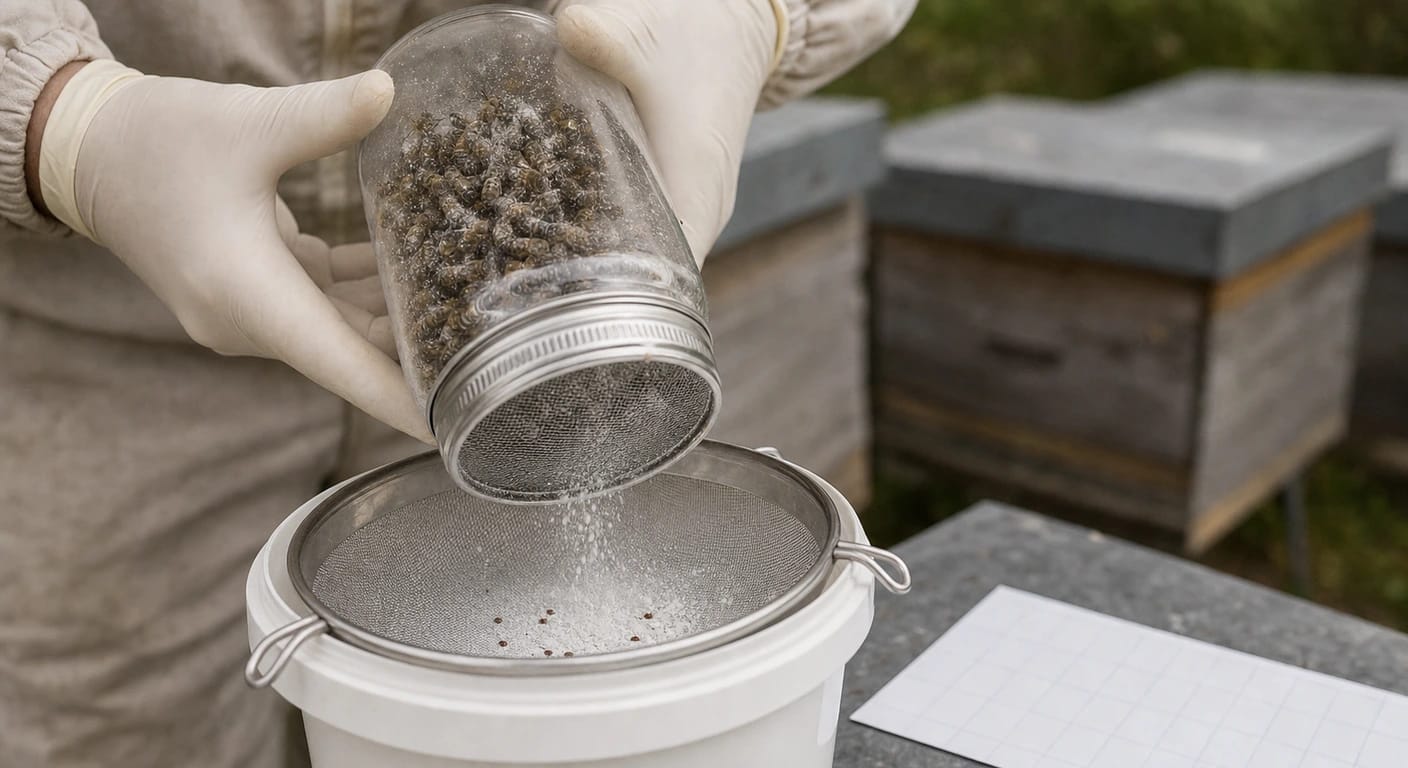
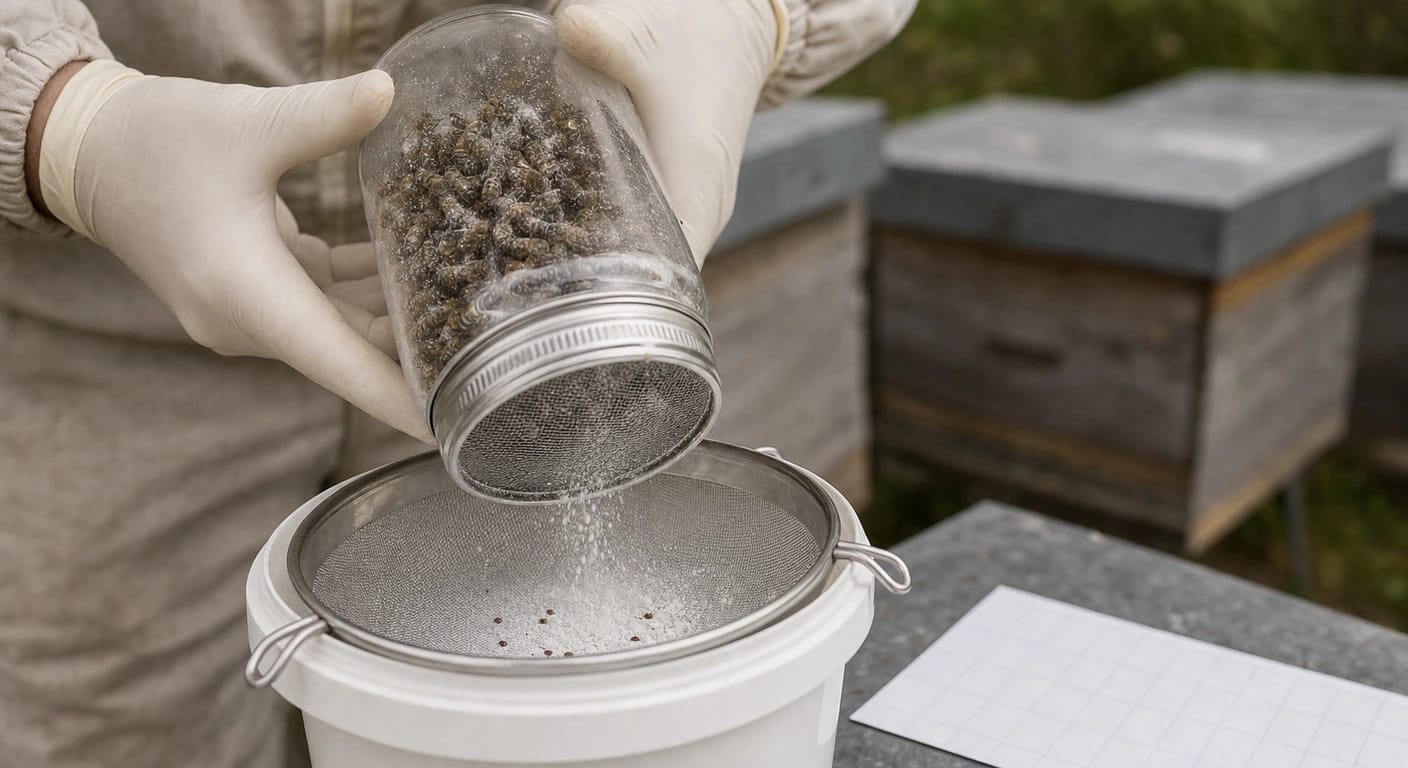
Bees are dusted with fine powdered sugar. The sugar disrupts the mites' grip on the bee surface, and they fall off. The mites are caught through a mesh and counted. The bees survive the procedure unharmed.
Step-by-Step Instructions
- 1
Prepare Materials
You need: a wide-mouth jar (500 ml) with a wire mesh lid (mesh width 3-4 mm -- lets mites through, keeps bees in), a measuring cup (125 ml / half cup), approx. 2 tablespoons of fine powdered sugar, a white tray or white sheet of paper, and water.
- 2
Brush Bees Into the Jar
Open the colony and select a brood frame with as many bees as possible. Important: Make sure the queen is NOT on this frame! Brush approximately 300 bees (about half a cup / 125 ml) into the jar. 300 bees is the standard for meaningful results.
- 3
Add Powdered Sugar
Add 2 heaped tablespoons of powdered sugar through the wire mesh lid into the jar. Close the jar and gently roll it for 1-2 minutes so all bees are evenly coated. The sugar disrupts the mites' grip.
- 4
Shake Out the Mites
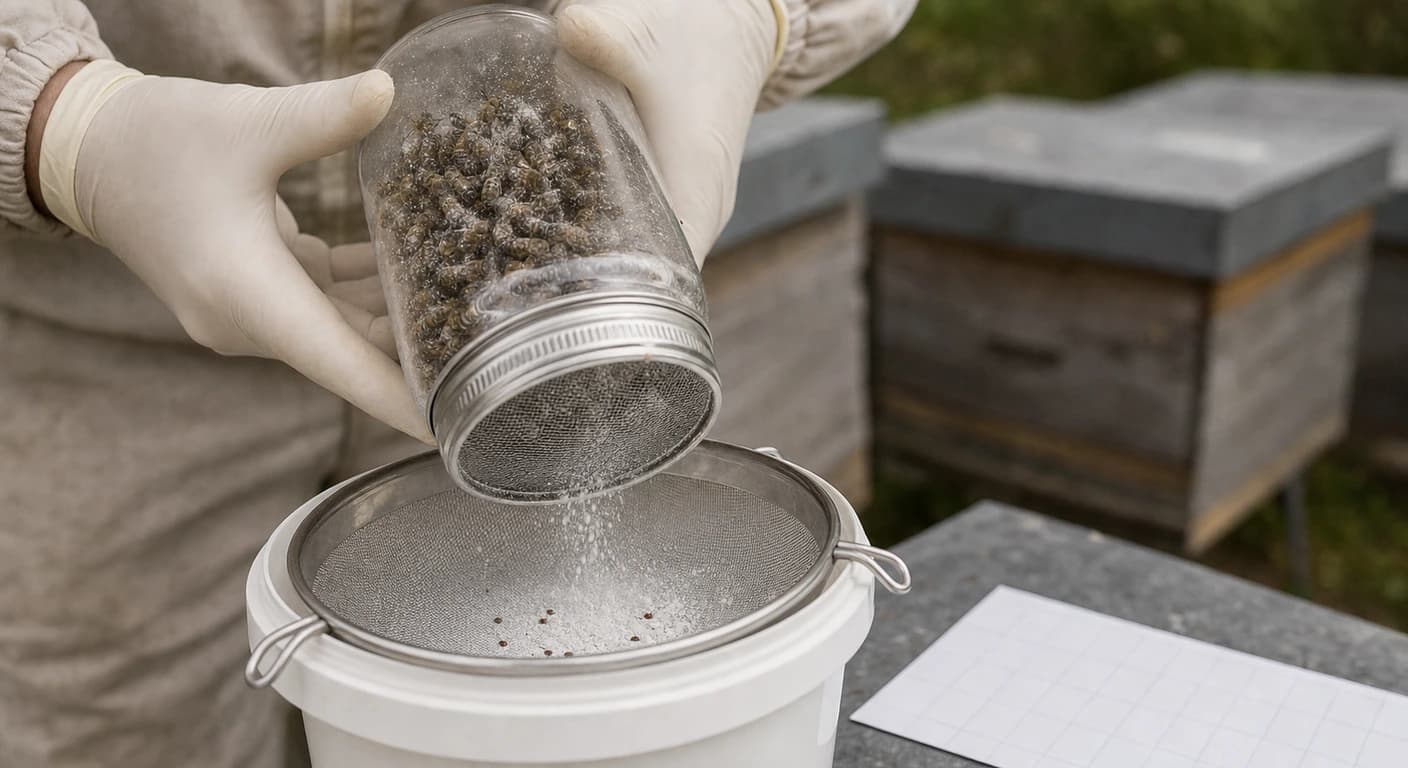
Turn the jar upside down and shake it vigorously over the white tray. Mites and excess powdered sugar fall through the mesh. Shake for 30-60 seconds. Optionally repeat with a splash of water -- this dissolves the sugar and makes the mites more visible.
- 5
Count and Calculate
Count the red-brown mites on the white surface. Calculate: (number of mites / 300) x 100 = infestation in percent. Example: 9 mites from 300 bees = 3 % infestation.
- 6
Return the Bees
Shake the sugared bees back into the colony. They clean off the sugar within a few minutes -- unharmed.
- Wide-mouth jar 500 ml with wire mesh lid (3-4 mm mesh width)
- Measuring cup 125 ml
- Fine powdered sugar (2 tbsp)
- White tray or paper
- Water (optional for rinsing)
- Select a brood frame (without the queen!)
- Brush approx. 300 bees into the jar (125 ml volume)
- Add 2 tbsp powdered sugar through the mesh
- Gently roll the jar for 1-2 minutes
- Shake over a white surface for 30-60 seconds
- Count mites, calculate infestation percentage
- Return bees to the colony
Method 2: Debris Board Analysis (Natural Mite Drop)
The debris board analysis is the simplest and least disruptive method. You count the mites that naturally fall from the colony -- without opening the hive.
Principle
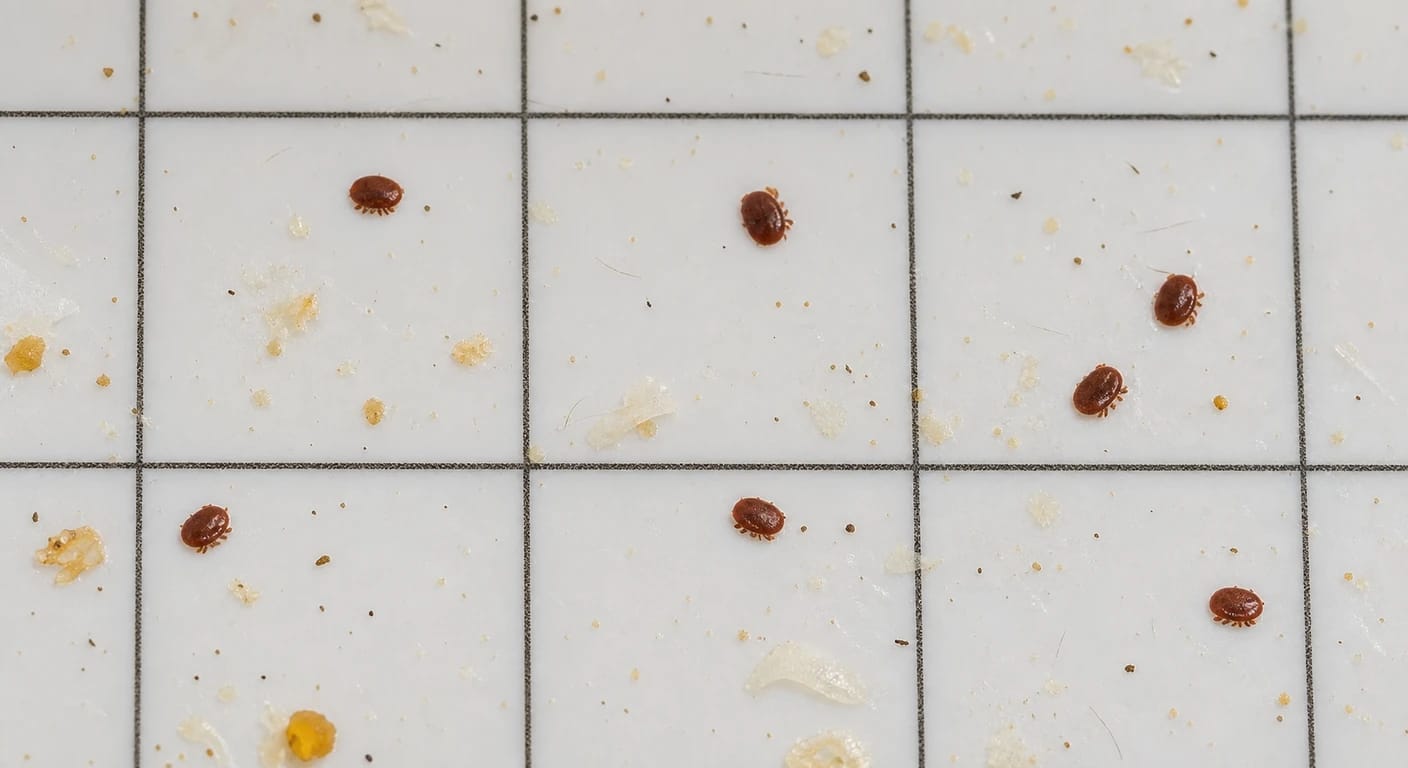
A white insert (monitoring board) is placed under the screened bottom board. After 3-7 days, the mites that have fallen onto it are counted and the daily mite drop is calculated.
- White monitoring board/insert (matching your hive system)
- Magnifying glass (helpful)
- Grease pen or petroleum jelly (optional, against ants)
- Slide the white insert under the screened bottom board
- Optional: apply a thin layer of petroleum jelly to the insert (fixes mites, deters ants)
- Leave in place for 3-7 days (3-day minimum is more accurate)
- Remove the insert and count the mites
- Calculate: total mites / number of days = daily mite drop
- Document the result and compare against thresholds
Greasing the insert with petroleum jelly prevents ants from carrying away mites and distorting the results. It also keeps the mites fixed so they do not roll off when you pull out the board.
Method 3: Alcohol / Soapy Water Wash
This method is the most accurate but kills the sample bees. It is preferred by research institutions and professional beekeepers.
Principle
Approximately 300 bees are washed in a solution of alcohol (70 % isopropanol) or soapy water. The mites detach from the bees and can be counted exactly.
| Aspect | Alcohol Wash | Soapy Water Wash |
|---|---|---|
| Accuracy | Very high (>90 % of mites captured) | High (~85 % capture rate) |
| Bees survive? | No | No |
| Material | 70 % isopropanol | Water + dish soap |
| Cost | Low (alcohol from the pharmacy) | Minimal |
| Recommended for | Professionals, breeding operations, research | Alternative when no alcohol available |
For most hobby beekeepers, the powdered sugar method is perfectly sufficient. The alcohol wash is worthwhile when you are selecting breeding stock (low Varroa tolerance as a breeding criterion) or when you need a second opinion due to conflicting results from other methods.
Method 4: Drone Brood Inspection
Inspecting drone brood provides valuable information about infestation levels, as the mite strongly prefers drone cells.
Principle
Capped drone cells are opened with an uncapping fork and the pupae examined for mite infestation. The red-brown mites are easily visible on the white drone pupae.
- Uncapping fork
- Light-coloured surface
- Magnifying glass (helpful)
- Locate a capped drone brood area on the drone frame
- Carefully pull out at least 100 drone pupae with the uncapping fork
- Spread the pupae on a light surface
- Count the mites (red-brown, oval bodies, approx. 1.5 mm)
- Calculate: mites / number of pupae x 100 = infestation in percent
- Above 10 % infestation in drone brood, urgent action is needed
Comparison of All Monitoring Methods
| Criterion | Powdered Sugar | Debris Board | Alcohol Wash | Drone Brood Inspection |
|---|---|---|---|---|
| Accuracy | Good (80-90 %) | Medium (trend value) | Very good (>90 %) | Good (drone brood only) |
| Bee loss | None | None | Approx. 300 bees | Drone pupae |
| Disturbance to colony | Medium (hive opened) | None | Medium (hive opened) | Low to medium |
| Time required | 10-15 min/colony | 5 min + waiting time | 10-15 min/colony | 10 min/colony |
| Material cost | Minimal (powdered sugar) | Minimal (insert) | Low (alcohol) | None |
| Period usable | April-October | Year-round | April-October | April-June |
| Recommendation | Standard method | Supplementary / trend monitoring | Breeding operations | Spring check |
The best results come from combining methods: Debris board as an ongoing trend monitor (cheap, non-disruptive) plus powdered sugar method before every treatment decision (quantitative, reliable). This gives you both the trend and the current absolute value.
The Critical Thresholds
The decisive question: When must I treat? The following thresholds are based on recommendations from German bee institutes and apply to natural mite drop (debris board) and the powdered sugar method.
The thresholds listed here reflect German and Central European guidelines. Specific treatment thresholds and approved products may vary in your country. Always consult your local beekeeping association or veterinary authority for the regulations that apply in your area.
Natural Mite Drop (Debris Board)
| Mites per Day | Assessment | Action |
|---|---|---|
| <3 | Low infestation | Continue monitoring, next check in 3-4 weeks |
| 3-5 | Elevated infestation | Plan treatment, treat within the next 2 weeks |
| 5-10 | High infestation | Treatment needed! Treat promptly (within 1 week) |
| >10 | Critical infestation | Treat IMMEDIATELY! Total loss imminent |
Powdered Sugar / Wash Method (per 300 bees)
| Mites per 300 Bees | Infestation % | Assessment | Action |
|---|---|---|---|
| 0-2 | <1 % | Low infestation | Continue monitoring |
| 3-9 | 1-3 % | Elevated infestation | Plan treatment |
| 9-15 | 3-5 % | High infestation | Treat promptly |
| >15 | >5 % | Critical infestation | Treat IMMEDIATELY! |
The thresholds must be interpreted in the seasonal context. 5 mites per day in May is far more alarming than 5 mites per day in early August after the honey harvest -- because in May the colony still has an entire brood season ahead during which the mite population will multiply. Early high values indicate massive reinvasion or a failed winter treatment.
Seasonal Interpretation of Thresholds
| Month | Natural Mite Drop/Day | Assessment |
|---|---|---|
| May | >3 | Alarming! Winter treatment was insufficient or strong reinvasion. Act immediately. |
| June | >5 | Concerning. Plan treatment, move honey harvest forward if possible. |
| July (after harvest) | >10 | Treat immediately! Winter bees are in danger. |
| September (after treatment) | >1 | Treatment was insufficient. Consider follow-up treatment. |
| October | >0.5 | Reinvasion possible. Winter treatment particularly important. |
Monitoring Calendar: When to Count?
- Mar-AprFirst CheckDebris board after spring inspection: How successful was the winter treatment? Establish the baseline value for the season.
- MayDrone Brood CheckWhen removing the drone frame: check drone brood for infestation. Simultaneously run a debris board analysis.
- JunMid-Season CheckPerform a powdered sugar test. Critical question: Is the infestation already above thresholds?
- JulBefore TreatmentCRITICAL: Sugar shake test BEFORE summer treatment. Determines whether immediate or planned treatment is needed.
- Aug-SepTreatment Efficacy CheckDebris board AFTER formic acid treatment: Was the treatment successful? Is follow-up treatment needed?
- Oct-NovBefore Winter TreatmentFinal debris board analysis before the oxalic acid treatment. Assessment of residual mite load.
- Mar-Apr
First Check
Debris board after spring inspection: How successful was the winter treatment? Establish the baseline value for the season.
- May
Drone Brood Check
When removing the drone frame: check drone brood for infestation. Simultaneously run a debris board analysis.
- Jun
Mid-Season Check
Perform a powdered sugar test. Critical question: Is the infestation already above thresholds?
- Jul
Before Treatment
CRITICAL: Sugar shake test BEFORE summer treatment. Determines whether immediate or planned treatment is needed.
- Aug-Sep
Treatment Efficacy Check
Debris board AFTER formic acid treatment: Was the treatment successful? Is follow-up treatment needed?
- Oct-Nov
Before Winter Treatment
Final debris board analysis before the oxalic acid treatment. Assessment of residual mite load.
Documentation: The Key to Long-Term Success
Individual measurements are good -- a continuous documentation chain is better. Only by tracking the infestation trend over the season and across years do you recognise patterns:
- Which colonies are systematically more heavily infested? (Genetics? Location?)
- Which treatment showed the best efficacy?
- Are there reinvasion problems at certain apiaries?
- Is the situation deteriorating from year to year?
In Hivekraft, you can document the Varroa infestation at every inspection: method, mite count, calculated percentage. The Varroa dashboard shows you the infestation trend as a chart -- so you can see at a glance whether treatment is needed.
What You Should Document
Documentation at Every Varroa Check
Knowledge Check
In the next lesson, we cover biotechnical methods: How you can reduce Varroa infestation without chemicals -- from drone brood removal to total brood removal and queen caging.