Formic Acid Treatment: Getting It Right
Everything about formic acid treatment against Varroa: long-term and short-term methods, critical temperatures, dosing, and safety instructions.
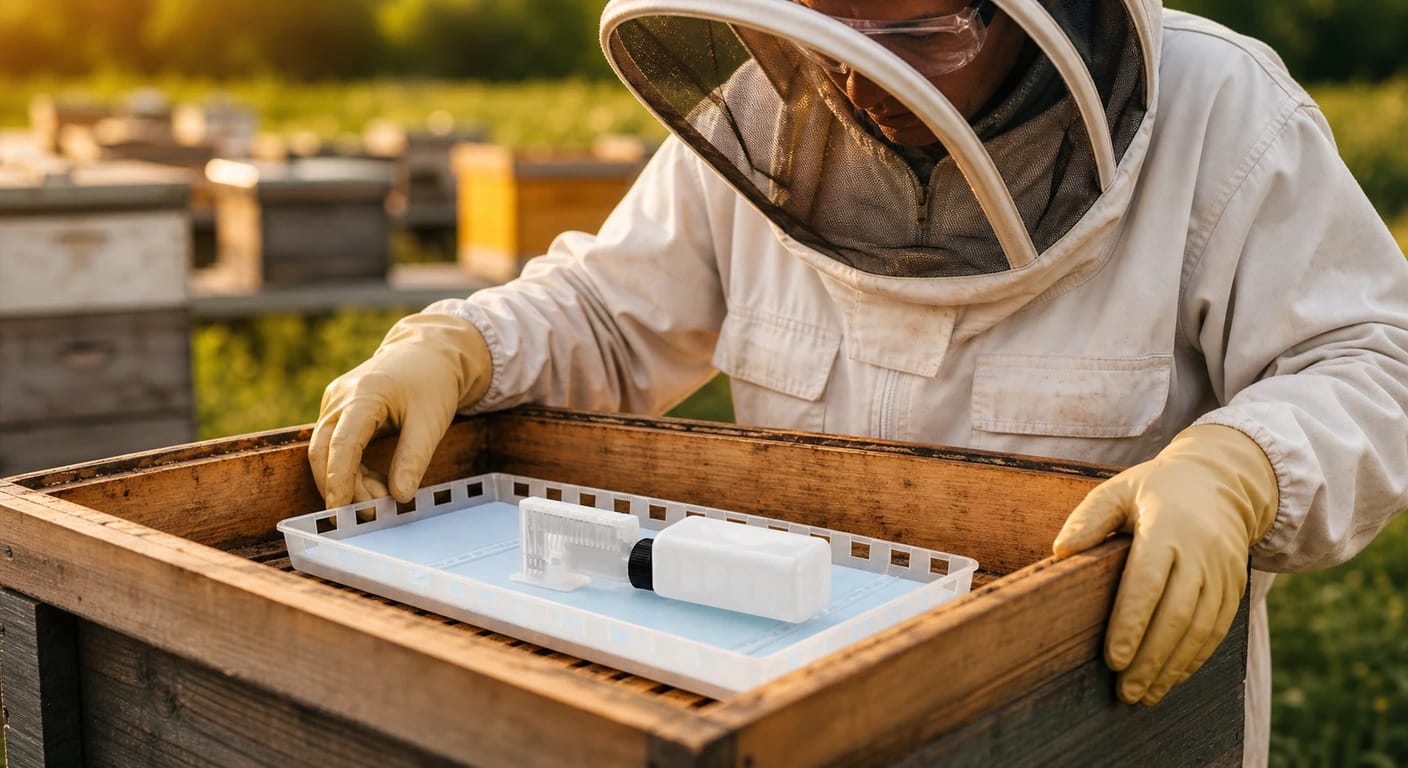
Formic acid (FA) is the centrepiece of summer Varroa treatment in Germany and many European countries. It has one decisive advantage over all other organic acids: as a gas, it can penetrate into capped brood cells and kill mites there. Since up to 80 % of mites are in capped brood during the brood season, this property is indispensable.
However, formic acid is also the most demanding treatment method. Temperature, dosing, evaporation rate, and application timing must all be right -- otherwise the treatment is ineffective or damages the colony. In this lesson, you will learn everything you need for a safe and successful treatment.
Formic acid (60 %) is classified as corrosive and harmful to health. It causes severe burns on skin and in the eyes. Vapours irritate the respiratory tract. For EVERY handling of formic acid, wear: acid-resistant gloves (nitrile, NOT latex!), safety goggles (tight-fitting), long-sleeved clothing. Always keep clean water nearby for rinsing. For skin contact: rinse with water for at least 15 minutes; for eye contact, call emergency services immediately!
The specific products, concentrations, and legal requirements described here apply primarily to Germany and the EU. In other countries, different formic acid products may be approved, or different regulations may apply. Always consult your local beekeeping association or veterinary authority for the treatments approved in your region.
Mode of Action
Formic acid (HCOOH) is a naturally occurring organic acid -- it is also found in honey in small amounts. During treatment, it is introduced as a liquid into the hive and evaporates in a controlled manner. The formic acid vapour distributes throughout the hive interior and:
- Kills phoretic mites on the bees through contact
- Penetrates into capped cells and kills reproducing mites and their offspring
- Is tolerated by bees (at the correct dosage)
The formic acid approved for bee treatment in Germany has a concentration of 60 % (ad us. vet. -- for veterinary use). This concentration offers the best balance between efficacy against mites and tolerability for bees. Higher concentrations would be dangerous for bees, lower ones ineffective.
Method 1: Long-Term Treatment (LTT)
Long-term treatment is the recommended standard method, especially for less experienced beekeepers. The acid evaporates in a controlled and even manner over a longer period (10-14 days).
Common Evaporators
| Evaporator | Principle | Fill Volume | Duration | Recommendation |
|---|---|---|---|---|
| Nassenheider Professional | Wick system with adjustable evaporation | 180-200 ml FA 60 % | 10-14 days | Most widely used, reliable |
| Nassenheider Universal | Simple sponge cloth system | 200 ml FA 60 % | 14 days | Cheaper, slightly less precise |
| Liebig Dispenser | Plate with wick, gravity-fed | Variable (per instructions) | 10-14 days | Proven, somewhat older system |
| Formic Pro (NOD) | Pre-made gel strips with FA (successor to MAQS) | 2 strips per colony | 14-20 days | Easy application, no dosing needed |
Step-by-Step: Long-Term Treatment
- 1
Check Preconditions
Make sure that:
- The last honey harvest is completed (honey must be off!)
- Daytime temperatures are between 15 and 25 degrees C
- The weather forecast shows no heatwave above 30 degrees C in the next 14 days
- The entrance is open (bees must be able to ventilate)
- No feeding is running simultaneously
- 2
Prepare the Evaporator
Fill the evaporator with the amount of 60 % formic acid specified by the manufacturer. For the Nassenheider Professional: approx. 180-200 ml. Wear gloves and safety goggles! Work outdoors or with good ventilation.
- 3
Insert the Evaporator
Place the filled evaporator on top of the top bars of the brood frames. Most evaporators are placed with a spacer (frame or strips) directly on the comb top edges. Alternatively: on a cloth or mesh over the frames. The acid must be able to evaporate downward.
- 4
Close the Hive
Put the lid on. The evaporator needs the enclosed space for the vapour to distribute. The entrance stays open -- the bees regulate ventilation themselves.
- 5
Check After 3-5 Days
Check the fill level of the evaporator. The evaporation rate should be approximately 10-20 ml per day. Also check the mite drop on the monitoring board -- an increased mite drop in the first days shows that the treatment is working.
- 6
Complete Treatment (after 10-14 days)
Remove the evaporator when it is empty or after a maximum of 14 days. Dispose of residues properly (not into the drain!). Monitor the mite drop on the monitoring board for a further 3 days.
Method 2: Short-Term Treatment (STT)
Short-term treatment works with a higher evaporation rate over a shorter period (3-4 days per round). It is repeated 2-3 times as needed.
Sponge Cloth Method
The classic STT method uses a sponge cloth (household all-purpose cloth) soaked with formic acid:
- Sponge cloth (all-purpose cloth, approx. 20x20 cm)
- Formic acid 60 % ad us. vet.
- Measuring cup or syringe
- Acid-resistant gloves (nitrile)
- Safety goggles
- PE film (optional, as evaporation brake)
Dosing by colony strength:
- Weak colony (5-8 frame gaps): 15-20 ml FA 60 %
- Medium colony (8-12 frame gaps): 20-30 ml FA 60 %
- Strong colony (12+ frame gaps): 30-40 ml FA 60 %
Procedure:
- Cut sponge cloth to the correct size
- Soak with the calculated amount of FA 60 %
- Place the sponge cloth in a PE bag on the top bars (open side facing down)
- Close the hive, leave the entrance open
- Remove the sponge cloth after 3-4 days
- Repeat after 5-7 days if needed (max. 3x)
Critical Parameters: These Must Be Right!
Formic acid treatment is the most temperature-sensitive of all Varroa treatments. If conditions are wrong, the treatment is ineffective or harmful.
Temperature
| Temperature | Effect | Recommendation |
|---|---|---|
| Below 12 degrees C | Evaporation too low, acid does not work sufficiently | Do not treat |
| 12-15 degrees C | Low evaporation, longer treatment duration needed | LTT only, monitor evaporation |
| 15-25 degrees C | Optimal evaporation, best efficacy with good tolerability | Ideal treatment range |
| 25-30 degrees C | Increased evaporation, shorter treatment, higher risk | Only with experience, reduce dosage if needed |
| Above 30 degrees C | Uncontrolled evaporation, brood damage, queen loss! | DO NOT TREAT! |
At temperatures above 30 degrees C, formic acid evaporates so quickly that the concentration inside the hive rises to a level lethal for bees. Consequences can include: brood damage, queen loss, in the worst case total colony loss. Check the weather forecast for the entire treatment duration and postpone the treatment if heat warnings are issued!
Not only the daytime temperature matters: if night temperatures fall below 8 degrees C, the bees cluster together and can no longer distribute the acid evenly throughout the colony. The result: uneven efficacy and increased stress on bees near the evaporator. Ideal is a temperature window of 15-25 degrees C during the day and not below 10 degrees C at night.
Timing in the Season
- July (end)Earliest Possible StartImmediately after the last honey harvest. In good years, treatment can begin at the end of July. Advantage: winter bees have not yet emerged.
- AugustOptimal PeriodThe standard period for summer treatment. Winter bee rearing begins, and the mite load must be reduced now.
- September (early)Latest DateLate treatment still possible, but winter bees are partially already damaged. Temperatures become borderline (often below 15 degrees C at night).
- September (mid)Too Late!Formic acid treatment is no longer meaningful. Winter bees are reared, damage cannot be repaired. Only OA in winter remains possible.
- July (end)
Earliest Possible Start
Immediately after the last honey harvest. In good years, treatment can begin at the end of July. Advantage: winter bees have not yet emerged.
- August
Optimal Period
The standard period for summer treatment. Winter bee rearing begins, and the mite load must be reduced now.
- September (early)
Latest Date
Late treatment still possible, but winter bees are partially already damaged. Temperatures become borderline (often below 15 degrees C at night).
- September (mid)
Too Late!
Formic acid treatment is no longer meaningful. Winter bees are reared, damage cannot be repaired. Only OA in winter remains possible.
Dosing
The correct dosage depends on the colony strength and the evaporator system:
| Colony Strength | Occupied Frame Gaps | LTT (Nassenheider Prof.) | STT (Sponge Cloth) |
|---|---|---|---|
| Weak colony | 5-8 | 120-150 ml FA 60 % | 15-20 ml per round |
| Medium colony | 8-12 | 150-200 ml FA 60 % | 20-30 ml per round |
| Strong colony | 12-16 | 200-250 ml FA 60 % | 30-40 ml per round |
The dosages listed here are guidelines. Always follow the specific manufacturer instructions for your evaporator system and the application directions of the acid supplier. When in doubt: ask your local bee inspector or beekeeping association.
Safety Instructions: This Is Serious!
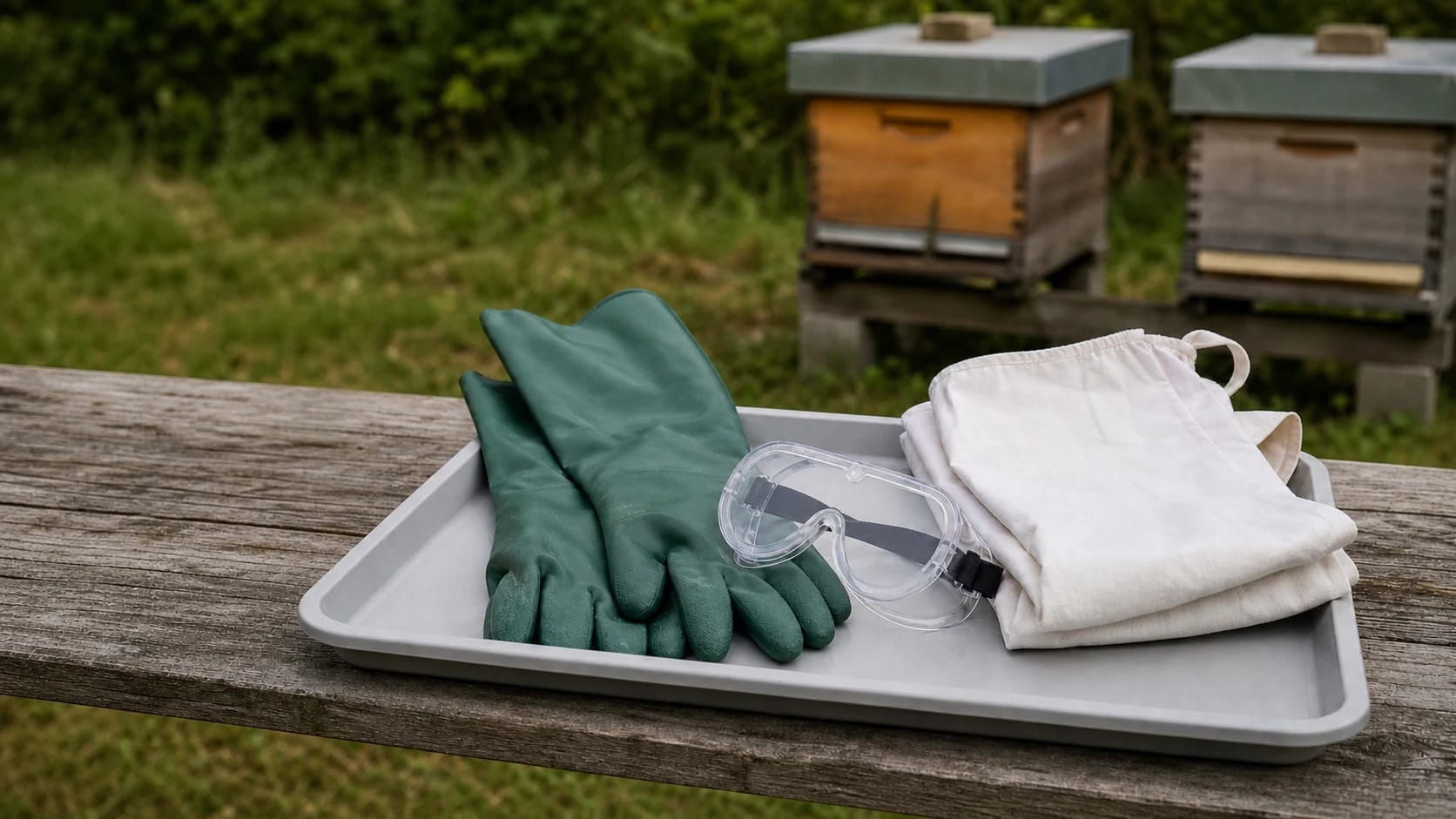 AI-generated
Personal Protective Equipment (PPE)
Safety Checklist: Formic Acid
First Aid
Skin contact: Immediately rinse with plenty of water for at least 15 minutes. Remove contaminated clothing. For blistering or large-area contact: seek medical attention.
Eye contact: Immediately rinse with plenty of water for at least 15 minutes (keep eyelids open!). Call emergency services immediately -- formic acid can cause severe eye damage leading to blindness.
Inhalation: Move to fresh air immediately. For shortness of breath, coughing, or dizziness: call a doctor.
Ingestion: Do NOT induce vomiting! Rinse mouth, drink water in small sips. Call emergency services immediately.
Efficacy Check: Did It Work?
After every treatment, an efficacy check is mandatory. Without a check, you do not know whether your colony is protected.
- 1
Insert Monitoring Board (3 days after treatment end)
Wait 3 days after the end of treatment and insert the white monitoring board.
- 2
Count After 3 Days
Count the fallen mites and calculate the daily drop.
- 3
Evaluate the Result
- Under 1 mite/day: Good efficacy, colony is well protected
- 1-3 mites/day: Acceptable, continue monitoring, winter treatment will handle the rest
- Over 5 mites/day: Treatment was insufficient! Consider a second treatment (consult your local bee advisor)
A formic acid treatment without an efficacy check is like an exam without grading. You do not know if it worked -- and that can have fatal consequences for your colony in winter.
Common Mistakes and How to Avoid Them
Alternative: Thymol Products
When temperature conditions for formic acid are difficult (heat wave, extreme fluctuations) or you prefer a gentler method, thymol products (Apiguard, Thymovar, ApiLife Var) offer an approved alternative:
| Aspect | Formic Acid | Thymol |
|---|---|---|
| Effect in brood | Yes (gas penetrates) | Partially (vapour, slower) |
| Treatment duration | 10-14 days (LTT) | 4-6 weeks (2 rounds) |
| Temperature range | 15-25 degrees C | 15-30 degrees C (more tolerant) |
| Efficacy | 80-95 % | 85-95 % |
| Honey contamination | Low (natural component) | Possible (taste!) |
| Application | Evaporator/sponge cloth | Gel tray/strips placed on top |
Thymol is a good choice if you keep bees in a region with high summer temperatures, the temperature range for formic acid is hard to hit, or you do not tolerate formic acid well. Note however: thymol requires 4-6 weeks of treatment time -- so you must start earlier. Also, thymol can carry over into the honey, so apply only after the last harvest.
Legal Framework
Formic acid 60 % ad us. vet. is classified in Germany as a pharmacy-only veterinary medicine. You can obtain it at the pharmacy or through your beekeeping association (group orders). A veterinary prescription is not required -- beekeepers may use formic acid on their own responsibility. However, documentation in the colony record book is mandatory (EU 2019/6): product, dosage, date, treated colonies, batch number, withdrawal period.
Approved products, concentrations, and legal requirements for formic acid treatment vary by country. In some regions, different products or methods may be standard. Always check with your national or regional beekeeping authority for the products approved and the documentation requirements in your area.
Knowledge Check
In the next lesson, we cover the winter treatment with oxalic acid -- the crowning conclusion of the Varroa year that ensures a clean start to the new bee season.