Oxalic Acid Treatment: Winter Treatment in Detail
Oxalic acid winter treatment against Varroa: trickle method, dosing, timing, and the most important safety rules.
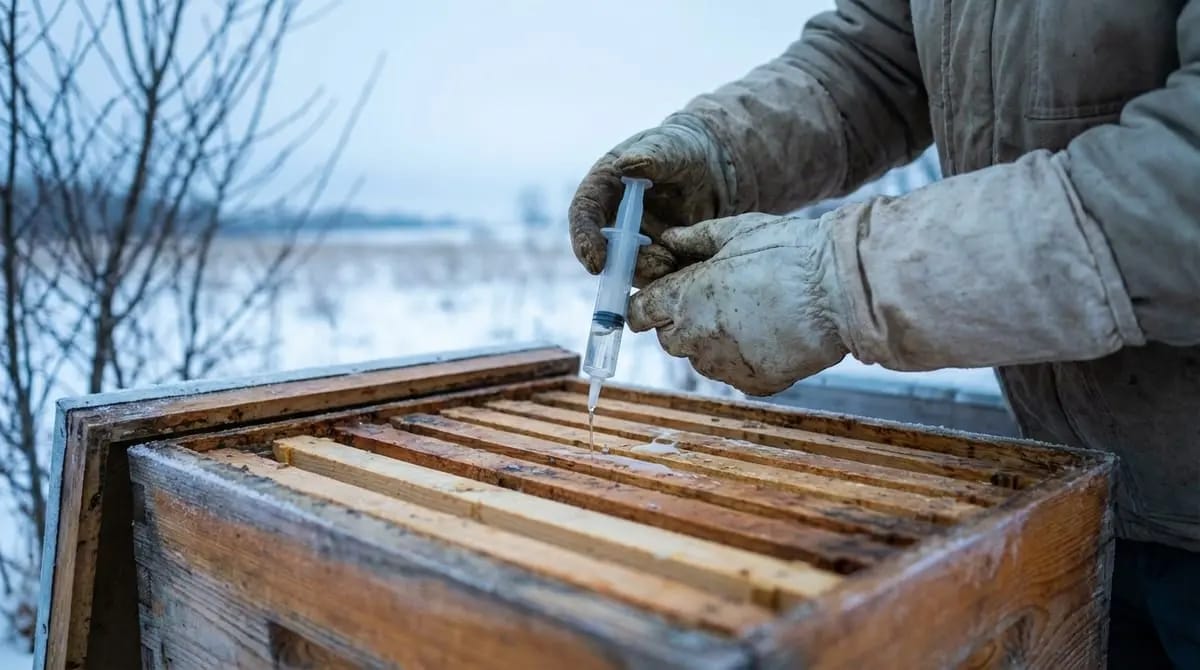
The oxalic acid winter treatment is the crowning conclusion of the Varroa year -- and at the same time the most effective single treatment of all. During the brood-free winter phase, all mites sit exposed on the bees. There are no capped brood cells where they can hide. A single, correctly performed oxalic acid treatment can kill over 95 % of the remaining mites under these conditions.
But the conditions must be right: the correct timing (brood-free phase), the correct dosage, and the single application are crucial. In this lesson, you will learn everything you need for a safe and successful winter treatment.
The specific products, concentrations, and legal requirements described here apply primarily to Germany and the EU. Approved oxalic acid products and application methods may differ in your country. Always consult your local beekeeping authority for the treatments approved in your region.
Mode of Action
Oxalic acid (C2H2O4) is a naturally occurring organic acid found in many plants (rhubarb, sorrel, spinach). It works as a contact poison on the Varroa mite:
- The acid comes into contact with the mite (via the bees grooming each other)
- It damages the body wall (cuticle) of the mite
- The mite dies within 1-3 days
Oxalic acid works exclusively on phoretic mites -- it does NOT penetrate into capped brood cells! This is why application is only meaningful during the brood-free phase. If there is still capped brood, the mites hidden within survive the treatment unscathed and can rebuild the infestation immediately. Brood-free conditions are the absolute prerequisite.
The Right Timing: When Is the Colony Brood-Free?
Brood-free conditions are the most critical success factor. In Central Europe, most colonies are brood-free between late November and mid-December -- but there are considerable variations depending on region, bee race, autumn weather, and colony strength.
- OctoberBrood DecliningThe queen strongly reduces her laying rate. Still significant capped brood present. Too early for OA!
- NovemberBrood-Free Phase BeginsIn many regions, the queen stops laying. Residual brood runs out. The ideal window begins approx. 3 weeks after last egg-laying.
- Early Dec.Optimal TimingHighest probability of complete brood-free conditions. Classic treatment window. Temperature often still mild enough.
- Mid Dec.Still PossibleStill a good time. In mild winters, some colonies may start brood rearing again.
- JanuaryOften Too LateMany colonies already have brood again. Treatment still possible but efficacy significantly reduced.
- October
Brood Declining
The queen strongly reduces her laying rate. Still significant capped brood present. Too early for OA!
- November
Brood-Free Phase Begins
In many regions, the queen stops laying. Residual brood runs out. The ideal window begins approx. 3 weeks after last egg-laying.
- Early Dec.
Optimal Timing
Highest probability of complete brood-free conditions. Classic treatment window. Temperature often still mild enough.
- Mid Dec.
Still Possible
Still a good time. In mild winters, some colonies may start brood rearing again.
- January
Often Too Late
Many colonies already have brood again. Treatment still possible but efficacy significantly reduced.
How Do I Check for Brood-Free Conditions?
Do not fully open the colony in winter -- the bees will break the winter cluster and become chilled. Instead: lift the lid only briefly and look from above at the top bars. Is the cluster sitting tightly together and you see no capped brood on the visible comb surfaces? Then brood-free conditions are likely. Alternatively: use a thermal imaging camera or check the debris on the monitoring board -- wax crumbs from brood cappings indicate brood is still present.
Method 1: Trickle Method (Standard)
The trickle method is the most widely used and recommended method for beginners. An oxalic acid solution in sugar water is trickled directly onto the bees in the occupied frame gaps.
The Solution: 3.5 % Oxalic Acid in Sugar Water
The standard solution consists of:
| Ingredient | Amount (for 500 ml) | Function |
|---|---|---|
| Oxalic acid dihydrate | 35 g | Active ingredient (3.5 % solution) |
| Sugar (household sugar) | 500 g | Improves distribution, bees take up the solution |
| Water (distilled or boiled) | 500 ml | Solvent |
There are now approved oxalic acid products available at pharmacies. In Germany, Oxuvar 5.7 % is a concentrate that is mixed with sugar and water according to the package insert to make a 3.5 % working solution. ADOX is a ready-to-use trickle solution. Note: dosage differs by product -- always read the package insert! Products available in your country may differ.
Step-by-Step: Trickle Method
- 1
Prepare the Solution
Warm the oxalic acid solution to approximately 35 degrees C (body-warm). Cold solution would stress the bees in the winter cluster. Use a water bath or hot water bottle -- the solution must not get hot (max. 40 degrees C, otherwise the oxalic acid decomposes).
- 2
Fill the Syringe or Trickle Container
Fill a syringe (50-60 ml) or trickle container with the warmed solution. Wear gloves and safety goggles!
- 3
Open the Colony -- Quick and Targeted
Open the hive and remove the lid. The bees are in the winter cluster -- you can clearly see the occupied frame gaps (dense bee coverage between the frame top bars). Count the occupied frame gaps. Work quickly -- the colony should be open as briefly as possible!
- 4
Trickle the Solution: 5 ml per Occupied Frame Gap
Trickle 5 ml of solution per occupied frame gap in a thin line directly onto the bees between the top bars. Distribute the solution evenly from front to back. The bees take up the sweet solution and distribute it through social contacts (food exchange, grooming) throughout the colony.
- 5
Close the Hive Immediately
Replace the lid promptly. The entire treatment should take no longer than 2-3 minutes. Every additional minute costs the bees energy and warmth.
- 6
Monitor Mite Drop
Insert the monitoring board 3 days after treatment and count the fallen mites after a further 3 days. A high mite drop (100+ mites) shows that the treatment worked. Document the result in the colony record book.
Dosage Table
- Oxalic acid solution 3.5 % in sugar water (35 degrees C)
- Syringe 50-60 ml or trickle container
- Acid-resistant gloves (nitrile)
- Safety goggles
- Monitoring board for post-treatment check
Dosage: 5 ml per occupied frame gap
| Occupied Frame Gaps | Amount of Solution |
|---|---|
| 4-5 gaps | 20-25 ml |
| 6-7 gaps | 30-35 ml |
| 8-9 gaps | 40-45 ml |
| 10-11 gaps | 50 ml (maximum!) |
IMPORTANT: Maximum 50 ml per colony! Even for very strong colonies with 12+ frame gaps, do not apply more than 50 ml -- overdosing damages the bees!
Method 2: Sublimation / Vaporisation
Since September 2023, oxalic acid vaporisation has been approved in Germany -- with the product Varroxal 0.71 g/g powder for the beehive (Andermatt BioVet). Vaporisation may only be carried out with the approved devices Varrox or Varrox Eddy.
In sublimation, oxalic acid crystals are heated to approximately 200 degrees C. The acid sublimates and distributes as a fine mist inside the hive. Studies show slightly higher efficacy (> 97 %) and better bee tolerability than trickling.
Vaporisation produces hot, toxic vapours. A respiratory mask with A1B1 combination filter is mandatory. Application may only take place outdoors. Devices other than Varrox/Varrox Eddy are not approved in Germany -- use of non-approved equipment is not covered by the authorisation. Check local regulations in your country for approved devices.
For beginners, the trickle method remains the simpler and recommended method. Vaporisation is suitable for experienced beekeepers with multiple colonies, as it is faster and better tolerated by bees.
Method 3: Spray Method
A less common but established method in some countries (e.g. Switzerland) is spraying the frames. Brood frames are individually removed and sprayed on both sides with oxalic acid solution. Since frames are treated individually, distribution is more even than with trickling.
The spray method is more labour-intensive than trickling (each frame must be removed), but offers more even distribution. It is suitable for beekeepers with few colonies and is less commonly used in Germany than the trickle method. Dosage: approximately 3-4 ml solution per occupied frame side.
The Golden Rule: ONLY ONCE Per Season!
The oxalic acid treatment may be carried out only once per brood-free phase (winter). Repetition significantly damages the bees -- the acid impairs the midgut and reduces the lifespan of winter bees. If you miss the treatment (wrong timing, no brood-free conditions), there is no second chance until the next winter!
Why Only Once?
Oxalic acid is taken up orally by the bees and reaches the midgut. There it damages the gut cells. A single treatment is well tolerated -- the cells regenerate. With repeated application, the damage accumulates, the lifespan of winter bees decreases, and the colony is weakened.
The once-only rule for oxalic acid is not a precautionary measure but a hard limit. Repeated treatment in the same season can increase winter losses rather than reduce them. If you miss the December treatment, it is better to wait until spring and then take other measures.
Temperature Conditions
| Temperature | Assessment | Note |
|---|---|---|
| Below -5 degrees C | Do not treat! | Bees are too tightly clustered, solution does not distribute. Cold stress when opening. |
| -5 to 0 degrees C | Conditionally possible | Trickle method difficult (bees become chilled). Only with brief opening and fast treatment. |
| 0 to 5 degrees C | Ideal for trickle method | Bees sit quietly in the cluster, easy to treat. |
| 5 to 10 degrees C | Good | Bees are slightly more active, treatment works well. |
| Above 10 degrees C | Critical | Bees may be flying, cluster is dispersed. Queen may already be laying again -- check for brood-free conditions! |
In hard frost, the winter cluster is extremely tight. Bees at the edges are already chilled and inactive. Opening the hive in such conditions can lead to bees becoming fatally chilled, and the trickle solution distributes poorly. Wait for a milder day (ideally 0-5 degrees C).
Safety Instructions
Safety Checklist: Oxalic Acid
Treatment Day: Planning the Procedure
- 1
Day Before: Preparation
Mix or buy the solution. Prepare materials: syringe, gloves, safety goggles, monitoring boards. Check the weather forecast: temperature between 0 and 10 degrees C, no heavy rain or wind. Store the solution cool overnight (do not freeze!).
- 2
Treatment Day: Warm the Solution
Warm the solution in a water bath to approximately 35 degrees C (body-warm). Transport it in a thermos flask to the apiary to maintain temperature.
- 3
Put on Protective Equipment
Put on gloves and safety goggles.
- 4
Treat the First Colony
Remove the lid, count occupied frame gaps, trickle 5 ml per gap (max. 50 ml). Replace the lid immediately. Total duration: maximum 2-3 minutes!
- 5
Next Colony
Repeat for each colony. Refill the syringe between colonies.
- 6
Insert Monitoring Boards
After treating the last colony: slide monitoring boards under all colonies. Count after 3-5 days and document.
- 7
Documentation
Document in the colony record book per colony: date, product, dosage, method, mite drop (after counting). In Hivekraft: record the treatment as a Varroa entry.
Interpreting Mite Drop After Treatment
| Mite Drop (3-5 days after treatment) | Assessment | What It Means |
|---|---|---|
| 0-50 mites | Very low residual infestation | Summer treatment was successful. The colony starts the spring clean. |
| 50-200 mites | Normal residual infestation | Typical value after a decent season. Colony should come through without problems. |
| 200-500 mites | Elevated residual infestation | Summer treatment may have been insufficient. Monitor spring development. Start monitoring early. |
| Over 500 mites | High residual infestation | Colony was heavily burdened. Winter loss possible. Spring: start monitoring immediately, consider early biotechnical measures. |
Common Mistakes in Winter Treatment
Legal Framework
Oxalic acid dihydrate ad us. vet. is approved in Germany as a pharmacy-only veterinary medicine (e.g. Oxuvar, ADOX). A veterinary prescription is not required -- beekeepers may carry out the treatment on their own responsibility. Documentation in the colony record book is mandatory: product, dosage, date, treated colonies, batch number. Retention period: 5 years (EU 2019/6).
Approved products and legal requirements for oxalic acid treatment vary by country. Check with your national or regional beekeeping authority for the specific products and documentation requirements in your area.
The Varroa Year at a Glance: Everything Together
With this fifth lesson, you now know the complete Varroa management toolkit. Here is the full overview of the Varroa year:
- April-JuneDrone Brood RemovalBiotechnical: provide drone frames, cut capped drone brood every 24 days. Reduces the mite increase by 20-30 %.
- May-JulyMonitoringRegular infestation checks every 3-4 weeks. Powdered sugar method + debris board. Watch the thresholds!
- July (end)Honey Harvest + FA StartRemove the last honey harvest. Immediately start formic acid treatment (LTT or STT). Temperature 15-25 degrees C.
- AugustSummer TreatmentFormic acid treatment is running or repeated. Efficacy check after treatment ends. Begin feeding after treatment.
- SeptemberFollow-Up CheckCheck mite drop. Follow-up treatment if needed (consult your bee advisor). Complete autumn feeding.
- Nov-DecWinter Treatment OAOxalic acid in brood-free phase. ONCE ONLY. 5 ml/frame gap, max. 50 ml. The most important single date of the year.
- April-June
Drone Brood Removal
Biotechnical: provide drone frames, cut capped drone brood every 24 days. Reduces the mite increase by 20-30 %.
- May-July
Monitoring
Regular infestation checks every 3-4 weeks. Powdered sugar method + debris board. Watch the thresholds!
- July (end)
Honey Harvest + FA Start
Remove the last honey harvest. Immediately start formic acid treatment (LTT or STT). Temperature 15-25 degrees C.
- August
Summer Treatment
Formic acid treatment is running or repeated. Efficacy check after treatment ends. Begin feeding after treatment.
- September
Follow-Up Check
Check mite drop. Follow-up treatment if needed (consult your bee advisor). Complete autumn feeding.
- Nov-Dec
Winter Treatment OA
Oxalic acid in brood-free phase. ONCE ONLY. 5 ml/frame gap, max. 50 ml. The most important single date of the year.
Annual Varroa Management Checklist
Knowledge Check
You now know the five core topics of Varroa control: mite biology, monitoring methods, biotechnical methods, formic acid summer treatment, and oxalic acid winter treatment. In the next lessons, you will learn about alternative treatment methods, the Varroa annual plan, and how to combine everything into an integrated concept.