Integrated Varroa Management: Bringing It All Together
The four pillars of integrated Varroa management: monitoring, biotechnical methods, targeted treatment, and breeding progress. Summary and final test.
Welcome to the final lesson of the Varroa Management Master Course. In the previous lessons, you learned the individual tools: monitoring methods, biotechnical measures, chemical treatments with various active ingredients, tolerance breeding, and digital tracking. Now we bring everything together into a comprehensive concept.
Successful Varroa management does not consist of a single measure -- it is a system that intelligently combines different approaches. In the professional world, this concept is called IPM: Integrated Pest Management.
What Is IPM?
Integrated Pest Management (IPM) is a concept that originally comes from plant protection and systematically combines different control strategies. The goal is not the complete eradication of the pest (unrealistic for Varroa), but the permanent control below an economically and biologically acceptable damage threshold.
For beekeeping, IPM means: we use all available tools -- from breeding to biotechnical methods to targeted chemical treatment -- and deploy them at the right time in the right combination.
The Four Pillars of Integrated Varroa Management
Pillar 1: Monitoring -- Knowledge Instead of Guessing
Without data, no good decisions. Monitoring is the foundation of the entire management.
What you need:
- Regular checks with a diagnostic method suited to the situation
- Interpretation using current guidance from the responsible bee institute
- Documentation of all measurements (digital or analogue)
- Understanding of infestation trends and seasonal patterns
Why it is the most important pillar: Monitoring tells you when to act. Without monitoring, you either treat too early (unnecessary stress for the bees) or too late (damage already done). Monitoring makes the difference between reactive "firefighting beekeeping" and proactive management.
Pillar 2: Biotechnical Methods -- Reducing Mites Without Chemicals
Biotechnical measures exploit Varroa biology to reduce the mite population -- entirely without chemical active ingredients.
Key methods:
- Drone brood removal (April to June): Exploits the mites' preference for drone brood. In LWG trials, end-of-season infestation was up to about 50 % lower after two to three well-built drone frames were removed in time than without this measure.
- Total brood removal: Temporarily separates capped brood, and therefore a large share of mites, from the production colony. Follow-up must fit the diagnosis and apiary concept.
- Trapping comb method: The queen is confined to successive trapping combs according to a defined procedure. Each comb is removed before emergence together with the concentrated mite load.
- Artificial swarm formation: Creates a brood-free unit. Any subsequent treatment must use a currently authorised veterinary medicine exactly according to its package leaflet.
When to use: Biotechnical methods can reduce mite pressure, but they replace neither diagnosis nor an otherwise required treatment. Total brood removal and trapping-comb procedures require a suitable schedule and safe handling of removed brood. Suspected American foulbrood is not managed under this Varroa scheme; contact the responsible authority without delay.
Pillar 3: Chemical Treatment -- Targeted and at the Right Time
German animal-disease law requires annual treatment against varroosis. The suitable authorised measure depends on the diagnosis, season, brood status, colony strength, honey-super status, and current marketing authorisation.
Treatment concept:
- 1
Summer Treatment (July/August)
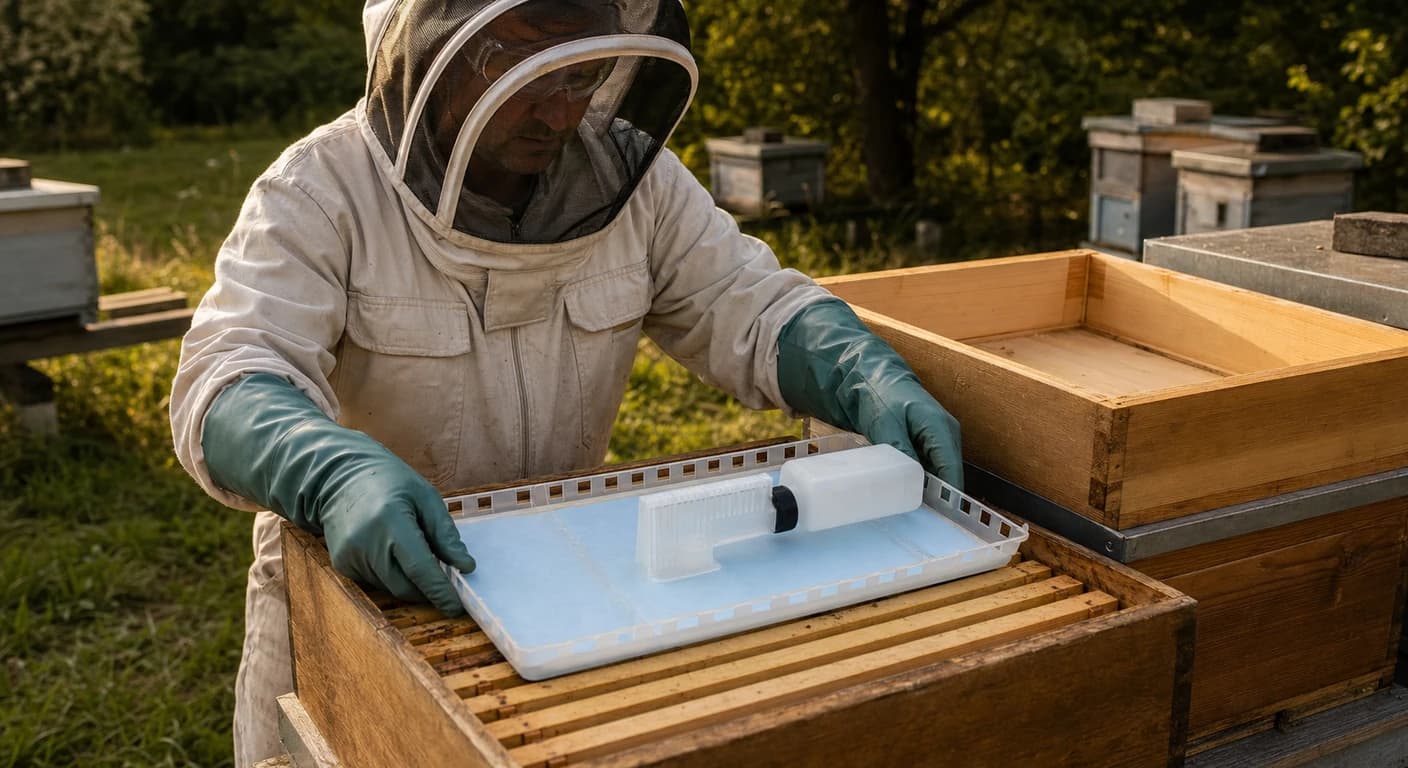
Selection: Use only a currently authorised veterinary medicine and follow its package leaflet exactly.
Timing: Base the decision on the diagnosis and act in time after removing honey intended for harvest. Honey-super status, brood status, and colony strength must match the authorisation.
Application: Temperature range, dose, duration, repeatability, and ventilation are product-specific.
- 2
Efficacy Check (September)
Method: Check with a suitable, standardised diagnostic method.
Assessment: Interpret the result only against current institute guidance matching the method, measurement period, season, colony type, and location.
If efficacy is insufficient: Seek qualified advice promptly and choose a lawful follow-up; do not alter dose or duration independently.
- 3
Winter Treatment (December)
Prerequisite: Verify the actual brood status; weather and calendar alone do not prove broodlessness.
Product and method: Use only a currently authorised veterinary medicine through a route authorised for the observed brood status.
Dose and repetition: Follow the package leaflet exactly. Do not repeat a route when its authorisation excludes repetition.
The specific products and legal requirements described here apply primarily to Germany and the EU. Approved treatment products, application methods, and documentation requirements may differ in your country. Always consult your local beekeeping authority for the regulations that apply in your area.
Pillar 4: Breeding -- The Best Long-Term Investment
Tolerance breeding does not work immediately, but it is the most sustainable strategy.
What you can do:
- Source queens from AGT breeders or breeders with high tolerance breeding values
- Preferentially rear from your own colonies with low mite infestation
- Participate in the monitoring network of your beekeeping association
- Cleanly document colony development and mite infestation (helps breeding value estimation)
The Decision Tree: When Which Method?
In practice, you repeatedly face the question: what must I do now? This decision tree helps:
Example Annual Plan: A Typical Colony
Here is a concrete annual plan for a single colony -- this is what your management might look like in practice:
| Month | Measure | Product/Method | Time Required |
|---|---|---|---|
| December | Brood-status check and winter measure | Assess result; authorised medicine per leaflet | apiary-dependent |
| February | Check monitoring board | Count natural mite drop | 5 min |
| April | Insert drone frame | Empty frame into the brood nest | 5 min |
| May | 1st drone cut + monitoring | Cut drone comb, powdered sugar test | 20 min |
| June | 2nd drone cut + monitoring | Cut drone comb, check mite drop | 20 min |
| July | Harvest + infestation assessment | If action is needed, authorised measure per leaflet | apiary-dependent |
| August | Efficacy check | Monitoring board 3 days, count mite drop | 10 min |
| September | Final check | Monitoring board, assess colony strength | 10 min |
| October | Winterise | Mouse guard, weight check | 10 min |
Total Varroa time per colony per year: Approximately 2-3 hours. That is time well invested -- it determines the survival of your colony.
Common Mistakes and How to Avoid Them
Mistake 1: Treating Too Late
The problem: The last honey harvest drags on until August, treatment begins only in mid/late August or even September.
The consequence: The winter bees emerging from August are already damaged by high mite infestation. Even a perfect treatment in September cannot undo this.
The solution: Monitor in time and base timing on the diagnosis, regional guidance, and development of winter bees. If a veterinary-medicine measure is required, honey intended for harvest may remain only where the authorisation permits it.
Mistake 2: Under-Dosing
The problem: Dose, applicator, or treatment duration differs from the package leaflet of the veterinary medicine used.
The consequence: Treatment does not achieve sufficient efficacy. Mites survive and continue reproducing.
The solution: Follow the package leaflet and authorisation conditions of the specific product exactly. Check efficacy with a suitable diagnostic method in the recommended time window.
Mistake 3: Treatment at the Wrong Temperature
The problem: Temperature, ventilation, or weather falls outside the product-specific application conditions.
The consequence: Either damage to the colony or an ineffective treatment.
The solution: Check the package leaflet and forecast for the complete application window specified there. Postpone if the conditions cannot be met; improvised adjustments do not replace the authorisation requirements.
Mistake 4: No Monitoring
The problem: "I just always treat in August and December." Without knowing the actual infestation level.
The consequence: Colonies with high infestation are not recognised in time. Colonies with low infestation are unnecessarily stressed.
The solution: At least 4 checks per season: May, June, July (before treatment), September (after treatment). Best documented digitally.
Mistake 5: Using Only One Method
The problem: Exclusively chemical treatment, no drone brood removal, no monitoring.
The consequence: Higher treatment requirement, potential resistance development, no long-term improvement.
The solution: Implement IPM! Drone brood removal as standard, monitoring as the foundation, treatment as the last tool, breeding selection as the long-term strategy.
The biggest mistake in Varroa management is not the wrong product or the wrong method -- it is the wrong timing. Anyone who acts at the right time will succeed with any method. Anyone who comes too late will fail despite the best method.
Summary of the Entire Course
In this course, you have learned:
-
Understanding Varroa biology: How the mite reproduces, why it is so dangerous, and what damage it causes (Lesson 1)
-
Mastering monitoring methods: Powdered sugar, monitoring board, wash method -- and how to interpret the results (Lesson 2)
-
Applying biotechnical methods: Drone brood removal, brood removal, trapping comb method (Lesson 3)
-
Assessing authorised summer measures: Product, route, temperature, timing, and safety (Lesson 4)
-
Assessing authorised winter measures: Brood status, route, and package leaflet (Lesson 5)
-
Knowing alternative treatment methods: Thymol, lactic acid, VarroMed -- when which product fits (Lesson 6)
-
Implementing the Varroa annual plan: Month by month the right measures (Lesson 7)
-
Understanding breeding approaches: VSH, SMR, grooming -- and why they do not yet replace treatment (Lesson 8)
-
Using digital tracking: Interpret method, unit, season and status together (Lesson 9)
-
Integrating everything: The four pillars of IPM combined into one concept (this lesson)
Final Test: Are You Ready?
Test your knowledge with these challenging questions:
Your Checklist: Am I Ready for the Next Varroa Season?
Varroa Season Readiness Check
Congratulations on completing the Varroa Management Master Course! You now have the knowledge to systematically and data-driven protect your colonies against the Varroa mite. Remember: Varroa management is not a one-time event but an ongoing process. The more consistently you implement the four pillars of IPM, the healthier your colonies will be.
This course is regularly updated as new research findings, products, or methods become available. Have questions or feedback? We welcome your message at kontakt@fero-solutions.de.