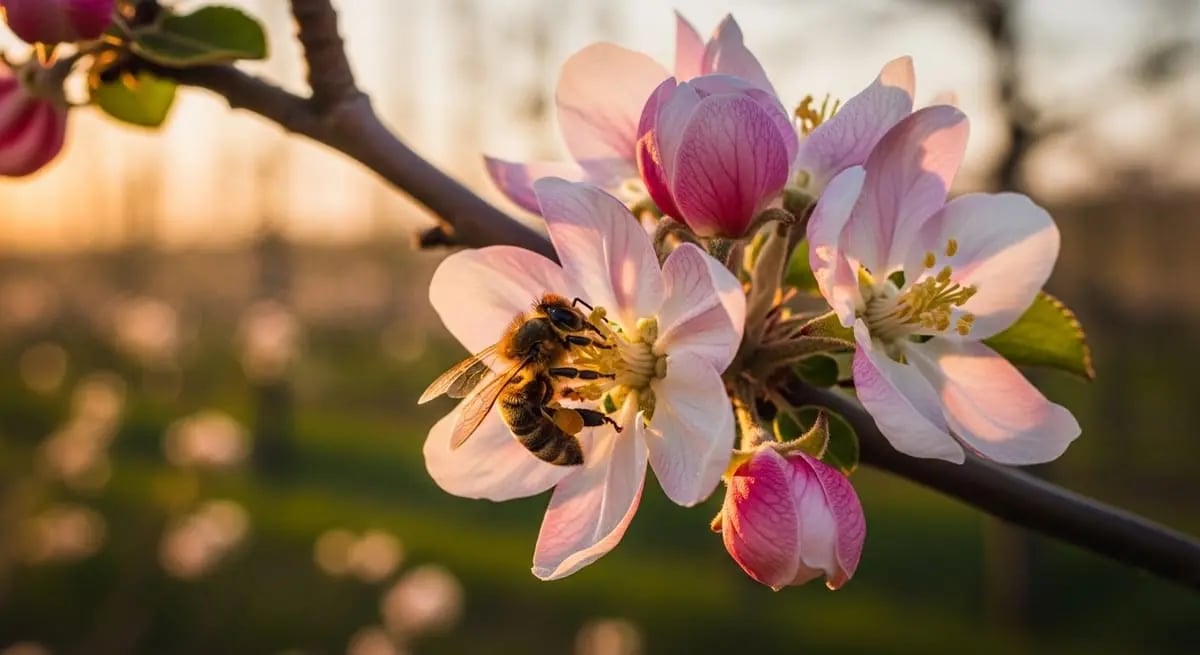
Bees and Fruit Trees — Measuring and Optimising Pollination
How far do bees fly for fruit blossoms? Which trees benefit most? Here is how to measure your colonies' pollination performance and position them optimally.
Beekeeping and fruit growing go together like blossom and bee. If you do both — or at least have fruit trees near your colonies — you benefit twice over: the bees get a valuable spring nectar flow, and the fruit trees deliver larger, more uniform fruit through better pollination. But how big is the pollination effect really? How far do bees fly for fruit blossoms? And how do you position your colonies optimally? This article provides the answers — practical and scientifically grounded.
Why Pollination Matters
The importance of honeybee pollination for fruit growing is often underestimated. Some key figures:
- Apple: Without bee pollination, yields drop by 40–90 percent. Even with "self-fertile" varieties, cross-pollination significantly improves fruit size and shape.
- Sweet cherry: Almost entirely dependent on insect pollination. Without bees, virtually no crop.
- Pear: Highly dependent on cross-pollination. At least two different varieties within flight range are needed.
- Plum/Damson: Many varieties are self-fertile but benefit significantly from bee pollination (more uniform fruit, less fruit drop).
- Walnut: Wind-pollinated — bees play no role here.
The Economic Value
The pollination contribution of the honeybee is estimated at 1.6 to 2.5 billion euros per year in Germany alone (German Beekeepers' Association, based on studies by the JKI and the University of Hohenheim). Globally, the figure exceeds 150 billion US dollars. For hobby beekeepers with their own garden, this means your bees increase the yield of your fruit trees — a concrete, measurable benefit.
The economic figures cited are specific to Germany. For other countries, the IPBES Global Assessment Report on Pollinators provides comparable data. The United States estimates pollination services at over 15 billion dollars annually; the UK values them at approximately 690 million pounds.
Pollination Range: How Far Do Bees Fly?
The Research
The flight distance of honeybees is well studied:
- Average foraging distance: 1–3 km from the hive
- Maximum flight distance: Up to 10 km (in extreme cases, during nectar dearth)
- Optimal pollination distance: Under 500 metres — this is where visit frequency is highest
- Effective pollination radius: Approximately 1.5 km — within this distance, pollination performance is reliable
Visit frequency decreases sharply with increasing distance. A study at the University of Wuerzburg showed that apple trees within 500 metres of a beehive are visited three times more frequently than those at 2 km distance.
What Does This Mean for Your Garden?
- Fruit trees in your own garden (under 100 m): Optimal pollination guaranteed
- Orchard in the neighbourhood (100–500 m): Very good pollination
- Meadow orchard in the village (500 m – 1.5 km): Good pollination, but other insects are also needed
- Distant fruit plantation (over 2 km): Pollination contribution is low — professional growers therefore place their own colonies or rent pollination hives
Fruit Blossom Calendar: When Does What Bloom?
The timing of fruit blossom varies by region, altitude, and weather. For Central Europe, the following rough guide applies:
| Fruit | Bloom Period | Bloom Duration | Bee Dependence |
|---|---|---|---|
| Plum/Damson | March–April | 7–14 days | Medium |
| Sweet cherry | April | 7–10 days | Very high |
| Sour cherry | April–May | 10–14 days | High |
| Pear | April | 7–12 days | Very high |
| Apple | April–May | 10–20 days | High |
| Quince | May–June | 14–21 days | Medium |
| Raspberry | May–June | 21–28 days | High |
| Strawberry | May–June | 21–28 days | Medium |
In phenology, the apple blossom marks the beginning of "full spring". When the apples bloom, the season is in full swing. Note the date of the first apple blossom each year — over time you build a personal calendar that is more valuable than any general table.
Bee-Friendly Fruit Trees: Which Ones Are Worthwhile?
Not all fruit trees are equally valuable for bees. Nectar and pollen value varies considerably:
Top 5 for Bees
1. Apple Tree (Malus domestica) The classic — and for good reason. Apples bloom comparatively long (10–20 days) and offer good nectar and pollen. Standard (full-size) trees are particularly valuable because they bear more blossoms than espalier or bush forms. A mature standard tree can have 50,000 to 100,000 blossoms.
2. Sweet Cherry (Prunus avium) Early bloom (April), very abundant nectar. Cherries are one of the first rich nectar sources in spring. Standard cherry trees in traditional orchards are a cornerstone of the spring nectar flow.
3. Pear (Pyrus communis) Good nectar, earlier than the apple. Pears are, however, dependent on cross-pollination — at least two different varieties must be within flight range.
4. Plum/Damson (Prunus domestica) Very early bloom (often as early as late March). Nectar is good, pollen yield moderate. An important early bloomer for bees.
5. Raspberry (Rubus idaeus) Technically not a tree, but as a shrub indispensable. Raspberries bloom in June and provide excellent nectar. Raspberry blossom honey is light, mild, and highly aromatic — one of the finest honey varieties.
Less Valuable for Bees
- Walnut: Wind-pollinated, no nectar for bees
- Hazel: Also wind-pollinated, but an important late-winter pollen source
- Modern ornamental varieties: Double-flowered ornamental cherries or crab apples often have less nectar than wild forms
Measuring Pollination Performance: Methods for Hobby Beekeepers
Want to know how well your bees pollinate your fruit trees? There are several methods — from simple to scientific:
Method 1: Count Blossom Visits (Simple)
Stand in front of a blooming apple tree for 5 minutes and count the bee visits:
- Under 5 bees in 5 minutes: Low visit frequency — more colonies needed or place them closer
- 5–15 bees in 5 minutes: Good visit frequency
- Over 15 bees in 5 minutes: Excellent pollination
Repeat the count on 3 different days and at different times (mornings are usually most active). Note the temperature and weather — below 12 degrees and in rain, bees hardly fly.
Method 2: Compare Fruit Set (Intermediate)
Mark 10 blossom clusters on one branch with good bee access and 10 on an equivalent branch with poor bee access (e.g. a branch facing a house wall). Compare fruit set after 4 weeks:
- How many blossoms developed into fruit?
- How uniform is the fruit development?
Method 3: Harvest Weight and Quality (Long-Term)
Document over several years:
- Harvest quantity per tree (in kg)
- Fruit size (spot-check diameter measurements)
- Uniformity (how many misshapen or lopsided fruits?)
- Distance to the nearest beehive
Over the years a picture emerges showing which trees benefit most from bee proximity.
Apiary Placement: Positioning Colonies Optimally
The placement of beehives relative to fruit trees has a major impact on pollination performance:
Basic Rules
- Distance: Under 200 metres to the fruit trees is ideal
- Flight direction: The entrance should face toward the fruit trees (bees orient by the entrance)
- Distribution: For larger orchards, 2–3 small groups are better than one large site
- Wind shelter: Bees are reluctant to fly into strong wind — position colonies in a sheltered spot, not on the windward side of the orchard
How Many Colonies per Hectare?
For reliable pollination, fruit-growing advisors recommend:
| Crop | Colonies per Hectare | Notes |
|---|---|---|
| Apple | 2–3 | More if bloom window is short or weather is cool and wet |
| Cherry | 3–4 | Early bloom, often still cool temperatures |
| Pear | 3–5 | Pear nectar is less attractive to bees than apple |
| Strawberry | 2–3 | Strawberries benefit but are not fully bee-dependent |
For a home garden with 3–10 fruit trees, 1–2 colonies in the immediate vicinity (under 50 m) are usually more than sufficient.
Using the Hivekraft Apiary Map
On the Apiary Map in Hivekraft you can see all your apiaries and colonies on the map. This way you can see at a glance how your apiaries are distributed spatially and whether a new apiary location closer to your fruit trees would make more sense.
Pollination Partnerships: Beekeeper Meets Fruit Grower
In many regions, cooperations between beekeepers and fruit growers are common:
- Migratory pollination: Beekeepers place their colonies at the orchard for 2–3 weeks during fruit blossom. The grower pays a fee (typically 30–50 euros per colony, varying by region).
- Permanent placement: The fruit grower provides free apiary space — a win-win arrangement with no money changing hands.
- Beekeeping club as broker: Many beekeeping associations facilitate connections between growers and beekeepers. Ask at your local club.
Regulations around migratory beekeeping vary by jurisdiction. In Germany, beekeepers must register moves with the local veterinary office and provide a current health certificate for the colonies. In the US, migratory pollination is regulated at the state level. In the UK, the National Bee Unit recommends voluntary registration. Always check your local requirements before moving colonies.
The Pollination Bonus: More Than Just Fruit
Your bees' pollination work extends far beyond your own garden:
- Wild plants: Over 80 percent of flowering plants in temperate regions depend on insect pollination
- Biodiversity: Well-pollinated plants produce more seeds, which in turn feed birds and small mammals
- Neighbours: Your bees also pollinate your neighbours' gardens — a compelling argument when there are concerns about beekeeping nearby
Fruit Blossom and Honey: What Does the Spring Crop Yield?
For many beekeepers, the fruit blossom is the first significant nectar flow of the year. The so-called "early crop honey" (sometimes called "fruit blossom honey") is produced mainly from:
- Fruit blossom (apple, cherry, plum)
- Dandelion
- Oilseed rape (if within flight range)
A pure fruit blossom honey is rare because other plants bloom simultaneously. Still, the fruit blossom shapes the flavour of the early crop honey — it is light, mild, and fruity.
Harvest quantity: From fruit blossom alone the yield is usually modest (2–5 kg per colony). Combined with oilseed rape it rises to 15–25 kg per colony — depending on rape fields within flight range.
Climate Change and Fruit Blossom
Climate change is shifting bloom times. Data from weather services across Europe show:
- The apple blossom has advanced by an average of 2–3 weeks since 1961
- Late frosts after bloom has already started are becoming more frequent — and are catastrophic for pollination and yield
- Bloom duration shortens in hot, dry springs
For beekeepers this means flexibility becomes more important. Those who know and document the phenology of their region can respond better than those who rely on rigid calendars.
For more on climate change and beekeeping, see the article Climate Change and Beekeeping.
Practical Tips for Beekeepers with Fruit Gardens
Optimising Pollination — Practical Checklist
If fruit plantations near your colonies are treated with pesticides, this can endanger your bees. Particularly harmful are neonicotinoids (banned for outdoor use in the EU, but possible under emergency authorisations) and certain fungicides that impair bees' navigation ability. Talk to the farmers in your area — most are cooperative when they know bees are nearby.
Conclusion
Bees and fruit trees are one of the oldest and most successful partnerships in agriculture. As a hobby beekeeper with a garden, you can actively shape this partnership: place your colonies near the fruit trees, plant multiple varieties for cross-pollination, and document the results over the years. You will see — well-pollinated trees deliver not only more fruit, but more beautiful fruit. And your bees thank you with a solid spring crop.
- Forage Plants and Bee Pasture — Lesson 3: Fruit Blossom and Spring Nectar Flow
- Beekeeping for Beginners — Lesson 5: Apiary Placement and Setup
Less paperwork. More time with your bees.
Hivekraft is free for up to 10 hives. Register in 30 seconds.