How to Extract Honey Properly - Tips for Best Quality
From the right timing to storage: How to extract your honey correctly and achieve the best quality according to German Honey Regulations and DIB guidelines.
The honey harvest is the highlight of the beekeeping year. To ensure your honey has the best possible quality, the right approach matters at every step - from the harvest timing to bottling. It is not just about taste, but also about complying with the legal requirements of the German Honey Regulation (HonigV) and - if you are a DIB member - the stricter DIB quality criteria.
Note: The regulations and quality standards mentioned in this article refer specifically to German and EU law. If you are beekeeping outside of Germany, please check your local food safety and honey labeling regulations.
In this comprehensive guide, we walk you through every step of the extraction process and give you the knowledge you need for first-class honey.
When Is the Honey Ripe?
The most important quality factor is the moisture content. Ripe honey has a moisture content of under 20 percent (legal maximum under German HonigV). For the coveted DIB quality seal, the stricter limit of under 18 percent applies, and premium honey is even under 16.5 percent.
The Shake Test
The shake test is the quickest method for assessing ripeness directly at the hive:
- At least two thirds of the honey cells must be capped
- Uncapped cells: hold the frame horizontally and shake lightly
- Nothing drips out? Then the honey is ripe enough
- Caution: With rapeseed honey, bees may cap late - here a refractometer measurement is particularly important
Using a Refractometer
For accurate measurement, a refractometer is indispensable. It costs between 20 and 40 euros and belongs in every beekeeper's basic equipment:
- Calibration: Check before each season with distilled water or calibration solution
- Sampling: Take a sample from different frames before extraction
- Measurement: Place a few drops on the prism, close the flap, read against the light
- Interpretation: Under 18% - perfect for DIB. Under 17% - premium quality. Over 18% - wait longer or dry the frames
Honey with over 20% moisture content may not be sold as honey in Germany (HonigV). Over 18% you lose DIB eligibility. Solution: Store frames for 24-48 hours in a warm, dry room (ideally with a dehumidifier). The moisture content drops by 0.5-1% per day.
Nectar Source-Specific Considerations
Not all honey behaves the same:
| Nectar Source | Special Feature | Ideal Moisture Content |
|---|---|---|
| Rapeseed honey | Crystallizes quickly, extract early | 16-17% |
| Forest honey | Stays liquid longer, higher enzyme values | 16-18% |
| Linden honey | Distinctive flavor, medium crystallization speed | 16-17% |
| Acacia honey | Stays liquid for a long time | 16-18% |
| Heather honey | Thixotropic gel-like, use pricker roller + extractor or press (HonigV allows up to 23%) | 17-21% |
Special Case: Rapeseed Honey - Timing Is Everything
Rapeseed honey is the first harvest of the year for many beekeepers and simultaneously the most demanding. Rapeseed typically blooms from late April to mid-May, and the honey crystallizes extremely fast - sometimes right in the combs.
Rapeseed honey can crystallize in the combs within a few days. Then it can no longer be extracted and the combs are lost. Check the condition daily from the end of rapeseed bloom. Better to extract one day too early than one too late. If necessary, extract at a slightly elevated moisture content and then let it dry in an open bucket in a dry room.
Rapeseed honey timeline:
- From full bloom: Check frames daily
- When 50-70% capped: Refractometer measurement
- Under 18.5%: Extract immediately
- Do not wait longer than 3 days after the end of rapeseed bloom
Extraction Room Requirements
Legal Requirements
Anyone who sells honey must observe the Food Hygiene Regulation (LMHV). Minimum standards also apply for direct farm sales:
- Registration: Your operation must be registered with the responsible veterinary office or food safety authority (Art. 6 Reg. (EC) 852/2004)
- Floors and walls: Easy to clean, smooth, and washable (tiles, stainless steel, or food-grade coating)
- Washing facility: Hand wash basin with warm water and soap must be available
- No pets: No access for dogs, cats, etc. during extraction
- Windows closed: Protection from robber bees and insects (fly screens recommended)
Optimal Room Conditions
- Temperature: 20-25 degrees Celsius - the honey flows better and the combs are more stable
- Humidity: Under 60% - prevents the honey from absorbing moisture
- Lighting: Well-lit so you can spot impurities
The quality of honey is not determined only during extraction but begins with your management practices. Beekeepers who give their bees enough room and know their nectar flow automatically harvest better honey.
Setting Up the Extraction Room - Checklist for Beginners
Not everyone has a perfect extraction room. Here is a realistic checklist:
Extraction room checklist
Preparation for Extraction
Equipment and Materials
Have everything ready before you start:
- Honey extractor (cleaned and dried)
- Uncapping fork and/or uncapping knife
- Uncapping tray or tub
- Double strainer (coarse and fine, stainless steel)
- Honey buckets (food-grade, with lids)
- Refractometer
- Kitchen scale
- Clean cloths
Bee Escape or Brushing
- Bee escape: Insert the evening before, colonies will be bee-free the next morning. The gentlest method.
- Brushing: Brush each frame with a soft bee brush. Faster but disturbs the bees more.
- Bee blower: With a leaf blower on low setting - for professional beekeepers with many colonies.
- Transport frames to the extraction room in sealed transport boxes.
Extractor Types Compared
The choice of the right extractor has a major impact on efficiency and results:
| Criterion | Tangential Extractor | Radial Extractor |
|---|---|---|
| Frame position | Flat side outward | Top bar outward |
| Turning required | ✓ | ✗ |
| Comb breakage risk | Higher | Lower |
| Extraction rate | ★★★★★ | ★★★★☆ |
| Time required | High (turning) | Low |
| Capacity (typical) | 3-4 frames | 6-20+ frames |
| Price (entry level) | 150-400 EUR | 500-2000 EUR |
| Recommendation | Up to 10 colonies | 10+ colonies |
Self-Reversing Extractor
A special form of tangential extractor: The baskets can be reversed inside the machine without removing the frames. A good compromise between tangential and radial, mid-range in price (300-800 EUR).
The Extraction Process Step by Step
- 1
Temper the frames (evening before)
Bring the honey frames to the extraction room the evening before. Ideal temperature: 25-30 degrees Celsius. At this temperature, honey flows optimally and the combs are stable enough. Frames that are too cold (under 18 degrees) lead to viscous honey and comb breakage. Transport frames in sealed boxes to prevent robbing.
- 2
Uncapping
Use an uncapping fork or an electrically heated uncapping knife. Work from top to bottom and catch the wax cappings in the uncapping tray. Cappings wax is valuable - it is the purest beeswax and is excellent for candles or cosmetics. Uncap both sides thoroughly. Scratch deeper cells with the fork.
- 3
Extracting - first round (gentle)
Hang the frames evenly in the extractor. With a tangential extractor: Start slowly and first extract only the first side (half power, approx. 100-150 RPM). This prevents comb breakage, as the full honey side presses from behind onto the empty front side. Be especially careful with natural combs (without foundation).
- 4
Turn and finish extracting
With a tangential extractor: Turn frames, extract second side at full power (200-250 RPM). Then turn again and extract the first side at full power. With a radial extractor, turning is unnecessary - simply spin up evenly and let it run for 5-8 minutes. Listen to the sound: When the splashing stops, the frames are empty.
- 5
Straining
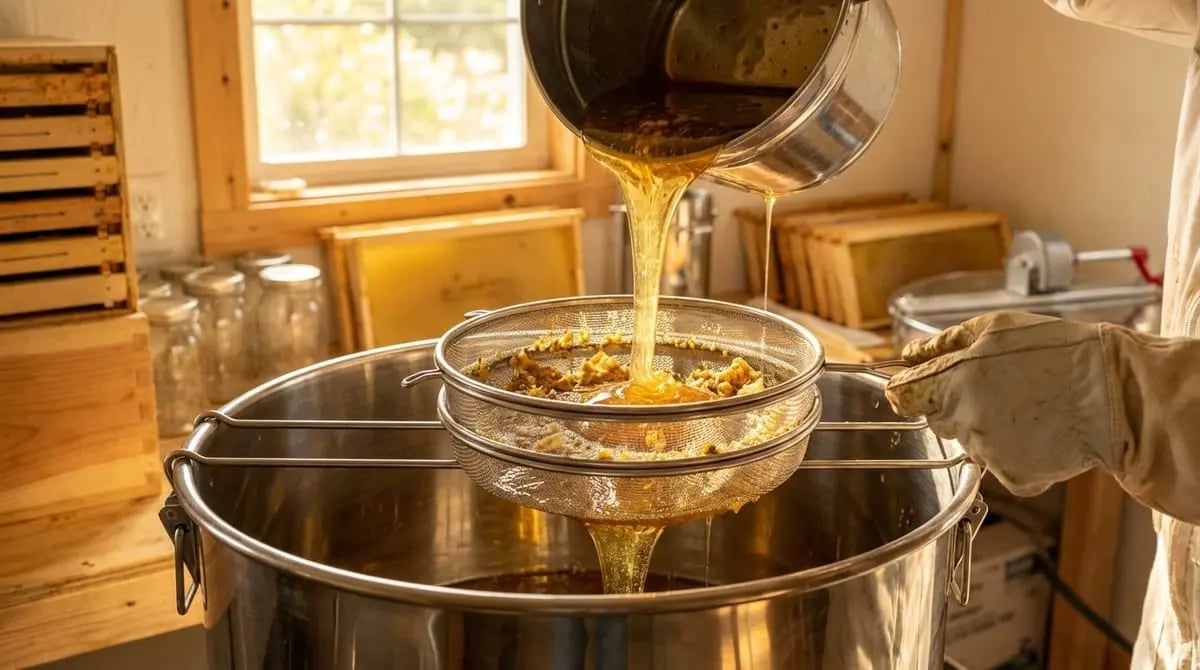
Let the honey flow through a double strainer (coarse sieve approx. 1.0 mm and fine sieve approx. 0.5 mm mesh) into the honey bucket. Wax remnants, bee parts, and impurities are retained. Empty the strainer regularly so the honey flows through well. For viscous honey (e.g., forest honey), slightly warm the strainer.
- 6
Measure and document moisture content
Measure the moisture content of each batch with the refractometer and note the result. Take the sample directly from the freshly extracted bucket. If the value is over 18%, extract this batch separately and store it in an open bucket in a dry room with a dehumidifier. Measure again after 24-48 hours.
- 7
Skimming and stirring
Let honey stand covered for 24-48 hours. Skim foam and rising air bubbles with a flat spoon. For creamed honey: Stir once daily from day 2, for 5-10 days, until the consistency is evenly creamy. For liquid honey: Just skim and bottle directly.
- 8
Bottling and storage
Fill into clean, food-grade jars or buckets. Fill jars to the brim (less air = less oxidation). Store cool and dark at 12-15 degrees. Never heat above 40 degrees - HMF value rises, enzymes are destroyed. Label jars immediately (variety, date, batch).
Making Creamed Honey - The Art of Stirring
Creamed (fine-cream) honey is particularly popular with customers. It is created through controlled crystallization:
Why Honey Crystallizes
Every honey crystallizes sooner or later - this is a natural process and not a quality defect. The speed depends on the glucose-fructose ratio:
- High glucose content (rapeseed, dandelion): Fast crystallization (days to weeks)
- High fructose content (acacia, forest honey): Slow crystallization (months to years)
Stirring Method Step by Step
- Seeding (optional): Stir in 5-10% already fine-cream honey to speed up the process
- Temperature: Store the honey at 14-16 degrees - ideal crystallization temperature
- Stirring: From the point when the honey becomes slightly cloudy (start of crystallization), stir 1-2 times daily for 3-5 minutes
- Duration: 5-10 days until the consistency is evenly creamy and spreadable
- Bottling: Fill into jars immediately after reaching the desired consistency
- Storage: At 12-15 degrees, the creamy consistency stays stable
A well-stirred creamed honey has a crystal size under 25 micrometers - the eye sees no crystals, the tongue only feels creaminess. The secret lies in regular stirring at the right temperature.
Temperature Control - The Underestimated Factor
Temperature influences every step of the extraction process:
Frame Temperature
- Ideal: 25-30 degrees Celsius - honey flows well and combs are stable
- Too cold (under 18 degrees): Honey is viscous, extraction takes longer, comb breakage risk increases
- Too warm (over 35 degrees): Combs become soft, can break in the extractor
- Practical tip: Bring frames to the tempered extraction room the evening before
Honey Temperature During Processing
- During stirring: 14-16 degrees - ideal crystallization temperature for fine-cream honey
- During bottling: 20-25 degrees - honey flows well into jars
- During storage: 12-15 degrees - optimal storage temperature, slows HMF formation
- Never above 40 degrees - enzymes are destroyed, HMF rises, DIB quality is lost
The HMF value (Hydroxymethylfurfural) is a measure of heat damage to honey. The German HonigV allows a maximum of 40 mg/kg, the DIB quality seal only 15 mg/kg. Any heating above 40 degrees raises the value - and it never decreases again. Once damaged, honey stays damaged.
Batch Management and Traceability
Clean batch documentation is important not only for DIB guidelines but also for your customers and food safety.
What Belongs in Batch Documentation?
For each extraction (= one batch) you should note:
- Date and time of extraction
- Colony numbers - which colonies does the honey come from?
- Nectar source/variety - e.g., spring flow, summer flow, rapeseed honey
- Quantity in kilograms
- Moisture content (refractometer measurement)
- Batch number - sequential number or date-based (e.g., "2026-06-15-A")
- Location - from which apiary
Traceability from Jar to Colony
With clean batch documentation, you can trace every sold jar:
Jar (label with batch number) -> Batch (extraction on date X) -> Colonies (No. 3, 5, 7 from garden apiary) -> Treatment history (last treatment, withdrawal period observed)
This traceability is essential for food safety and is required for DIB honey.
Hygiene Requirements According to LMHV and Reg. (EC) 852/2004
Personal Hygiene
- Clean clothing - ideally a dedicated coat for the extraction room
- Cover hair - wear a hair net or cap
- Wash hands - before starting work and after every break
- Remove jewelry - take off rings, bracelets, watches
- No smoking breaks in the extraction room
Equipment Hygiene
- Clean all equipment thoroughly before the season (hot water, food-grade cleaning agent)
- No detergent with fragrances - honey absorbs foreign odors
- Between different nectar sources: clean extractor, strainer, and buckets
- Wipe uncapping knife regularly
- Honey-contacting surfaces: Only stainless steel, food-grade plastic, or glass
HACCP Principles
While a complete HACCP system (Hazard Analysis and Critical Control Points) is primarily audited in commercial operations, the LMHV (Food Hygiene Regulation) is binding for everyone. You should know the principles:
- Hazard analysis: What risks exist? (contamination, moisture, temperature)
- Critical control points: Measure moisture content, control temperature
- Limits: Moisture content under 18% (DIB) or 20% (HonigV)
- Monitoring: Refractometer measurement at every extraction
- Documentation: Keep batch records
Using Cappings Wax - Waste Nothing
Cappings wax is the purest and most valuable beeswax you obtain as a beekeeper. It would be wasteful to throw it away:
Processing
- 1
Let cappings wax drip
Let the wax drip thoroughly in the uncapping tray (overnight). The dripping honey is high-quality pressed honey - perfect for personal use.
- 2
Wash the wax
Wash the wax with cold water to remove honey residues. Warm water dissolves honey better, but cold water preserves wax quality.
- 3
Melt down
Melt the wax in a water bath (never heat wax directly - fire hazard!). Temperature: 62-65 degrees is sufficient. Filter through a fine cloth or nylon stocking.
- 4
Use
Cleaned cappings wax is excellent for: beeswax candles (rolling or pouring), beeswax wraps, cosmetics (lip balm, creams), or exchange for new foundation sheets at a wax dealer.
Common Extraction Mistakes
| Mistake | Consequence | Solution |
|---|---|---|
| Harvested too early | Moisture content too high, fermentation risk | Use refractometer, min. 2/3 capped |
| Extracted too fast | Comb breakage, wax in honey | Start slowly, tangential - gentle first spin |
| Extraction room too cold | Viscous honey, longer extraction time | Heat room to 20-25 degrees |
| Honey left uncovered too long | Moisture absorption, foreign odors | Close buckets with lids |
| Strainer clogged | Honey backs up, overflow | Clean strainer regularly |
| Mixed different nectar sources | No varietal declaration possible | Extract and store different flows separately |
| Heated honey above 40 degrees | HMF rises, enzymes destroyed | Never melt in hot water bath |
| Extracted frames with brood | Bee larvae in honey | Only harvest brood-free frames |
The most common mistakes happen due to lack of planning. Create a harvest plan: When will each apiary be extracted? How many buckets do you need? Is the extraction room prepared? A checklist at the extraction room entrance helps you forget nothing.
Document Your Harvest
Note for every harvest: date, quantity, moisture content, nectar source, and which colonies the honey came from. With the harvest feature in Hivekraft, you can assign each harvest to a colony and later create bottling batches with QR codes - for full traceability from jar to colony.
Advantages of Digital Harvest Documentation
- Yield statistics: See at a glance which apiary and which colony delivers the most honey
- Nectar analysis: Compare harvest quantities by nectar source over multiple years
- QR code labels: Your customers scan the code and see where their honey comes from
- Batch records: Automatically generated, exportable as PDF at any time
- Withdrawal period check: Hivekraft warns if the withdrawal period after a treatment has not yet expired
Storing Honey Properly - Ensuring Long-Term Quality
Storage determines whether your honey still has premium quality after months:
Ideal Storage Conditions
- Temperature: 12-15 degrees Celsius (cellar, pantry)
- Light: Store in the dark - UV light breaks down enzymes and vitamins
- Humidity: Under 60% - honey is hygroscopic and absorbs moisture
- Odors: No strongly smelling substances nearby (honey absorbs foreign odors)
- Containers: Glass or food-grade plastic, always sealed
Shelf Life
- Optimally stored: At least 2 years (often much longer)
- Best-before recommendation: 2 years from bottling
- Detecting quality loss: HMF value rises, invertase activity drops, color becomes darker
Conclusion
Good honey is created through careful work from management practices through extraction to storage. Pay attention to moisture content, work hygienically, document every batch, and store properly. This way you achieve honey you can be proud of - and that meets all legal requirements. Your customers will thank you.
From extraction to sales - learn the complete process:
- Honey Business -- 10 lessons from harvest to marketing
- Beekeeping for Beginners -- Lesson 9: Summer work, honey supers and harvest
- Law and Compliance for Beekeepers -- Lesson 3: Food labeling and hygiene regulations
Track harvests, print labels, market your honey.
Hivekraft is free for up to 10 hives. Register in 30 seconds.