

Published on 10 min
The colony record book is mandatory for every beekeeper. Learn everything about EU Regulation 2019/6, required fields, retention periods, and how Hivekraft supports you in keeping it.
Every beekeeper in Germany is legally required to maintain a colony record book (Bestandsbuch). This applies to the hobby beekeeper with three colonies just as much as to the professional beekeeper with 300. Since the entry into force of EU Regulation 2019/6 on Veterinary Medicinal Products on January 28, 2022, the requirements have become even stricter. Those who do not comply risk significant fines.
In this article, we explain everything you need to know about the colony record book - from the legal basis through the required fields to concrete example entries.
Note: This article describes the legal requirements under EU Regulation 2019/6 and German national law (TAMG). The EU regulation applies across EU member states, but national implementing legislation may vary. Check your country's specific requirements if you are beekeeping outside Germany.
Legal Foundations in Detail
EU Regulation 2019/6 on Veterinary Medicinal Products
EU Regulation 2019/6 has been directly applicable law in all EU member states since January 28, 2022. It replaces earlier national regulations and creates a unified legal framework for the application and documentation of veterinary medicinal products.
For beekeepers, this means: Every application of a veterinary medicinal product - whether formic acid, oxalic acid, lactic acid, or any other approved product - must be documented without gaps.
National Implementation: TAMG
In Germany, the EU regulation is supplemented by the Veterinary Medicinal Products Act (TAMG) and the Animal Keeper Medicinal Product Application and Verification Ordinance (TAEHAMNV). These prescribe in detail which information must be documented.
Who Inspects the Colony Record Book?
- Responsible authority: The veterinary office of your district
- Reasons for inspections: Routine checks, suspicion of disease, sampling, complaints
- Inspections for migratory beekeepers: At the migration site, the local authority can request the colony record book
- When selling honey: The colony record book can also be requested as part of food safety inspections
All Required Fields at a Glance
For every individual treatment, the following information must be documented completely:
1. Animal Stock Information
- Number and type of treated animals - for bees: colony numbers or names
- Location of the colonies - address or coordinates of the apiary
2. Medicinal Product Information
- Product name - complete trade name (e.g., "Oxuvar 5.7% ad us. vet.")
- Active ingredient and concentration - e.g., oxalic acid dihydrate 5.7%
- Batch number (lot number) - printed on the product packaging
- Supplier/source - pharmacy, veterinarian, or authorized dealer
- Invoice number from the supplier - proof of legal procurement
3. Application Information
- Date of application - start and end dates for long-term treatments
- Treatment duration - how long was the treatment? (Art. 108 Para. 2 lit. i EU 2019/6)
- Administered quantity/dosage - e.g., "5 ml per frame gap" or "2 strips per colony"
- Application method - trickling, vaporizing, long-term evaporation, etc.
- Name of treating person - who performed the treatment?
4. Withdrawal Period and Veterinarian Information
- Withdrawal period in days - when may honey be harvested again?
- Name of prescribing veterinarian - for prescription medications
- Prescription number - number of the veterinary prescription
Example Entries for Common Treatments
To show you what a complete entry looks like, here are three practical examples:
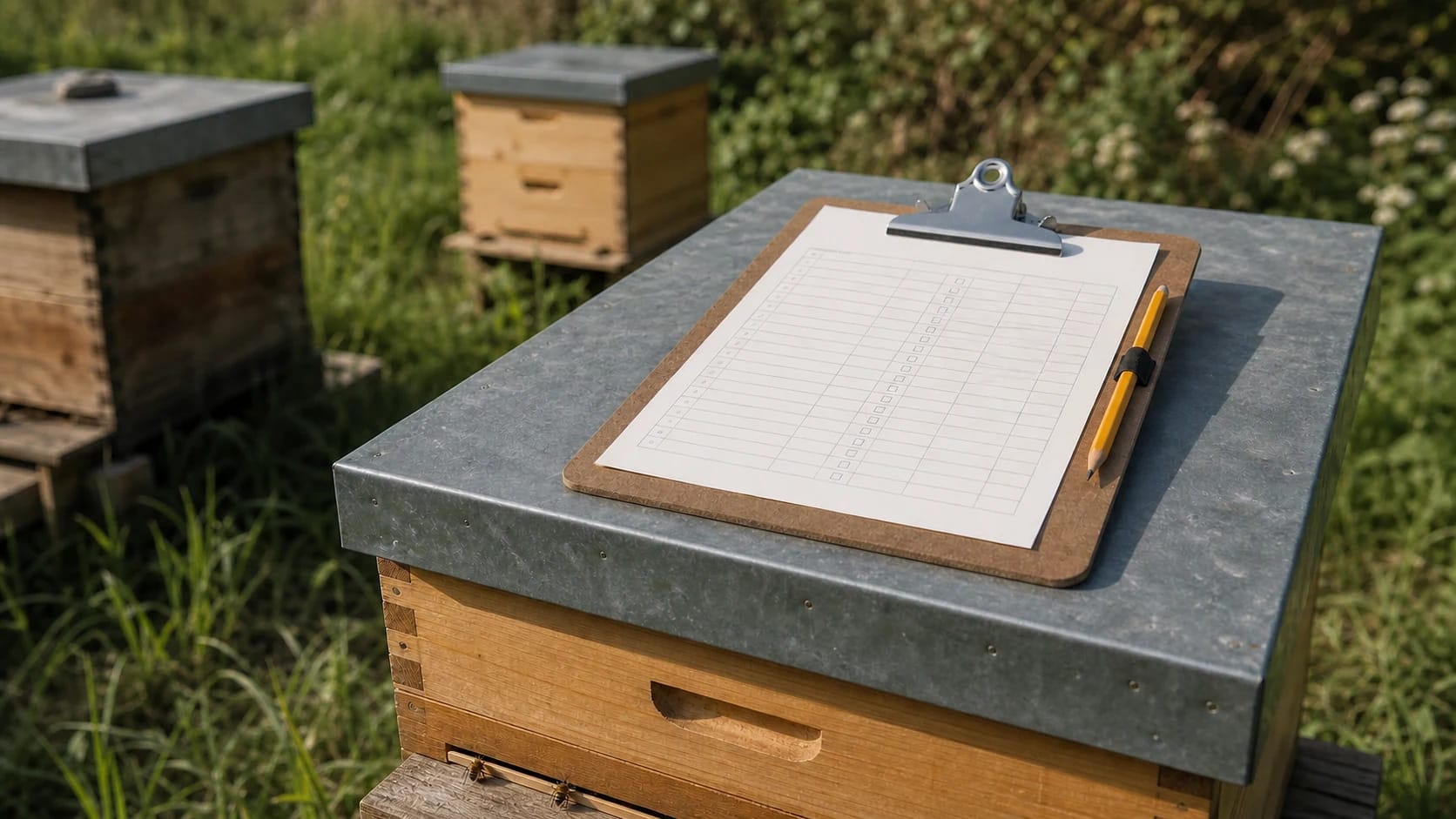 AI-generated. This image was created with AI. It does not show a real apiary.
Example 1: Summer Treatment with Formic Acid
| Field | Entry |
|---|---|
| Date | Aug 1, 2026 - Aug 14, 2026 |
| Colonies | Colony 1, 3, 5, 7, 9 (Garden apiary) |
| Product | Formivar 60% ad us. vet. |
| Active ingredient | Formic acid 60% |
| Batch number | LOT 2026-A-4471 |
| Supplier | Veterinary Practice Dr. Mueller, Munich |
| Invoice number | RE-2026-0814 |
| Dosage | 200 ml per colony, Nassenheider evaporator |
| Application method | Long-term evaporation, 14 days |
| Treating person | Max Mustermann |
| Withdrawal period | 0 days (no honey harvest during treatment) |
| Veterinarian | - (not prescription-only) |
| Prescription no. | - |
Example 2: Winter Treatment with Oxalic Acid (Trickling)
| Field | Entry |
|---|---|
| Date | Dec 18, 2026 |
| Colonies | Colony 1-12 (all colonies, Garden + Meadow apiary) |
| Product | Oxuvar 5.7% ad us. vet. |
| Active ingredient | Oxalic acid dihydrate 5.7% |
| Batch number | LOT OX-2026-887 |
| Supplier | Bee Supply Store GmbH |
| Invoice number | BW-2026-11-2234 |
| Dosage | 5 ml per occupied frame gap, max. 50 ml/colony |
| Application method | Trickling into frame gaps |
| Treating person | Max Mustermann |
| Withdrawal period | 0 days (winter, no honey harvest) |
| Veterinarian | - (over-the-counter) |
| Prescription no. | - |
Example 3: Biotechnical Measure (Drone Brood Removal)
| Field | Entry |
|---|---|
| Date | May 15, 2026 |
| Colonies | Colony 3 (Garden apiary) |
| Product | - (biotechnical measure) |
| Active ingredient | - |
| Measure | Drone brood frame removed and frozen |
| Treating person | Max Mustermann |
| Notes | Heavily capped drone brood, estimated >200 Varroa removed |
Retention Period: 5 Years Are Mandatory
EU Regulation 2019/6 prescribes a retention period of at least 5 years. This means concretely:
- Treatments from 2026 must be traceable until at least end of 2031
- Storage can be digital or analog
- Legibility must be ensured - with paper a problem, digitally no issue
- In case of business closure, the records must continue to be retained
What Happens with Violations?
Keeping the Colony Record Book with Hivekraft
Hivekraft generates your digital colony record book from recorded treatments and checks some of the details automatically. Whether your record book is complete is for you to check – the responsibility remains with you.
- 1
Record treatment
Go to Treatments and select "New Treatment." Choose the colony, treatment type, and product. Hivekraft shows you the fields for the colony record book - including batch number and supplier.
- 2
Bulk treatment for entire apiaries
When treating all colonies at an apiary simultaneously, use the apiary-wide treatment. One entry records the treatment for all colonies; you then check yourself whether the details are complete.
- 3
Use compliance check
Hivekraft checks some of the details automatically. A yellow warning shows missing information that you can still add; a green checkmark does not replace your own check.
- 4
Create PDF export
Under the Colony Record Book menu, select the year and click Export. The bilingual PDF export (German/English) is created instantly. Ongoing and completed treatments are listed chronologically with the details you recorded.
| Criterion | Paper Record Book | Hivekraft Digital |
|---|---|---|
| Always with you | ✗ | ✓ |
| Automatic backup | ✗ | ✓ |
| Flags missing details | ✗ | ✓ |
| PDF export for veterinarian | ✗ | ✓ |
| 5-year retention | File in folder | Stored while your account exists |
| Batch traceability | Tedious | Instantly filterable |
| Withdrawal period warning | ✗ | ✓ |
| Bilingual (DE/EN) | ✗ | ✓ |
Special Case: Migratory Beekeepers
Migratory beekeepers must document particularly carefully, as they must present their colony record book at every location. Additionally:
- Disease-free certificate (certificate under Section 5 of the Bee Disease Ordinance) must be carried - it confirms that colonies are free of American Foulbrood and is required for transport across district borders (validity: 9 months)
- Location documentation - every migration site with address and dates
- Official registration of the migration site with the local veterinary office
- Cross-state migration may involve additional requirements
Checklist: Is Your Colony Record Book Complete?
Check now whether your colony record book meets all requirements:
- All treatments of the current year documented?
- Batch numbers entered for every product?
- Supplier and invoice number provided?
- Withdrawal periods noted and observed?
- Name of treating person entered?
- Veterinarian information for prescription medications?
- Colony record books of the last 5 years archived?
- Records immediately presentable during inspection?
Conclusion
The colony record book is not a burdensome obligation but an important building block for responsible beekeeping. With EU Regulation 2019/6, the requirements are clearly defined - and with the right tools, compliance is easier. Whether you keep your record book on paper or digitally is up to you. The digital version saves time and points out some missing details – whether your record book is complete is for you to check.
Read also our detailed practical article: Varroa Treatment in August - Making the Most of the Window