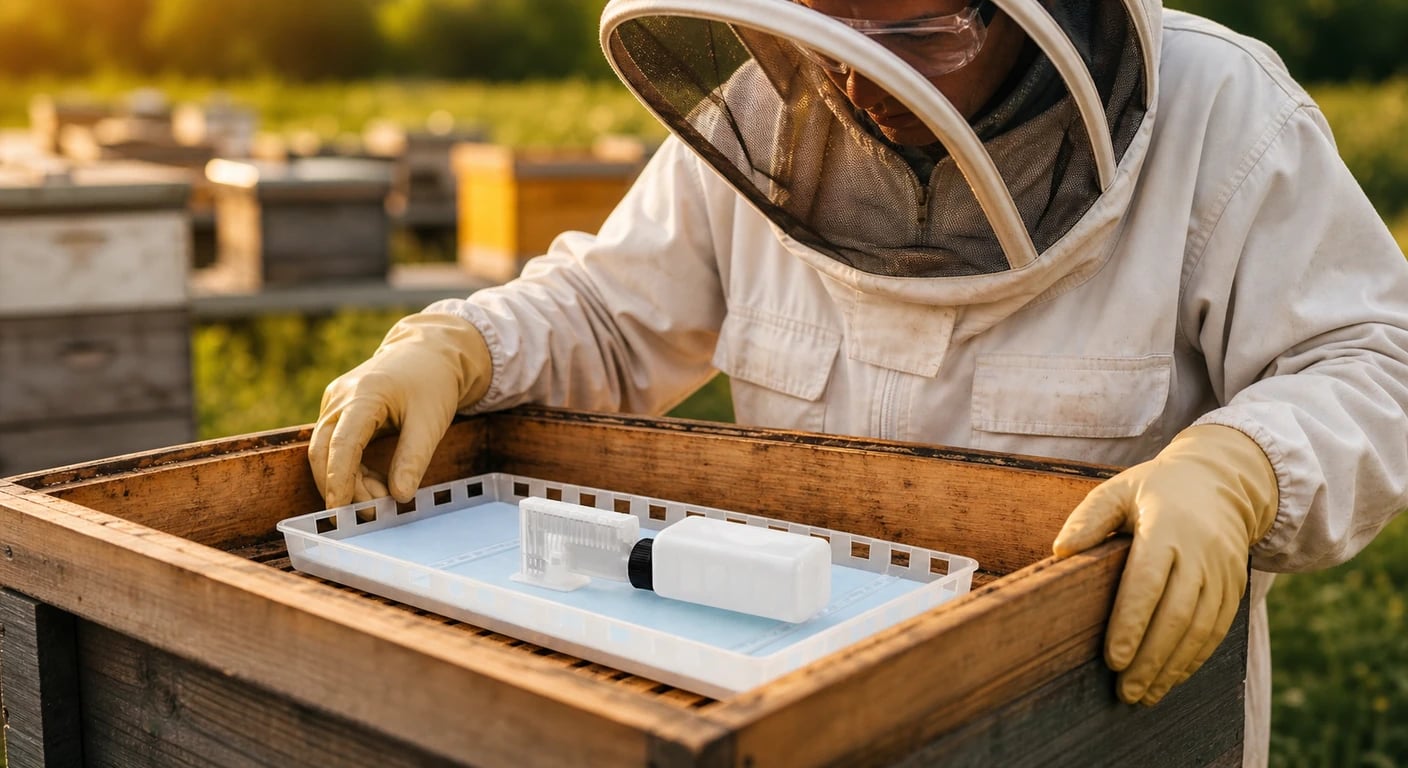
August: The Most Important Varroa Treatment of the Year
The August treatment against Varroa determines whether your colonies survive. Time window, formic acid 60%, and temperature requirements explained.
When the last honey has been extracted and summer draws to a close, the most important treatment of the entire beekeeping year arrives: the Varroa treatment in August. Its success determines whether your winter bees hatch healthy and whether your colonies survive the winter. Every day of delay costs winter bees -- and thus survival chances. This article explains why August is so critical, how to work with formic acid, and what temperature windows you need to observe.
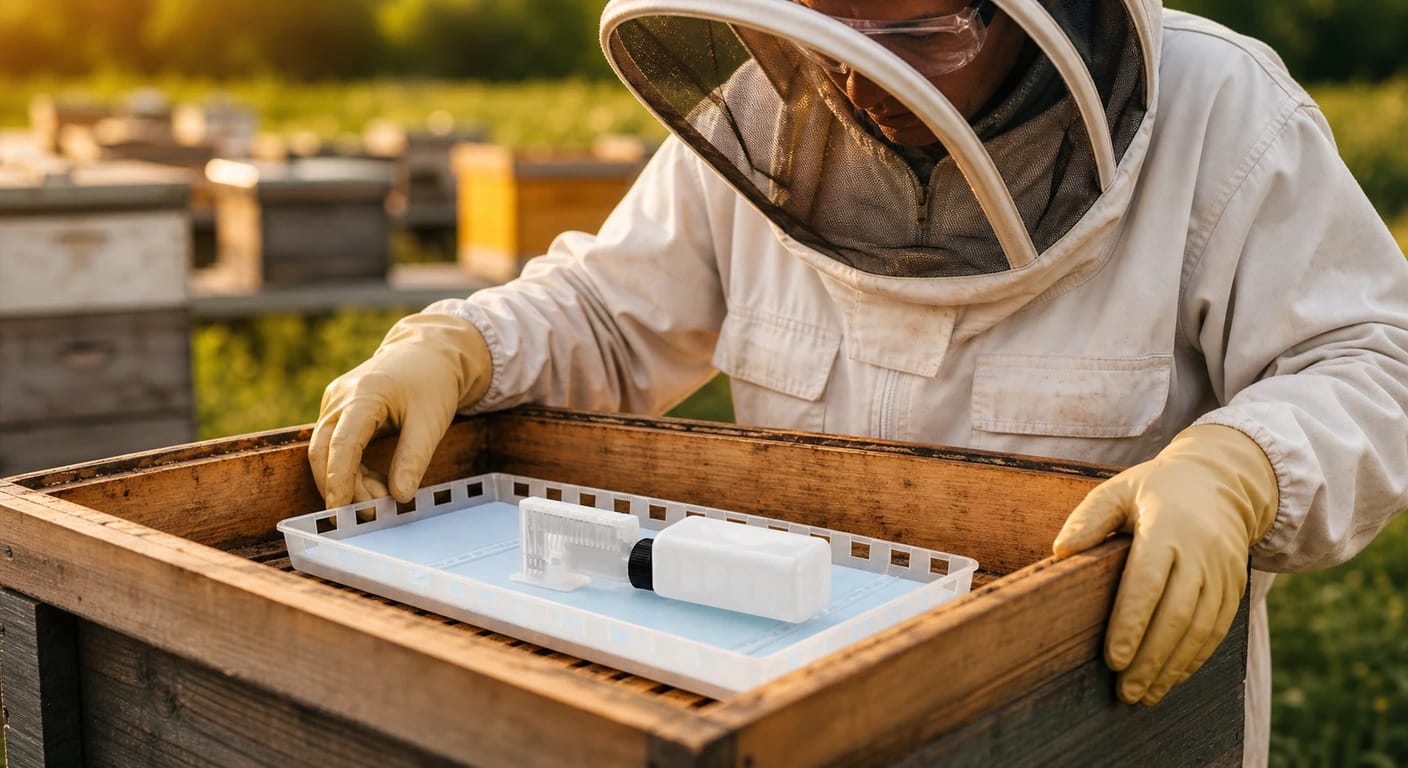
The regulations, approved treatments, and documentation requirements described in this article are based on German and EU law. If you are beekeeping outside of Germany, please check your local regulations regarding approved Varroa treatments and record-keeping obligations.
Why Is August So Critical?
The answer lies in the biology of winter bees. From early August onward, the bees that must carry your colony through winter begin to hatch. These winter bees differ fundamentally from summer bees:
| Characteristic | Summer Bees | Winter Bees |
|---|---|---|
| Lifespan | 4-6 weeks | 6-9 months |
| Fat body | Small | Strongly developed |
| Hatching period | March to July | August to October |
| Task | Foraging, brooding | Overwintering, first brood in spring |
When winter bees are parasitized as pupae by Varroa mites, they have a reduced fat body, shorter lifespan, and often carry viruses (DWV -- Deformed Wing Virus). These damaged bees cannot make it through winter.
A treatment in late September or October is too late for winter bees. By then they have already hatched -- as damaged bees if the Varroa load was high. The summer treatment must take effect BEFORE winter bees hatch. The time window is late July to mid-August.
The Integrated Varroa Concept
The August treatment is not an isolated event but part of a year-round concept:
- 1
Spring: Drone Frame Cutting (April-June)
By regularly cutting out capped drone brood, you remove Varroa mites from the colony. Mites preferentially reproduce in drone brood (5 to 12 times preferred over worker brood). Cut out the capped drone frame every 3 weeks.
- 2
Summer: Monitor Natural Mite Drop (July)
Insert the bottom board insert (monitoring tray) for 3 days and count the mites. Divide the number by 3 for the daily mite drop. With more than 5 mites per day in July, quick action is needed.
- 3
Summer: Main Treatment with Formic Acid (August)
The central treatment. After the last honey harvest, treat with 60% formic acid. Goal: reduce Varroa load to below 1 mite per day so that winter bees hatch healthy.
- 4
Autumn: Check Treatment Success (September/October)
After treatment, check the natural mite drop again. With more than 1 mite per day in October: follow-up treatment needed.
- 5
Winter: Final Treatment with Oxalic Acid (December/January)
During the broodless phase, treat with oxalic acid (trickling or sublimation). Goal: remove the last mites so the colony starts the new year clean.
Formic Acid 60%: The Standard Summer Treatment
Formic acid (FA) is the only approved substance that reaches both mites on the bees (phoretic mites) and mites in the capped brood (reproductive mites). This makes it the treatment of choice for the summer treatment.
Formic acid evaporates inside the hive and reaches the entire hive as gas. It also penetrates through the wax caps of brood cells and kills the mites there. When applied correctly under proper weather conditions, effectiveness is 85 to 95 percent.
Approved Products
Several formic acid products are approved in Germany:
Products:
| Product | Concentration | Application | Duration |
|---|---|---|---|
| Formic Pro (Andermatt BioVet) | 68.2 g formic acid per strip | 2 strips on top bars | 7 days |
| Formic acid 60% ad us. vet. | 60% formic acid liquid | Via evaporator (see below) | 10-14 days |
Applicators for formic acid 60%:
| Applicator | Principle | Application | Duration |
|---|---|---|---|
| Nassenheider Professional | Wick-based evaporation | On top bars of brood box | 14 days |
| Liebig Dispenser | Evaporator with wick | Placed on top bars | 10-14 days |
The Right Temperature Window
The evaporation rate of formic acid is highly temperature-dependent. Too cold: the acid does not evaporate sufficiently, effectiveness is poor. Too warm: evaporation is too strong, bees are damaged.
| Temperature | Evaporation | Effectiveness | Risk |
|---|---|---|---|
| Below 12°C | Too low | Ineffective | No effect |
| 12-15°C | Low | Borderline | Extend treatment |
| 15-25°C | Optimal | Very good (85-95%) | Low with correct dosage |
| 25-30°C | Elevated | Good but critical | Queen loss possible |
| Above 30°C | Too strong | Harmful | Bee and brood damage |
NEVER treat with formic acid at temperatures above 30 degrees. The acid evaporates too quickly and can kill the queen, damage brood, and poison adult bees. Wait for cooler days or treat in the cool morning hours.
Step by Step: Long-Term Treatment with Formic Acid
The long-term treatment over 14 days is the most common method for summer treatment. Here using the Nassenheider Professional as an example:
Preparation
- Complete the last honey harvest and remove honey supers
- Check food reserves -- the colony needs at least 5 kg of food during treatment
- Open the entrance completely for maximum ventilation
- Put on protective equipment (legally required under hazardous substance regulations!): Acid-resistant gloves, tight-fitting safety goggles, beekeeper suit, and if needed a respirator mask. An eye wash bottle and water container must be within reach.
- Check the weather forecast: The next 14 days should be within the temperature window
Execution
- Fill the evaporator with 60% formic acid (dosage according to manufacturer's instructions)
- Place the evaporator on the top bars of the brood box
- Place the inner cover on top (with spacer for air circulation)
- Close the outer cover
- Document date, time, and outdoor temperature
After Treatment
- Days 1-3: Increased mite drop is normal and desired
- Day 7: Check mite drop on the monitoring tray
- Day 14: Remove evaporator, count mite drop
- Day 21: Final check of natural mite drop (3-day tray)
Checking Treatment Success
After treatment, monitoring is crucial. Only then do you know whether the treatment was sufficiently effective.
Natural Mite Drop After Treatment
| Mite Drop/Day (October) | Assessment | Action |
|---|---|---|
| Below 0.5 | Very good | No further action until winter treatment |
| 0.5-1 | Good | Monitor carefully, plan winter treatment |
| 1-3 | Borderline | Consider follow-up treatment |
| 3-5 | Critical | Follow-up treatment urgently needed |
| Above 5 | Dangerous | Immediate follow-up treatment, colony at risk |
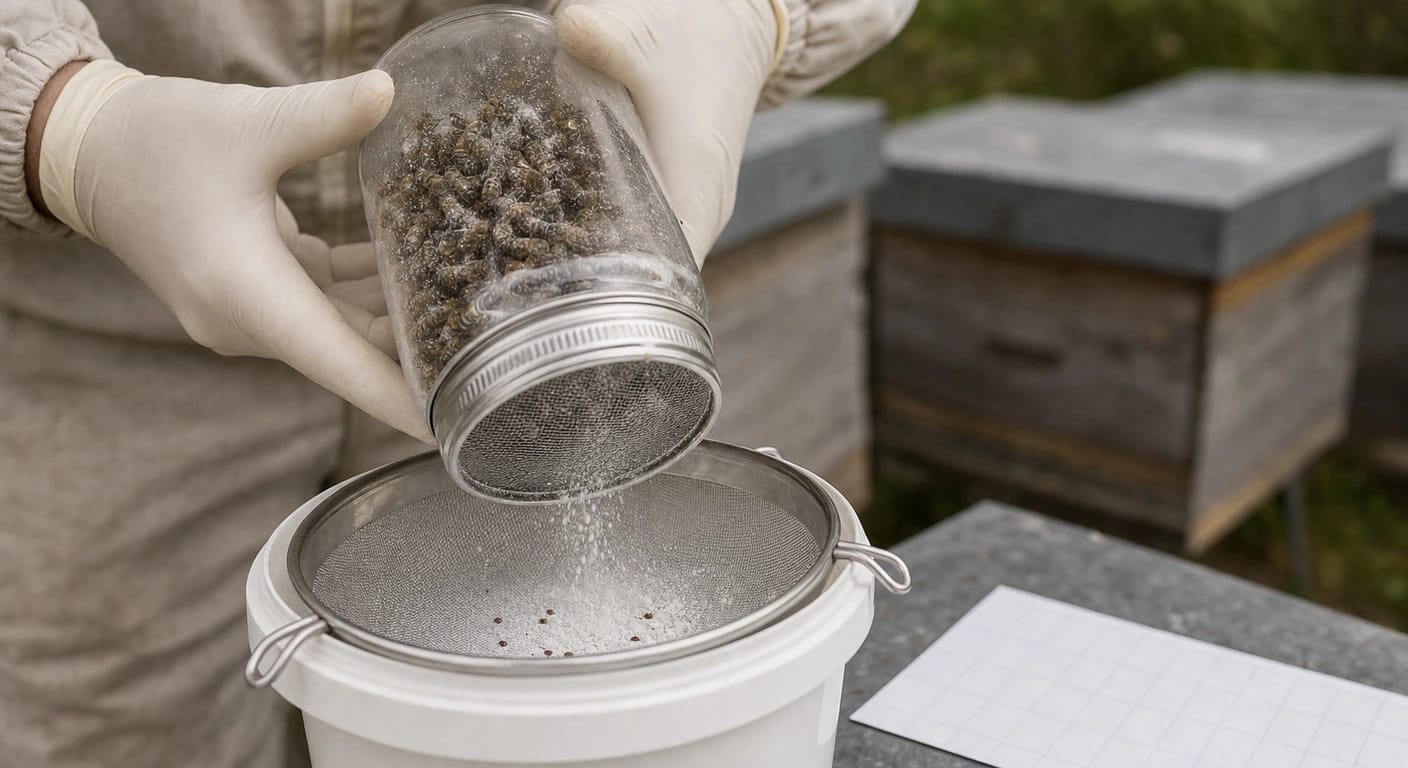
Powdered Sugar Method (Quick Test)
For a quick assessment of mite infestation, the powdered sugar method works well:
- Shake approximately 300 bees (about 100 ml) into a jar
- Add 2 tablespoons of powdered sugar
- Close the jar (mesh lid) and roll for 1 minute
- Shake the powdered sugar through the mesh onto a white sheet
- Count the mites
- Return the bees to the colony
Assessment: With 300 bees, 3 counted mites correspond to approximately 1% infestation rate. More than 9 mites (= over 3% infestation) in August requires treatment.
Common Mistakes in August Treatment
Treatment Documentation
Since 2022, with the adaptation of the Veterinary Medicinal Products Act (TAMG), all treatments must be documented in the colony record book (implementation of EU Regulation 2019/6). This applies to hobby beekeepers just as much as professional beekeepers. The following data is mandatory:
Mandatory Entries in the Colony Record Book
Alternatives to Formic Acid in August
In certain situations, formic acid treatment can be problematic -- for example during persistent heat or with sensitive queens. The following alternatives are available:
Total Brood Removal + Oxalic Acid
With total brood removal, all brood combs are removed and replaced with foundation. The broodless bees can be immediately treated with oxalic acid (spray or trickling method) since all mites are on the bees.
Advantages: Very high effectiveness (>95%), no temperature dependency, simultaneous comb renewal Disadvantages: High labor effort, colony is significantly set back, brood must be disposed of separately
Hyperthermia (Heat Treatment)
The Varroa mite is more heat-sensitive than bee brood. Special devices (e.g., Varroa Controller) heat the brood combs to 42°C -- the mites die, the brood survives.
Advantages: Residue-free, no chemicals, temperature-independent Disadvantages: Expensive equipment (starting at approx. 2,700 euros), time-consuming, only for experienced beekeepers
The summer treatment is the linchpin of Varroa control. Those who work carefully here and monitor treatment success have given their colonies the best chances of survival.
Conclusion: Your August Roadmap
August is the decisive month in the fight against Varroa. Here is your roadmap:
| Week | Task |
|---|---|
| Week 1 (Late July/Early August) | Last honey harvest, remove honey supers |
| Week 1-2 | Start formic acid treatment immediately (observe temperature window!) |
| Week 2-3 | Treatment running, monitor mite drop |
| Week 3 | Remove evaporator, begin fall feeding |
| Week 4 | Check treatment success (3-day tray) |
| If needed | Initiate follow-up treatment |
Take the August treatment seriously -- it is the single most important measure for the survival of your colonies. Document everything carefully in your digital hive records, check the results, and act quickly if effectiveness is insufficient. With the Varroa documentation, you can track mite counts throughout the entire season.
Winter Treatment with Oxalic Acid - Complete Guide for Beekeepers Swarm Season: Recognizing, Preventing, and Utilizing Swarms Fall Feeding: Amounts, Timing, and the Right Method- Varroa Management Masterclass -- 10 lessons on integrated Varroa management
- Bee Health Complete Course -- Recognize and treat all diseases
Document varroa treatments and stay on top of your hive health.
Hivekraft is free for up to 10 hives. Register in 30 seconds.