Honey Quality Testing: Moisture, HMF, and Lab Analysis
Honey quality is defined by internationally recognized standards. Learn how to measure moisture with a refractometer, understand HMF limits, read a Pfund color grade, and know when to send honey to a lab — before your harvest fails a quality check.
Honey quality testing is where beekeeping meets food science. Whether you sell a few jars at a farmers market or supply honey to a regional co-op, understanding how quality is measured — and meeting those standards — protects your customers, your reputation, and your legal standing. This guide covers the key parameters defined by international and US standards, the tools you need to test honey yourself, and when laboratory analysis becomes necessary.
The Standards Framework
Honey quality is governed by standards at multiple levels, and understanding which applies to you depends on where and how you sell.
Codex Alimentarius
The international reference standard for honey is the Codex Alimentarius standard for honey (CXS 012-1981, revised 2001). Published by the joint FAO/WHO body, it defines honey parameters that are adopted — sometimes with modification — by most national regulatory bodies:
| Parameter | Codex Standard |
|---|---|
| Moisture content | Max 20% (max 23% for heather honey) |
| HMF | Max 40 mg/kg (max 80 mg/kg for tropical origin honey) |
| Diastase activity | Min 8 Schade units (min 3 if HMF <15 mg/kg — for naturally low-diastase honeys) |
| Sucrose | Max 5% (max 10% for some floral honeys) |
| Reducing sugars | Min 60% (min 45% for heather and manuka) |
| Apparent reducing sugars | Min 65% |
| Water-insoluble matter | Max 0.1% |
US Grade Standards (USDA)
In the United States, the USDA has established voluntary grade standards for extracted honey:
| Grade | Moisture | HMF | Defects | Color |
|---|---|---|---|---|
| Grade A | Max 18.6% | Max 40 mg/kg | Practically free | Any natural color |
| Grade B | Max 20% | Max 40 mg/kg | Reasonably free | Any natural color |
| Grade C | Max 25% | Max 40 mg/kg | Fairly free | Any natural color |
| Substandard | Does not meet Grade C | — | — | — |
Note that the USDA Grade A moisture limit (18.6%) is more stringent than the Codex standard (20%), making it the more conservative and commercially preferred target in the US market.
State Regulations
Many US states have their own honey labeling and quality regulations that may be stricter than federal standards. California, Florida, and Texas — major honey-producing states — each have specific labeling requirements. Always check your state department of agriculture's requirements before selling commercially.
Key Quality Parameters
1. Moisture Content
Why it matters: Honey with too much water content will ferment. Yeasts naturally present in honey (primarily Zygosaccharomyces rouxii) become active when moisture exceeds approximately 18%. Fermented honey cannot be sold as food and is extremely difficult to recover.
Target: Below 18% is the safe zone for all US and Codex markets. The ideal range is 16–18%. Very dry honey (<16%) is excellent for longevity but can be challenging to extract from comb and may crystallize quickly.
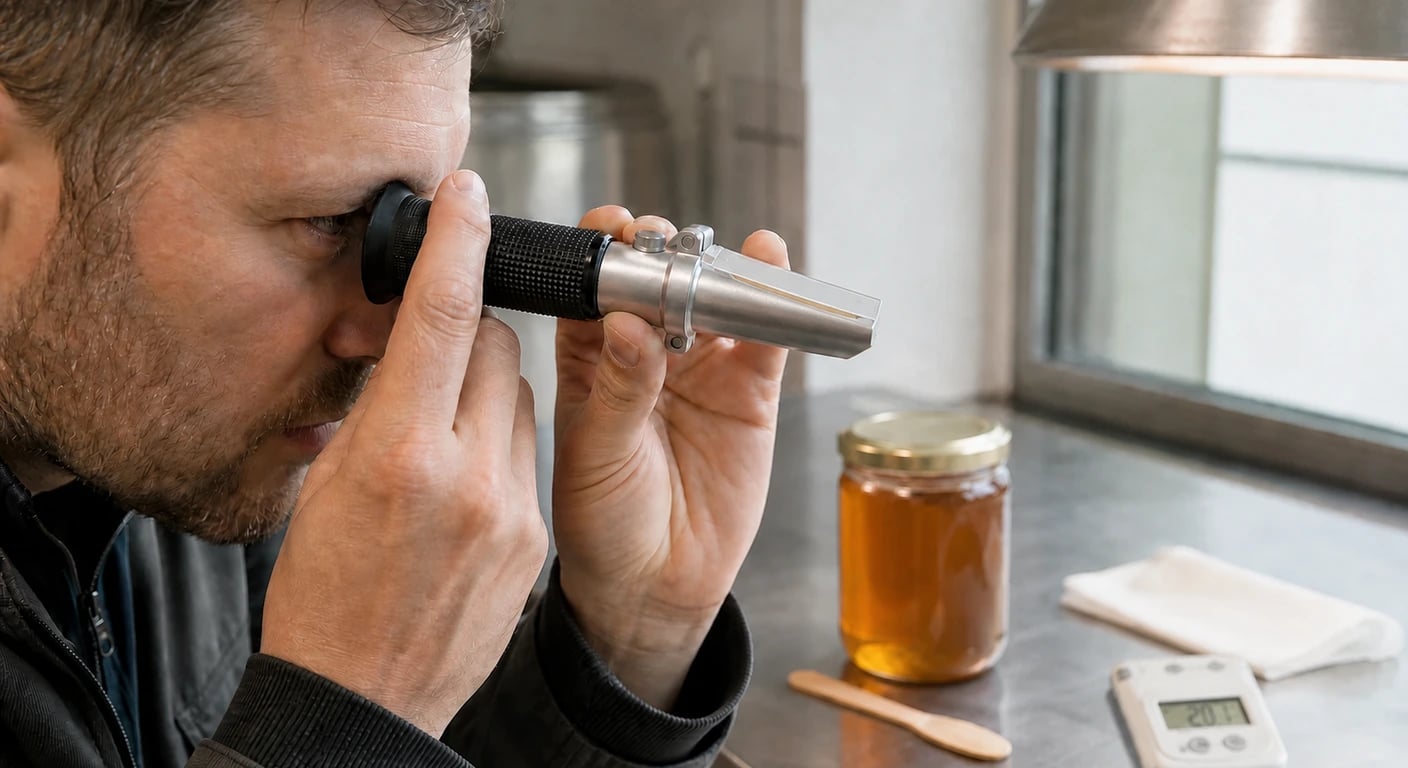
Measuring moisture: Moisture is measured with a refractometer — specifically one calibrated for honey.
How to Use a Honey Refractometer
- Clean the prism surface with distilled water and dry completely with a lint-free cloth.
- Open the cover plate and place one small drop of honey on the prism using a thin spatula.
- Close the cover plate gently and ensure the honey spreads without bubbles.
- Hold the refractometer up to a light source and look through the eyepiece.
- Read the moisture content where the line between the light and dark fields meets the scale.
- Note the temperature — a good refractometer has temperature compensation (ATC), or you apply a temperature correction factor.
Calibration: Calibrate with distilled water (should read 0° Brix or 100% water on the appropriate scale) before each use.
Important: Not all refractometers are designed for honey. A standard wine or brewing refractometer measures sugar content (Brix) rather than water content. You need a refractometer specifically scaled for honey, typically reading 12–27% moisture. They are widely available for $20–60.
When to test: Test honey in the capped comb before extraction. A standard beekeeper's trick is to shake a frame horizontally — if honey splashes out, moisture is probably too high. A refractometer reading confirms definitively.
2. HMF (Hydroxymethylfurfural)
What is HMF? Hydroxymethylfurfural is a chemical compound that forms from fructose as honey ages or is exposed to heat. It is naturally present in honey in very small amounts and increases over time even without heating.
Why it matters: High HMF indicates either:
- The honey has been overheated during processing (extraction equipment too hot, storage too warm)
- The honey is old and has degraded
- The honey may have been adulterated with industrial fructose syrup
Limits:
- Codex: Max 40 mg/kg (80 mg/kg for tropical honey)
- USDA: Max 40 mg/kg
- EU: Max 40 mg/kg (80 mg/kg for tropical honey)
Fresh honey from temperate climates typically has HMF below 5–10 mg/kg. Well-handled honey that is sold within a year of harvest rarely approaches the 40 mg/kg limit.
What raises HMF:
- Processing temperatures above 40°C (104°F)
- Long storage at warm temperatures
- Direct sunlight exposure
- Low pH (more acidic honey degrades faster)
- Old honey that has been stored for years
Practical guideline: Never heat honey above 45°C (113°F) during processing. Extract at room temperature or slightly warm (honeycomb room at 25–30°C is fine). Store processed honey in a cool, dark location.
Testing HMF at home: Precise HMF testing requires laboratory analysis (UV spectrophotometry or HPLC). Several rapid test kits exist (such as Reflectoquant strips), but for reliable results, send samples to an accredited lab.
3. Diastase Activity
Diastase (also called amylase) is an enzyme naturally present in honey that breaks down starch. It is a marker of honey freshness and whether the honey has been overheated — diastase degrades rapidly with heat and time.
The Schade Diastase Number (DN) — sometimes called the Diastase Activity (DA) — is measured in Schade units. The Codex minimum is 8 Schade units for most honeys.
Naturally low-diastase honeys (acacia/black locust, clover) may fall below 8 Schade units even when fresh and unheated. The Codex accommodates this: if the natural diastase is below 8 but HMF is below 15 mg/kg, the honey still passes. This is important for acacia producers, who should document the naturally low diastase activity of their specific floral variety.
Diastase testing requires a laboratory or specific kit chemistry.
4. Color Grading (Pfund Scale)
Honey color is measured on the Pfund scale, ranging from 1mm (water white) to over 140mm (dark amber). The color is measured using a spectrophotometer or a purpose-built Pfund grader (a device that matches the honey color against a set of reference standards).
| Pfund Value | USDA Color Grade |
|---|---|
| <9 mm | Water white |
| 9–17 mm | Extra white |
| 17–34 mm | White |
| 34–50 mm | Extra light amber |
| 50–85 mm | Light amber |
| 85–114 mm | Amber |
| >114 mm | Dark amber |
Color is not a quality criterion per se — dark honey is not inferior to light honey. However, color affects market positioning and pricing. Mild, light-colored honeys (acacia, clover) typically command higher retail prices; darker honeys (buckwheat, wildflower) have distinct flavors and their own market.
5. Fermentation and Yeast Activity
Signs of fermentation:
- Foam or bubbles forming on the surface or inside the jar
- Off-smells (sour, yeasty, alcoholic)
- Moisture reading consistently above 18.5%
- Actual taste test showing sourness or off-notes
Prevention: Extract only capped honey (or honey with less than 18% moisture). Store in sealed containers. Never add water to honey for any reason. Keep storage temperatures below 20°C (68°F) — cold storage significantly retards yeast activity even at borderline moisture levels.
Partially fermented honey cannot be saved by heating (the off-flavors remain even after the yeast is killed). It must be discarded or used as fermentation feedstock (mead, shrubs).
Adulteration Detection
Honey adulteration — the addition of cheap sugars such as corn syrup, rice syrup, beet sugar syrup, or industrial fructose — is a significant commercial problem. Several tests can detect adulteration:
C4 Sugar Test (Stable Carbon Isotope Analysis)
Bees collect nectar from plants that use C3 photosynthesis (most flowering plants). Corn and sugarcane use C4 photosynthesis and have a distinct carbon isotope ratio. Adding corn syrup or cane sugar to honey shifts the isotope ratio in a measurable way.
The C4 test is performed by USDA-accredited labs and is one of the most reliable adulteration screens for corn- and cane-based adulterants.
Limitation: Rice syrup (a common adulterant) is also C3, making it invisible to C4 testing.
NMR (Nuclear Magnetic Resonance) Analysis
NMR is the state-of-the-art method for comprehensive honey authenticity testing. A full NMR profile identifies the detailed chemical fingerprint of honey — including sugar ratios, amino acid profiles, and other biomarkers — and compares it against a large database of authentic honey samples.
NMR can detect adulteration with C3 sugars (including rice syrup), identify botanical and geographic origin, and flag fermented or overheated honey. It is expensive ($50–200 per sample) but is increasingly required by large buyers and retailers as a condition of purchase.
LMRS / SIRA / DNA Testing
Various other methods (Liquid Chromatography, Stable Isotope Ratio Analysis, pollen DNA testing) are used in combination to build a complete picture of honey authenticity. For small producers selling directly to consumers, these are unlikely to be required. For producers supplying retailers, co-ops, or export markets, at least an NMR screen is increasingly expected.
Quality Standards Comparison Table
| Parameter | Codex | US Grade A | EU Standard | Notes |
|---|---|---|---|---|
| Moisture | Max 20% | Max 18.6% | Max 20% | US Grade A is strictest |
| HMF | 40 mg/kg | 40 mg/kg | 40 mg/kg | 80 mg/kg for tropical honey |
| Diastase | Min 8 Schade | Not specified | Min 8 Schade | Exception for low-diastase varieties |
| Sucrose | Max 5% | Not specified | Max 5% | Higher for some varieties |
| Color | Not specified | Pfund graded | Not specified | Voluntary in most markets |
| Adulteration | Prohibited | Prohibited | Prohibited | No method specified in standard |
When to Use a Laboratory
For most small-scale beekeepers selling directly to consumers, a good refractometer and careful processing practice is sufficient. As your operation grows or you target commercial buyers, lab testing becomes increasingly important:
| Situation | Recommended Test | Frequency |
|---|---|---|
| Farmers market / direct sale | Moisture (refractometer) | Every batch |
| Retail / store placement | Moisture + HMF | Annually per floral type |
| Co-op / bulk buyer | Moisture + HMF + Diastase | Per batch |
| Export or premium retailer | Full NMR or C4+LMRS | Per batch |
| Suspected adulteration | NMR or C4 isotope test | As needed |
Finding a lab: The USDA Agricultural Marketing Service (AMS) laboratory, the National Honey Board, and numerous private food testing labs (such as SGS, Eurofins, and Michigan State's Diagnostic Lab) offer honey testing services. Many state university extension programs also offer reduced-cost testing for small producers.
Crystallization: Not a Defect
One of the most common misconceptions about honey quality is that crystallization indicates poor quality or adulteration. This is incorrect.
Crystallization is a natural process that occurs in all genuine honey. The rate of crystallization depends on the glucose-to-fructose ratio, water content, temperature, and the presence of seed crystals (fine particles that nucleate crystal formation). High-glucose honeys (clover, canola/rapeseed) crystallize quickly; high-fructose honeys (black locust/acacia, tupelo) may remain liquid for years.
Crystallized honey is entirely safe and of full quality. It can be gently reliquified by warming in a water bath at no more than 40°C (104°F) — ideally lower to preserve enzymes and minimize HMF development.
Fine-grain crystallization (smooth, creamy texture) is actually considered desirable in many markets and is achieved through controlled seeding and temperature management. This is sold as "creamed honey" or "whipped honey."
Conclusion: Build Quality In from the Start with Hivekraft
Honey quality begins in the field and ends with how you store and handle your product. The most important decisions — when to extract, whether to feed, what the moisture level is before capping — happen at the colony level, not in the processing room.
Hivekraft lets you log moisture readings alongside every extraction event in the harvest management and associate quality data with specific colonies, apiaries, and floral sources. The batch number can be printed on the jar via QR code using the label function, enabling full traceability. Over time, you will identify which colonies consistently produce honey below 17% moisture, which locations produce your lightest-colored honey, and whether your fall feeding is affecting moisture levels in late-season production.
Quality is not something you test into existence — it is something you manage from the hive outward. The refractometer is just your first confirmation that the work was done right.
Track harvests, print labels, market your honey.
Hivekraft is free for up to 10 hives. Register in 30 seconds.