 AI-generated
QR Codes on Honey Jars: Modern Honey Marketing
With a QR code on your honey jar, you strengthen customer loyalty and transparency. A guide for content, design, and technical implementation.
The regulations described in this article apply to Germany and the EU. Labeling rules may differ in other countries and regions.
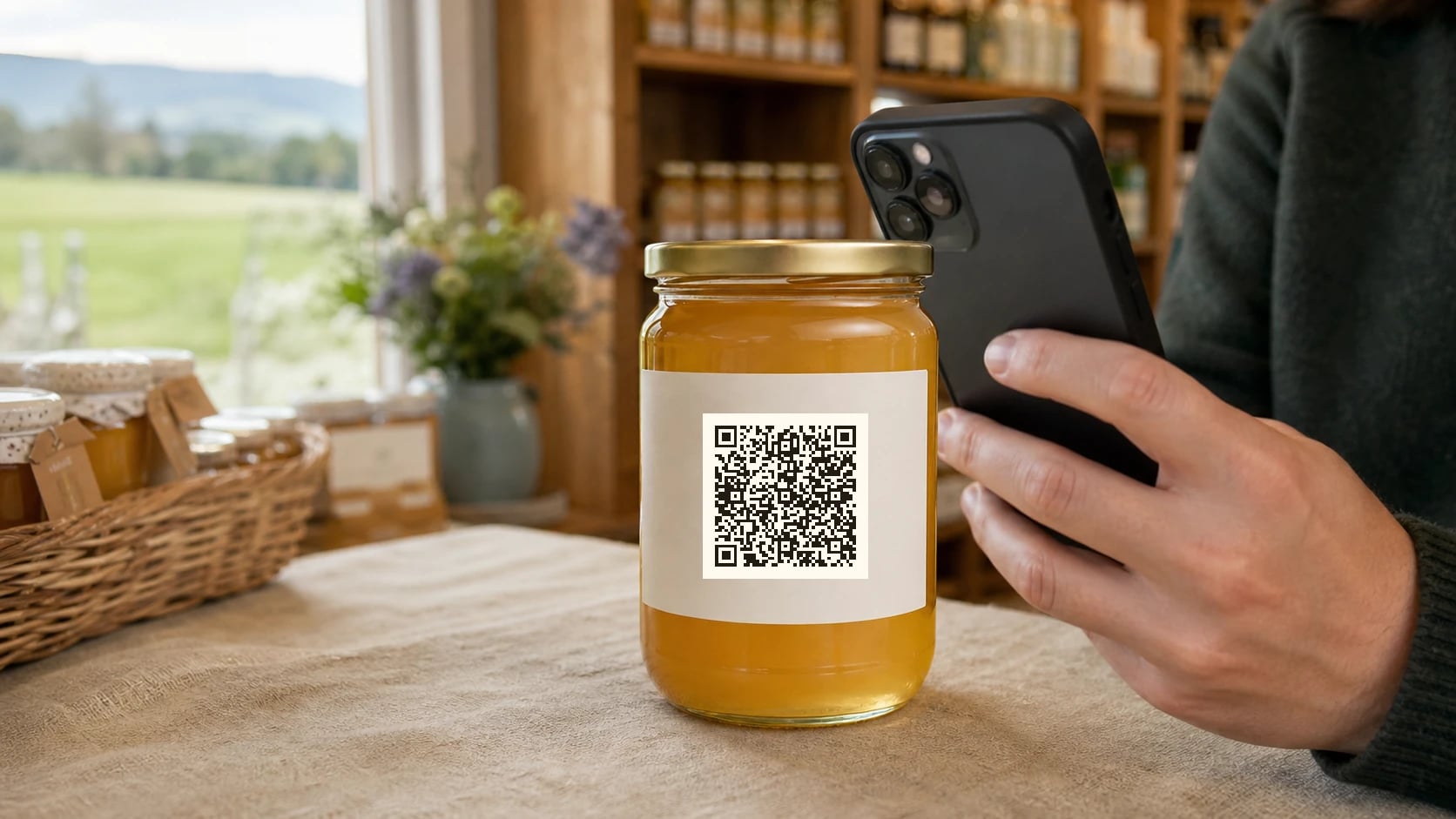
A small square on the label can make all the difference: the QR code connects your honey jar to the digital world. Customers scan it, learn everything about origin and quality — and you stand out from the competition. In this article, we show you what content belongs on the QR code landing page, how to implement it technically, and why transparency is your strongest selling point.
Why QR Codes on Honey?
Consumers today want to know where their food comes from. With honey, this is especially pronounced: regional honey is consciously purchased because buyers want to know the beekeeper and the origin. A QR code turns this transparency into an experience.
Many smartphone cameras can read QR codes directly. Whether customers actually scan one still depends on the audience, placement, and a clear benefit. State exactly what the scan opens instead of assuming a general scan rate.
The Benefits at a Glance
For you as a beekeeper:
- Free, measurable advertising with every jar sold
- Professional appearance that builds trust
- Traceability for inquiries or complaints
- Repeat purchase incentive through direct contact
For your customers:
- Transparency: Where exactly does my honey come from?
- Trust: Who is the beekeeper behind the product?
- Knowledge: Which blossoms, which location, which season?
- Contact: Direct reorder option
What Belongs on the QR Code Landing Page?
The landing page is the centerpiece. When a customer scans the code, they need to understand what they're looking at within 10 seconds. At the same time, the page should spark curiosity and build trust.
- 1
Batch information
The basics: a batch reference, honey variety, harvest or bottling date, and voluntary quality information. Statutory particulars must still appear in full on the physical label; the QR code only adds context.
- 2
Origin and location
Where were the bees? Show the approximate location on a map (not the exact GPS position, for security reasons). Describe the forage: "This honey comes from our apiary at the forest edge near Freising. The main forage consisted of linden, raspberry, and forest blossoms."
- 3
Your beekeeper profile
Introduce yourself briefly: name, how long you've been beekeeping, number of colonies, your philosophy. A photo of you at the apiary makes the connection personal. Customers don't just buy honey — they buy a story.
- 4
Quality data
Water content, enzyme activity (invertase), HMF value — if you know these values, show them. This signals professionalism and sets you apart from discount honey where such information is missing.
- 5
Contact and reordering
Make it easy to reach you: email, phone, farm shop address, social media links. Anyone who has good honey will be asked for more — the QR code is your shortest path to a reorder.
Design Tips for QR Codes on Labels
Size and Placement
There is no universal minimum size: it depends on factors such as URL length, error correction, print quality, surface, and scanning distance. Size it generously, print a prototype, and test it with several devices. Place it so that:
- It doesn't run over a curve of the jar (choose the flattest spot on round jars)
- There is sufficient contrast to the background (black on white or dark on light)
- It has a clear quiet zone of at least four QR modules on every side (no text or graphics in that area)
With or Without a Call-to-Action?
A QR code alone does not explain its destination. A short, specific call to action makes the benefit clear:
| Variant | Assessment |
|---|---|
| QR code without text | Destination and benefit remain unclear |
| QR code + 'Learn more' | Brief but generic context |
| QR code + 'Where does my honey come from?' | The benefit is clear before scanning |
| QR code + additional graphics | Useful only if contrast and the quiet zone remain unobstructed |
Color and Design
QR codes don't have to be black and white. They can be designed in your brand colors, as long as the contrast remains high enough. Avoid:
- Light colors on a light background
- Gradients within the code
- Elements that are too small or too much information (shorter URLs = simpler codes)
A QR code with a short permanent URL such as hivekraft.com/honig/abc123 needs fewer modules than a long link with many parameters. That makes robust printing easier, but you should still test the finished label.
Technical Implementation: Your Options
Option 1: Manual Creation
You create the QR code with a free online generator and manually add it to your label design. You build the landing page yourself — as a simple HTML page, social media profile, or Google Sites page.
Advantage: No cost. Disadvantage: Every batch needs a new code, a new page. With 10 batches per year, this gets tedious.
Option 2: Beekeeping Software with Integrated Solution
Specialized software like Hivekraft automatically generates the QR code from your harvest and bottling data. The landing page is assembled from existing data — you don't need to maintain anything extra.
The workflow in Hivekraft:
- Record harvest: Date, location, honey variety, weight, water content
- Create bottling: Batch number, jar size, quantity, assigned harvest(s)
- Generate QR code: One click — the code links to a public honey page
- Create label: Combine the QR code with mandatory information in the label generator
- Print: Download PDF, print on label paper, stick on jars
Advantage: Everything from one source, data is reused, no double maintenance. Disadvantage: You're tied to a platform (but export is always possible).
Option 3: Own Website + Dynamic QR Codes
For tech-savvy beekeepers: you build your own website with dynamic subpages per batch. Dynamic QR codes (via services like QR.io or Beaconstac) allow you to change the target URL afterward — useful if the page changes or you switch providers.
Advantage: Full control over design and content. Disadvantage: Technical know-how required, ongoing costs for QR code service.
Real-World Example: Honey Marketing at the Farmers' Market
Imagine: it's Saturday morning at the farmers' market. A customer picks up a jar of summer blossom honey and asks: "Where does this honey come from?" You say: "Scan the QR code." The customer scans — and sees the location on the map, your photo, the water content of 16.8%, the bottling date, the forage description.
What happens:
- The customer is impressed: "I've never seen anything like this with honey!"
- They buy not one jar but two — one to give as a gift
- They scan the code again at home and show it to their family
- Three weeks later, they come back: "Do you still have forest honey?"
Transparency is the strongest argument for regional honey. When consumers can trace where their honey comes from, who harvested it, and what quality values it has, it creates a trust that no marketing budget in the world can replace.
Legal Aspects
Mandatory Information on the Label
The QR code does not replace the legally required mandatory information on the physical label. These remain obligatory:
- Product designation ("Blossom honey," "Forest honey," etc.)
- Net fill quantity
- Best-before date
- Name and address of the person placing it on the market
- Lot identification (batch number)
- Country of origin
The QR code is a supplement that voluntarily offers the customer more information.
New EU Honey Directive from June 2026
From June 14, 2026, EU Directive 2024/1438 on honey labeling takes effect. The most important change: for honey blends, all countries of origin must be listed in descending order with percentage on the label. The previous designation "Blend of EU and non-EU honeys" is eliminated.
For regional beekeepers, this is an opportunity: your honey comes 100% from your country, from a specific region, from a specific location. The QR code makes this origin tangible — while industrial honey must now disclose its country-of-origin mix, you show the meadow, the forest edge, the linden tree.
The new EU directive primarily affects packagers of blended honeys. As a beekeeper with your own honey, you already meet the origin requirement with your address and country of origin. The QR code goes beyond this and turns your transparency into a marketing advantage.
Data Protection (GDPR)
If you collect personal data on the landing page (e.g., email for reordering), you need a privacy policy. If you only display information and don't collect data, it's unproblematic.
Avoid invasive tracking (Google Analytics, Facebook Pixel) on your honey landing page. Your customers trust you — don't betray that trust with data collection. A simple visitor counter (cookieless, GDPR-compliant) is enough to see how many people scan.
Advanced Ideas: Storytelling via QR Code
Seasonal Updates
Change the landing page throughout the year: in spring, show pictures of the orchard blossom; in summer, the linden; in fall, the feeding. Customers who scan the code multiple times experience the season along with you.
Embed Video
A 30-second video of the honey harvest or the apiary brings the origin to life. You don't need professional equipment — a smartphone video in good lighting is perfectly fine.
Recipe Suggestions
Matching the honey variety: linden blossom honey in tea, acacia honey in salad dressing, forest honey with cheese. A simple recipe on the landing page gives the customer a usage suggestion and increases appreciation.
Customer Reviews
If you're bold: let customers leave a short review on the landing page. "Best honey I've ever had!" — that's free advertising for the next jar.
Costs and Effort
| Solution | One-time Cost | Ongoing Costs | Time per Batch |
|---|---|---|---|
| Online generator + own page | 0 € | 0–10 €/month (hosting) | 20–30 minutes |
| Hivekraft (integrated) | 0 € (in plan) | 0 € (basic) / 5 €/month (Pro) | 2–3 minutes |
| Dynamic QR codes (service) | 0–50 € | 5–15 €/month | 10–15 minutes |
| Graphic designer + printer | 100–500 € | Varies | 1–2 hours (coordination) |
For most hobbyist beekeepers, the integrated solution of beekeeping software is the best compromise of effort and results. The data is already there (harvests, batches), and the QR code is generated automatically.
Step by Step: Your First QR Code Label
Checklist for your first QR code label
Conclusion: Small Code, Big Impact
A QR code on the honey jar costs nothing, takes up little space, and offers enormous value — for you and your customers. It makes transparency visible, professionalism tangible, and reordering easy. In a time when consumers question the origin of their food, the QR code is no longer a nice-to-have — it's a competitive advantage.
Start with a simple landing page and one code per batch. You'll be surprised how many customers scan — and how conversations at the farmers' market suddenly gain a whole new depth.
The QR code and label feature of Hivekraft makes getting started especially easy: record harvest, create bottling, generate code — done. Try it in the demo and see what a public honey page looks like.
Honey Quality Testing: HMF, Water Content, and Lab Analysis Extracting Honey Properly: Tips for Best Quality Honey Labeling: What Must Be on Every Label Marketing Honey: From Jar to Customer- Digital Beekeeping with Hivekraft -- Lesson 5: QR codes for transparency
- Honey Business -- Lesson 9: Brand building
Track harvests, print labels, market your honey.
Hivekraft is free for up to 10 hives. Register in 30 seconds.