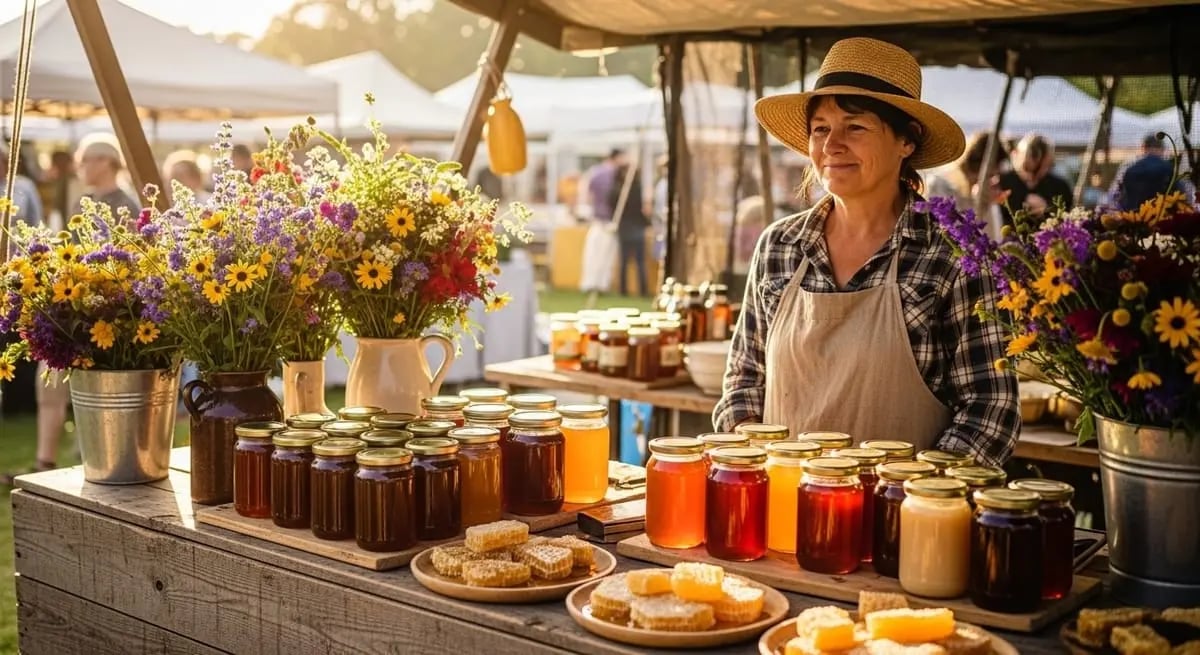
Marketing Honey - From Jar to Customer
Successfully selling your own honey. Labeling, pricing, sales channels and legal requirements for hobby and sideline beekeepers.
You have extracted, filtered, and bottled - now you want to get your honey to the people. Honey marketing is more than a sign on the garden gate. With the right strategy, you not only sell your honey but build a loyal customer base - and can cover the costs of your beekeeping or even earn an attractive side income.
Note: The legal requirements, tax rules, and market prices described in this article are specific to Germany. If you are selling honey in another country, please check your local food safety, labeling, and tax regulations.
Legal Foundations
What You Need to Consider
Before you sell the first jar, the legal framework must be in place:
- Honey Regulation (HonigV): Governs quality standards, moisture content (max. 20%), designation, and origin labeling
- Food Information Regulation (LMIV, EU 1169/2011): Mandatory information on the label, allergen labeling
- Packaging Act (VerpackG): Registration requirement in the LUCID register and system participation for single-use packaging (exception: deposit jars are exempt)
- Trade law: Beekeeping as primary agricultural production is not subject to trade registration as long as you mainly sell your own products. A trade registration only becomes necessary with significant purchased goods or commercial further processing (e.g., own cosmetics production). There is no fixed percentage threshold - the overall assessment by the tax office is decisive
- Tax office: Income is taxable - for up to 30 colonies, the tax office sets the profit flat at 0 EUR
- Food Hygiene Regulation: Clean processing and storage
Anyone who sells honey - even in small quantities - must register their extraction room with the responsible food safety authority (public order office or veterinary office). This is free and straightforward, but mandatory. Inspection without registration can result in a fine.
Mandatory Label Information
Every honey jar must carry the following information:
| Information | Example | Regulation |
|---|---|---|
| Designation | "Blossom honey" or "Forest honey" | HonigV |
| Net weight | 500 g, 250 g | FertigPackV |
| Best before date | "best before: 12/2028" | LMIV |
| Name and address | Max Mustermann, Musterstr. 1, 12345 Musterstadt | LMIV |
| Country of origin | "Country of origin: Germany" | HonigV |
| Lot number | "L 2026-05" (or BBD as lot identifier) | LMIV |
| Nutrition table | Energy, sugar etc. | LMIV (for pure honey not required - exemption under Annex V) |
DIB Jar or Custom Design?
The German Beekeepers' Association (DIB) offers the well-known honey jar with the green label:
| Criterion | DIB Jar | Custom Design |
|---|---|---|
| Brand recognition | Very high (nationally known) | Must be built up |
| Customer trust | Immediate (DIB seal) | Build through quality |
| Label cost | ~0.15 EUR/piece | 0.20-0.80 EUR/piece |
| Jar cost | 0.70-0.90 EUR | 0.40-1.50 EUR |
| Pricing flexibility | Limited (market price) | Higher prices possible |
| Quality requirement | Max. 18% moisture | Max. 20% (HonigV) |
| Branding | No own brand | Full freedom |
| QR code possible | Only as additional label | Integrated in design |
Pricing
What Is Your Honey Worth?
Many hobby beekeepers sell their honey too cheaply. An honest calculation:
| Cost Factor | Per 500g Jar |
|---|---|
| Jar + lid | 0.50-0.80 EUR |
| Label | 0.15-0.40 EUR |
| Processing (labor) | 1.00-2.00 EUR |
| Proportional operating costs | 0.50-1.00 EUR |
| Feed, treatment, materials | 0.50-1.00 EUR |
| Total costs | 2.65-5.20 EUR |
Market Prices 2025/2026
- Blossom honey (conventional): 6-8 EUR / 500g
- Varietal honey (linden, acacia): 8-12 EUR / 500g
- Organic honey: 10-15 EUR / 500g
- Premium/Regional: 8-14 EUR / 500g
- Direct sales: 7-12 EUR / 500g (average)
Rule of thumb: Under 7 EUR/500g, the effort is barely worthwhile. Regionality and quality justify higher prices.
Sales Channels in Detail
1. Direct Sales (from Home)
The classic route and often the most profitable:
- Sign at the house/garden
- Self-service stand with honor box
- Regular customers through word of mouth
- Advantage: No commission, direct customer contact
2. Farmers' Markets
Ideal for winning new customers:
- Stand fee: 10-30 EUR per market day
- Offer tastings (flavor sells!)
- Present multiple varieties
- Highlight seasonal specialties
3. Regional Retail
- Farm shops and organic stores
- Health food stores and delicatessens
- Bakeries and cafes
- Typical commission: 20-30% or fixed-price purchase agreement
4. Online Sales
For greater reach:
- Own webshop (Shopify, WooCommerce)
- Regional platforms (local food networks)
- Social media (Instagram, Facebook Marketplace)
- Caution: Factor in shipping costs and breakage risk
5. Corporate and Events
An often overlooked channel with high margins:
- Corporate gifts: Honey with custom labels
- Weddings: Honey as wedding favors
- Christmas markets: Seasonal business with high margins
- Hotels and restaurants: Breakfast honey in small portions
Storytelling - Customers Buy Stories
Customers do not just buy honey - they buy a story. Those who tell why their honey is special sell more and can charge higher prices.
Quality Assurance
Storage
- Cool and dark storage (15-18 degrees Celsius)
- Prefer glass containers (no plastic)
- BBD: 2 years from bottling (with proper storage)
- Moisture content under 18% for optimal shelf life
Traceability
Traceability is becoming increasingly important - for customers and authorities:
- Batch number on every jar
- Extraction date and location documented — the harvest feature in Hivekraft links each batch to the colony
- Moisture content measured and noted
- QR code on the label for digital transparency
A QR code on the label is more than a gimmick. Your customers scan the code and learn everything about the honey - location, extraction date, variety, and even the hives from which the honey came. This transparency builds trust and justifies higher prices. With the label feature in Hivekraft, you create these QR code labels with just a few clicks.
Tax Aspects
For Hobby Beekeepers (up to ~30 Colonies)
- Flat-rate taxation: For up to 30 colonies, the tax office sets the profit flat at 0 EUR - no income tax on honey sales
- Agriculture and forestry: VAT flat-rate possible (Section 24 UStG, currently 7.8% since 2025)
- No trade registration needed for direct marketing of own products
For Sideline Beekeepers (30+ Colonies)
- Income from agriculture and forestry (Appendix L of the tax return)
- Small business regulation (Section 19 UStG): No VAT at max. 25,000 EUR previous year revenue and max. 100,000 EUR in the current year (new thresholds since Jan 1, 2025)
Summary
Successful honey marketing rests on three pillars:
- Quality: Clean processing, low moisture content, proper storage
- Presentation: Professional labels, appealing design, good story
- Sales: The right channels for your quantity and region
Start with direct sales and word of mouth, expand gradually. And do not forget: Your honey is a premium regional product - the price should reflect that.
Read also: Honey Labeling - What Must Be on Every Label Quality starts here: How to Extract Honey Properly Modern marketing: QR Code on the Honey Jar - Modern Honey MarketingSuccessfully selling honey takes more than a good product:
- Building a Honey Business -- 10 lessons from quality management to scaling
- Digital Beekeeping with Hivekraft -- Lesson 5: QR codes for transparent marketing
- Law and Compliance for Beekeepers -- Lesson 3: Food labeling and hygiene regulations
Track harvests, print labels, market your honey.
Hivekraft is free for up to 10 hives. Register in 30 seconds.