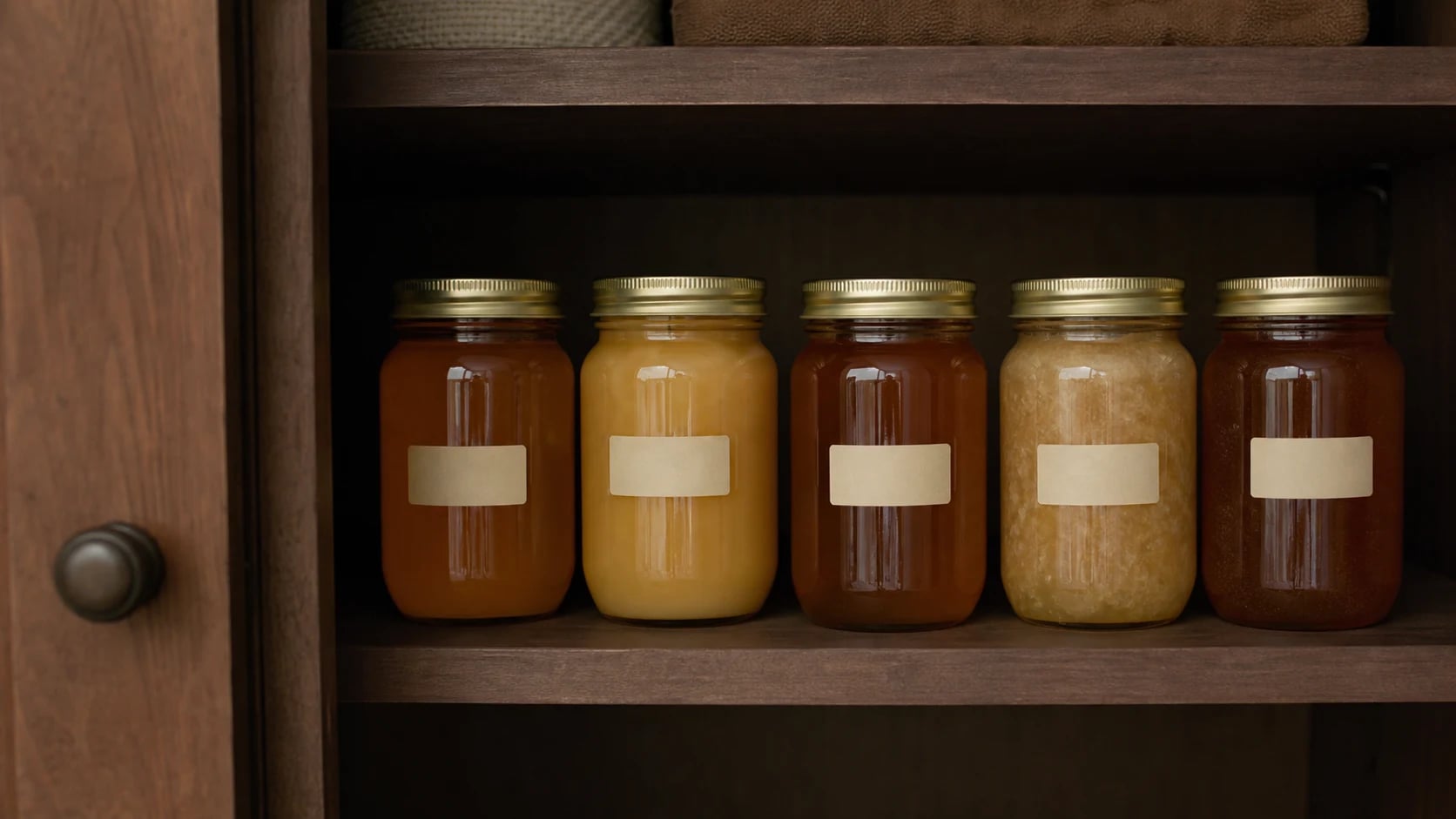
 AI-generated
Storing Honey Correctly — Tips for Hobby Beekeepers
Cool, dark, dry — storing honey correctly sounds simple, but the details determine quality and shelf life. Here is how to store your honey optimally.
You have extracted, strained, and bottled your honey — now what? Storage is the final step that determines your honey's quality. Improperly stored, even the best honey loses its enzymes, flavour, and value. Properly stored, it remains a premium food for years. In this article you will learn what truly matters when storing honey — practical, scientifically grounded, and without unnecessary alarm.
Why Storage Matters
Honey is a living food product. It contains enzymes (invertase, diastase, glucose oxidase), amino acids, vitamins, and aroma compounds, all of which are sensitive to external influences. The three greatest enemies of honey:
- Heat — accelerates enzyme degradation and the formation of hydroxymethylfurfural (HMF)
- Light — UV radiation breaks down enzymes and alters the flavour
- Moisture — honey is hygroscopic and absorbs water from the air, which can lead to fermentation
The Right Temperature: The Most Important Factor
Temperature has the greatest impact on honey quality during storage. The relationships are well researched:
Temperature and HMF Levels
The HMF level (hydroxymethylfurfural) is the most important indicator of heat damage in honey. It rises with increasing temperature and storage duration — and never drops back:
| Storage Temperature | HMF Increase per Month | Shelf Life (DIB limit 15 mg/kg) |
|---|---|---|
| 10 °C | approx. 0.1 mg/kg | over 10 years |
| 15 °C | approx. 0.3 mg/kg | approx. 4 years |
| 20 °C | approx. 0.8 mg/kg | approx. 1.5 years |
| 25 °C | approx. 2.0 mg/kg | approx. 7 months |
| 30 °C | approx. 4.5 mg/kg | approx. 3 months |
The values are guidelines and depend on the pH and water content of the specific honey. The key takeaway: every degree matters. Honey stored at 25 degrees for a year has lost its quality certification. The same honey at 15 degrees would retain premium quality for years.
Above 40 degrees Celsius, enzymes are irreversibly destroyed. This applies not only to storage but also to warming honey for bottling or creaming. Once damaged, the damage is permanent — there is no going back. Avoid proximity to radiators, direct sunlight on storage shelves, and hot water baths.
The DIB (Deutscher Imkerbund) quality standard of maximum 15 mg/kg HMF is a German industry benchmark, stricter than the EU Honey Directive limit of 40 mg/kg. If you sell in markets outside Germany, check the applicable standard in your country. The Codex Alimentarius standard is 40 mg/kg (80 mg/kg for tropical honeys).
Temperature and Crystallisation
Honey crystallisation is a natural process and not a quality defect. It depends primarily on the glucose-to-fructose ratio but is influenced by temperature:
- Below 10 °C: Crystallisation is greatly slowed (molecules too immobile)
- 10–15 °C: Optimal crystallisation temperature (ideal molecular mobility)
- Above 25 °C: Crystallisation is slowed (too much energy, crystals partially dissolve)
- Above 40 °C: Crystals dissolve — but enzymes are destroyed
For creamed honey, controlled crystallisation at 14–16 degrees is desired. For liquid honeys (e.g. acacia, forest honey), storage at 10–12 degrees is optimal to preserve fluidity as long as possible.
Where to Store? Practical Tips
- Ideal: Cellar (10–15 degrees, dark, dry)
- Good: Pantry, unheated utility room
- Acceptable: Kitchen — but not near the stove or in the sun
- Poor: Attic (heat in summer), garage (temperature fluctuations, odours)
- Unacceptable: Windowsill (sun!), next to a radiator, in a car
Light Protection: Darker Is Better
UV light breaks down enzymes and vitamins in honey. The effect is gradual but measurable:
- Direct sunlight: Destroys invertase within a few weeks
- Indirect daylight: Slower degradation, but significant over months
- Artificial light: Low impact, though LED is better than fluorescent tubes (less UV)
Practical Implications
- Always store honey in dark or opaque containers
- Amber glass or ceramic offers better protection than clear glass
- Clear glass is fine for retail sales — but the honey should not sit for months under fluorescent lighting
- Use storage boxes or dark shelving
Traditional beekeeping association jars (such as the German DIB jar) are clear glass with a green cap — designed for retail so customers can see the honey. For long-term storage, however, amber or brown glass is superior because it filters UV light. If you store larger quantities, opaque honey pails or amber glass work best.
The Right Containers: Glass, Plastic, or Stainless Steel?
Glass
- Advantages: Flavour-neutral, no chemical interaction, recyclable, premium appearance for sales
- Disadvantages: Heavy, breakable, no UV protection with clear glass
- Recommendation: The best choice for bottling and retail. Always seal with a lid.
Food-Grade Plastic (PP or HDPE)
- Advantages: Light, shatter-proof, affordable, stackable (honey pails)
- Disadvantages: Can cause minimal flavour changes over very long storage; sensitive to UV
- Recommendation: Ideal for intermediate storage and transport. Only use containers with food safety certification.
Stainless Steel
- Advantages: Robust, flavour-neutral, light-proof, long-lasting
- Disadvantages: Expensive, heavy, not transparent
- Recommendation: Ideal for large quantities (storage tanks, bottling vessels). Standard in beekeeping for extractors and settling tanks.
What to Avoid
- Aluminium: Reacts with the acids in honey — do not use
- Non-food-grade plastic: Plasticisers can leach into the honey
- Open containers: Honey absorbs moisture and odours
Moisture: The Silent Quality Killer
Honey is strongly hygroscopic — it absorbs water from the surrounding air. Above a water content of 20 percent, osmotolerant yeasts (naturally present in every honey) begin to ferment. The result: a foamy surface, slightly alcoholic smell, and spoiled honey.
Rules for Practice
- Keep containers sealed at all times — including between bottling sessions
- Humidity in the storage room: Below 60 percent
- Cellar caveat: Many cellars are damp. A hygrometer (from around 10 euros/dollars) shows whether the cellar is suitable
- Spoon hygiene: Never dip a wet or used spoon into honey — moisture and contaminants accelerate spoilage
Understanding and Managing Crystallisation
Nearly every honey crystallises sooner or later. This is natural and not a sign of poor quality — on the contrary, it proves the honey has not been heat-treated.
Why Does Honey Crystallise?
Honey is a supersaturated sugar solution. Glucose (dextrose) is less soluble than fructose. When the glucose content is high, it precipitates as crystals:
- Fast crystallising: Rapeseed honey, dandelion honey, sunflower honey (high glucose content)
- Slow crystallising: Acacia honey, forest honey, chestnut honey (high fructose content)
- Medium speed: Wildflower blend, linden honey
Making Crystallised Honey Liquid Again
If you want to re-liquefy crystallised honey:
- Place the jar in a water bath (maximum 40 degrees — use a thermometer!)
- Be patient: At 35–40 degrees it takes 30–60 minutes depending on quantity
- Stir regularly to speed up the process
- Never use a microwave — uncontrollable heat destroys enzymes instantly
- After liquefying, use promptly — the honey will crystallise faster next time
Preventing Phase Separation
In some honeys, a liquid layer separates on top (fructose-rich portion) and a solid layer settles below (glucose-rich portion) after extended storage. While safe to consume, it looks unappealing and may concern customers.
Prevention: Store honey at a stable temperature (no fluctuations), bottle promptly after creaming, and visually check the honey at room temperature before selling.
Shelf Life: How Long Does Honey Keep?
Honey has no true expiration date. Archaeological finds show that honey can still be edible after millennia (tomb offerings in ancient Egypt). In practice, however, economic and quality limits apply:
Best-Before Date (BBD)
- EU law: A best-before date is required under the EU Food Information Regulation (EU No. 1169/2011)
- Common practice: 2 years from bottling
- Industry recommendation: 2 years (with strict quality standards)
- Reality: With proper storage (below 15 degrees, dark), actual shelf life far exceeds the stated BBD
The BBD is not an expiration date but a quality guarantee. After it passes, the honey is not spoiled, but changes (HMF increase, enzyme degradation, crystallisation) can no longer be ruled out.
In the EU, a best-before date is mandatory for honey. In the US, the FDA does not require a BBD for honey. In the UK, the Food Standards Agency requires a BBD or "best before end" date. Always check the regulations in your country.
Signs That Honey Is No Longer Optimal
- Fermentation: Foam on the surface, slightly sour or alcoholic smell. Cause: water content was too high or the container was not airtight
- Significant darkening: Normal colour change over long storage, but a sign of advanced HMF buildup
- Off-odours: Honey has absorbed ambient smells (cellar, cleaning products, spices)
Slightly fermented honey is not dangerous but unsuitable for retail. Use it for baking (yeasts are killed above 40 degrees) or for mead brewing — for mead, an initial fermentation is actually helpful.
Storing Large Quantities: Tips for the Season
Beekeepers with many colonies quickly face the question: where to put 100+ kg of honey? Some practical tips:
- Honey pails (12.5 kg or 25 kg): Food-grade pails with lids, stackable. Ideal for intermediate storage before bottling.
- Plan bottling sessions: Do not bottle everything at once. Bottle in batches when the honey has the right consistency (liquid) or after creaming.
- Separate batches: Store different nectar sources and extraction dates separately. This allows varietal bottling later.
- Label pails: Date, nectar source, apiary, water content, quantity. Sounds obvious — but is often forgotten.
With the Bottling module in Hivekraft you can link each batch to the extraction date, the apiary, and the colonies. This gives you full traceability — even months later when you are bottling the third pail of summer harvest.
Storage for Retail: What You Must Consider
If you sell honey, additional obligations apply:
- Labelling: BBD, net weight, country of origin, lot/batch number (details in the article on honey labelling requirements)
- Retailer storage conditions: You cannot control how a retailer stores your honey. Point out storage instructions (sticker: "Store in a cool, dark place").
- Market sales: Do not leave honey in the sun for hours. Use a canopy or choose a shaded spot.
Summary: The Golden Rules
Honey Storage — The Golden Rules
Conclusion
Storing honey correctly is not rocket science, but the details make the difference. If you keep temperature, light, and moisture under control, you preserve the quality of your honey for years. And if you document your batches properly, you will still know which honey came from which pail months later — saving time and preventing unpleasant surprises.
- Honey Business Course — 10 Lessons from Harvest to Marketing
- Law and Compliance for Beekeepers — Lesson 3: Food Labelling and Hygiene Regulations
Track harvests, print labels, market your honey.
Hivekraft is free for up to 10 hives. Register in 30 seconds.