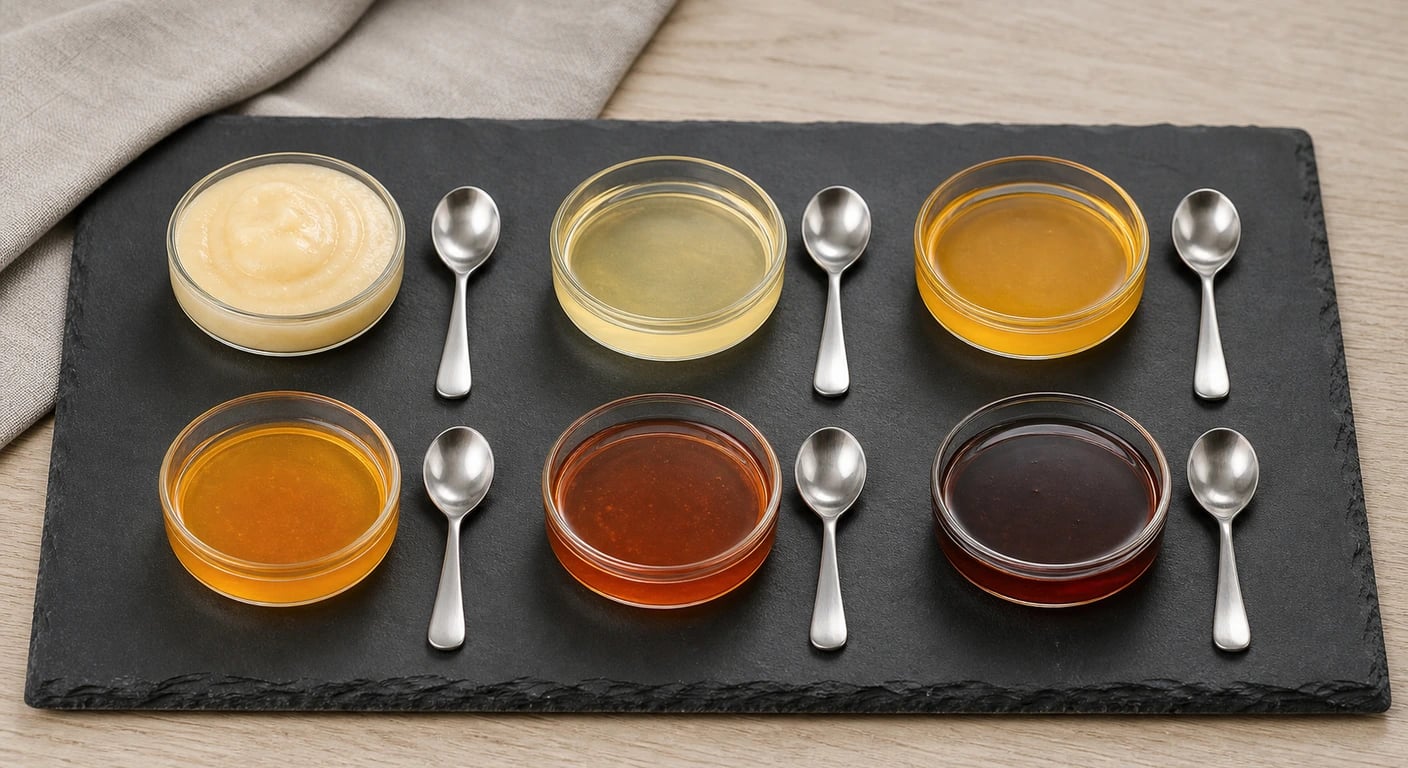
Honey Varieties in Germany: From Rapeseed to Forest Honey
Germany offers an impressive variety of honey types. From creamy rapeseed honey to aromatic fir and forest honey: learn what makes each variety unique, when they are harvested, and what the DIB jar means.
This article focuses on honey varieties found in Germany. While many of these honeys are available worldwide, the specific variety names, quality standards (DIB), and legal requirements (HonigV) described here apply to the German market. Equivalent quality standards and labeling regulations exist in other countries.
Germany offers a wide range of honey varieties — each with its own story, flavor, and characteristics. Whether you harvest honey, sell it, or simply want to understand it better, knowing the key varieties is essential. This article gives you a comprehensive overview.
Blossom Honey vs. Honeydew Honey: The Key Distinction
Before diving into individual varieties, an important fundamental distinction:
Blossom Honey
Blossom honey is made from nectar that bees collect from plant flowers. Nectar is a sugar-rich liquid that plants produce specifically to attract pollinators. Bees collect it with their proboscis, transport it in their honey stomach, and process it into honey in the hive.
Typical characteristics:
- Sweet, often floral to fruity in aroma
- Usually crystallizes faster than honeydew honey
- Lighter color (depending on the nectar source)
- Electrical conductivity below 0.8 mS/cm (per German Honey Ordinance)
Honeydew Honey
Honeydew honey is made from honeydew — an excretion product of aphids, scale insects, and other sap-sucking insects. These insects extract plant sap from needles or leaves and excrete a sugar-rich liquid that bees collect.
Typical characteristics:
- Spicy, malty, sometimes slightly bitter
- Crystallizes much more slowly than blossom honey
- Darker color (amber to blackish-brown)
- Higher electrical conductivity (> 0.8 mS/cm)
- Key varieties: forest honey, fir honey, spruce honey
The Most Important German Honey Varieties in Detail
Rapeseed Honey
Rapeseed honey is by far the most produced honey variety in Germany. The yellow-blooming rapeseed (Brassica napus) covers large areas of the German agricultural landscape in spring — especially in Lower Saxony, Mecklenburg-Western Pomerania, and Brandenburg.
Characteristics:
- Color: light yellow to creamy white in liquid state
- Crystallization: extremely fast (within a few days to 2 weeks)
- Consistency: firm, creamy to grainy (barely melts on the tongue)
- Taste: mild, slightly sweet, sometimes slightly rancid note if poorly processed
- Glucose content: very high (main reason for rapid crystallization)
Harvest period: April to May (depending on weather and region)
Beekeeping note: Rapeseed honey must be harvested and stirred immediately after the flow ends, otherwise it crystallizes in the combs and can no longer be extracted. Miss the right moment, and in the worst case you have combs cemented with crystallized honey.
Processing: Creamed (stirred) rapeseed honey is a popular product. Through controlled stirring at cool temperatures of 14-16 degrees Celsius, a fine-grained, spreadable honey is produced.
Linden Honey
Linden blossoms are particularly valuable for bees and beekeepers: the linden tree (Tilia spec.) offers a very productive flow that is short but intense.
Characteristics:
- Color: light yellow to golden yellow
- Crystallization: medium to slow (2-4 months)
- Consistency: liquid at first, then crystallizes with medium grain
- Taste: characteristic, slightly mentholated, fresh linden blossom fragrance
- Special feature: one of the most aromatic German varietal honeys
Harvest period: Late June to mid-July (summer linden blooms first from mid-June, winter linden follows about 2 weeks later)
Regional distribution: Throughout Germany, particularly productive in cities (avenue trees) and parks.
Acacia Honey
Botanically, this is actually the black locust (Robinia pseudoacacia), not the true acacia. However, the name "acacia honey" is so well established in Germany that it is also used in trade.
Characteristics:
- Color: water-clear to light yellow
- Crystallization: extremely slow (often stays liquid for 1-2 years)
- Consistency: very liquid, thin-flowing
- Taste: very mild, sweet, barely any distinctive flavor
- Fructose content: very high (hence the slow crystallization)
Harvest period: May to June (black locust blooms very briefly, often only 10-14 days)
Beekeeping note: The black locust is one of the highest-yielding nectar plants. Good locations can produce 20-40 kg of honey per colony. Weather-dependent flow: if it rains or is cold during bloom, the harvest can nearly fail.
Popularity: Acacia honey is very popular with consumers due to its mild taste and long liquid phase — ideal for breakfast and cooking.
Chestnut Honey
Chestnut honey comes from the blossoms of the sweet chestnut (Castanea sativa), found in warmer regions of Germany (Rhineland, Palatinate, Franconia).
Characteristics:
- Color: dark brown to reddish-brown
- Crystallization: very slow (stays liquid for a long time)
- Consistency: viscous, thick-flowing
- Taste: robust, slightly bitter, tannin-rich
- Special feature: high pollen content (chestnut pollen is characteristic)
Harvest period: July (chestnut blooms late in the year)
Typical regions: Middle Rhine, Moselle, Palatinate, Baden, South Tyrol (for imports). Genuine German chestnut honey is rare and correspondingly valuable.
Phacelia Honey (Bee's Friend)
Phacelia tanacetifolia — the bee's friend — is not only popular as a bee pasture plant among beekeepers but also produces a characteristic honey.
Characteristics:
- Color: light yellow to whitish after crystallization
- Crystallization: fast to medium
- Taste: mild, pleasant, slightly floral
Harvest period: Depending on sowing, May to September (multiple harvests possible)
Forest Honey
Forest honey is not a blossom honey but a honeydew honey. Bees collect honeydew from various deciduous and coniferous trees — mainly oak, beech, maple, spruce, and fir.
Characteristics:
- Color: dark brown to blackish-brown
- Crystallization: very slow (often stays liquid for over 1 year)
- Consistency: thick to viscous
- Taste: spicy, malty, slightly resinous, complex
- Electrical conductivity: > 0.8 mS/cm (required for the "forest honey" designation)
Harvest period: July to August (highly weather-dependent, varies with honeydew availability)
Special feature: Forest honey is very nutrient-rich (more minerals than blossom honey) and is considered particularly valuable. Availability fluctuates greatly — in some years there is hardly any honeydew.
Fir Honey / Spruce Honey
A special form of forest honey, harvested from honeydew of spruce and fir trees in low mountain ranges and Alpine regions.
Characteristics:
- Color: dark green to black-brown (characteristic!)
- Crystallization: extremely slow (can stay liquid for years)
- Consistency: very thick, viscous
- Taste: intensely spicy, slightly resinous, slightly bitter
- Electrical conductivity: often > 1.2 mS/cm
Typical regions: Black Forest, Bavarian Forest, Allgau, Harz Mountains
Harvest period: July to August (fir honeydew occurs mainly in warm, dry summers)
Heather Honey
Heather honey from common heather (Calluna vulgaris) is one of the most sought-after German varietal honeys.
Characteristics:
- Color: reddish-brown to dark brown
- Crystallization: remains thixotropic after granulation (becomes liquid again when shaken)
- Consistency: gelatinous in the jar, viscous after stirring
- Taste: robust, aromatic, slightly bitter, very distinctive
Harvest period: August to September (heather blooms very late)
Special feature: Due to its thixotropic properties, heather honey cannot be extracted normally. It must be loosened in the combs with a special heather honey loosening device before extraction, or it is sold as comb honey or pressed.
Regions: Luneburg Heath, Rhenish heath, Sauerland, Palatinate Forest
Comparison Table: German Honey Varieties at a Glance
| Honey Variety | Type | Color | Crystallization | Taste | Harvest Month | Electrical Conductivity |
|---|---|---|---|---|---|---|
| Rapeseed | Blossom | Creamy white | Very fast (<2 wk.) | Mild, sweet | Apr-May | <0.8 mS/cm |
| Acacia | Blossom | Water-clear | Very slow (> 1 yr.) | Very mild, sweet | May-Jun | <0.8 mS/cm |
| Linden | Blossom | Light yellow | Medium (2-4 mo.) | Fresh, mentholated | Jun-Jul | variable* |
| Phacelia | Blossom | Light yellow | Medium | Mild, floral | May-Sep | <0.8 mS/cm |
| Chestnut | Blossom | Dark brown | Very slow | Robust, bitter | Jul | > 0.8 mS/cm* |
| Forest | Honeydew | Dark brown | Very slow | Spicy, malty | Jul-Aug | > 0.8 mS/cm |
| Fir | Honeydew | Dark green | Extremely slow | Intense, resinous | Jul-Aug | > 0.8 mS/cm |
| Heather | Blossom | Reddish-brown | Thixotropic | Robust, aromatic | Aug-Sep | 0.4-0.8 mS/cm* |
*Chestnut honey must have at least 0.8 mS/cm conductivity per the German Honey Ordinance (treated like honeydew honeys). Heather honey (Calluna) and linden honey are exempt from the 0.8 mS/cm rule and can be above or below this threshold.
The DIB Jar: Quality Standard for German Honey
The DIB jar (jar of the German Beekeepers' Association — Deutscher Imkerbund) is the hallmark of high-quality German honey. Its use is tied to strict requirements:
Requirements for the DIB Jar
- Membership in the German Beekeepers' Association through a state association
- Honey course: Proof of a DIB honey course (training on honey harvesting, processing, storage, and food law)
- Origin: Honey must come from Germany (apiaries located in Germany)
- Quality control: Random spot checks according to federal standards
- Moisture content: Maximum 18 percent (DIB standard, stricter than the legally permitted 20%)
- Invertase activity: At least 64 U/kg (enzyme activity as a freshness marker)
- HMF value: Maximum 15 mg/kg (stricter than the legal limit of 40 mg/kg)
- No heat treatment above 40 degrees Celsius
- No foreign additives
What the DIB Jar Means for You
As a beekeeper with DIB membership, you may use the standardized jar with the beekeepers' association label. This builds trust with buyers: anyone who buys a DIB jar knows what they're getting.
For direct sales, the DIB jar is particularly recommended because:
- Customers recognize and trust the emblem
- The quality control provides reassurance
- The uniform jar design looks professional
Varietal Honey and Pollen Analysis
If you want to market your honey as a varietal honey (e.g., "linden honey" instead of just "blossom honey"), you must meet certain requirements:
Requirements for Varietal Honey Designation
Under the German Honey Ordinance (HonigV, based on the EU Honey Directive):
- The honey must originate at least 60% from the named nectar source (proven through sensory, physicochemical, and microscopic analysis)
- The so-called dominant pollen (> 45% in the pollen spectrum) is an important indicator but alone is not sufficient — taste, color, and conductivity must also match the variety
- For rapeseed honey: rapeseed pollen can make up 90%+, making attribution usually straightforward
- Exception acacia/black locust: Despite low pollen content (black locust is a weak pollen producer), the varietal designation is secured through sensory and physicochemical characteristics
Pollen Analysis (Melissopalynology)
Pollen analysis is the scientific method to identify varietal honey. It is performed by specialized laboratories:
- Dissolve honey sample in water
- Centrifugation
- Microscopic evaluation of pollen grains
- Percentage analysis per pollen type
Cost: 40 to 100 euros per analysis. Recommended for marketing as certified varietal honey.
Electrical Conductivity
A quickly measurable parameter for distinguishing blossom and honeydew honey:
- Blossom honey: below 0.8 mS/cm
- Honeydew honey (forest honey): above 0.8 mS/cm
Measured according to DIN 10753 with a conductivity meter (conductometer) in a 20% honey solution (dry matter). Exceptions to the 0.8 mS/cm rule apply to chestnut honey (treated like honeydew honey) as well as linden honey and heather honey (Calluna), which are exempt from this regulation.
Honey Varieties and Regional Specialties
Germany offers very different forage depending on the region:
| Region | Main Forage | Typical Honey Varieties |
|---|---|---|
| Northern Germany | Rapeseed, linden, heather | Rapeseed, linden, heather honey |
| Central Germany | Rapeseed, linden, fruit blossom | Rapeseed, linden honey |
| Rhineland / Moselle | Black locust, chestnut, fruit blossom | Acacia, chestnut honey |
| Bavaria / Allgau | Rapeseed, spruce/fir, mountain meadows | Fir honey, mountain blossom honey |
| Black Forest | Fir, spruce, forest honeydew | Fir honey, forest honey |
| Saxony / Thuringia | Rapeseed, linden, black locust | Rapeseed, acacia honey |
These regional patterns are only guidelines — the actual forage situation depends on local flora, weather, and agriculture.
Extracting and Marketing Honey: Putting It All Together
From the apiary to the jar is a long journey. Read our articles Extracting Honey Properly and Honey Labeling Requirements — both cover the practical and legal aspects of honey harvesting in detail.
Conclusion
The variety of German honey types reflects the diversity of the landscape. Whether creamy rapeseed honey from Northern Germany, aromatic linden honey from the city outskirts, or spicy fir honey from the Black Forest — each variety has its place and its fans. As a beekeeper, it pays to know your local forage well and market your honey accordingly. A well-labeled varietal honey with a DIB jar and pollen analysis achieves significantly higher prices than generic "blossom honey" without origin information.
Managing Harvests by Honey Variety with Hivekraft
In Hivekraft, you can assign each harvest to a specific forage and honey variety. The system helps you evaluate harvest quantities by variety, create batches for bottling, and ensure full traceability from jar to colony and apiary via QR code. This way you always know which variety you have in stock — and so do your customers.
- Honey Business Masterclass -- Lesson 3: Honey varieties of Germany
- Forage Plants and Bee Pastures -- Which plants produce which honey
Track harvests, print labels, market your honey.
Hivekraft is free for up to 10 hives. Register in 30 seconds.