Bees in the Garden: 20 Simple Tips for Bee-Friendly Gardening
Bee-friendly garden made easy: 20 practical tips for plants, water stations, and nesting aids that truly help bees.
Bees need our help -- and your garden can make a real difference. You don't need to be a beekeeper or have a huge garden. Even a window box with the right plants or a small water station can make life easier for bees and other pollinators. In this article, you'll find 20 concrete, actionable tips to turn your garden into a bee paradise -- from the smallest balcony to a large property.
Why Is a Bee-Friendly Garden So Important?
Bees are the most important pollinators in our ecosystems. In Germany alone, there are over 600 wild bee species besides the honeybee -- and more than half of them are on the Red List. The reasons: habitat loss, pesticides, and gaps in food availability.
Private gardens and balconies make up an enormous area. If just a fraction of them were designed to be bee-friendly, it would have a measurable effect. Everyone can contribute -- and it's fun too.
The 20 Best Tips for Your Bee-Friendly Garden
Plants and Flowers (Tips 1-8)
Tip 1: Prefer Single Flowers Over Double Flowers
Double flowers (e.g., in roses or dahlias) look pretty but offer bees neither nectar nor pollen -- the stamens have been converted into petals. Always choose the single-flower variety. For roses, these include wild roses or heritage varieties.
Tip 2: Create a Bloom Calendar -- From March to October
Bees need continuous food. Plan your planting so that something is always blooming from spring to autumn:
| Season | Recommended Plants | Bloom Time |
|---|---|---|
| Spring | Crocus, Snowdrop, Willow, Lungwort | Feb-Apr |
| Early Summer | Lavender, Phacelia, Sage, Thyme | May-Jun |
| Midsummer | Sunflower, Borage, Wild Mallow, Cosmos | Jul-Aug |
| Late Summer | Stonecrop, Ivy, Autumn Aster, Bluebeard | Sep-Oct |
Tip 3: Let Your Herbs Bloom
Many gardeners cut herbs back before they flower. But for bees, blooming herbs are a feast! Let some of your herbs go to flower:
- Thyme -- Bee magnet, blooms June to August
- Sage -- Abundant nectar, a bumblebee favorite
- Oregano -- Underrated long-blooming plant
- Chives -- The purple flowers are very popular
- Borage -- One of the best nectar producers of all
A herb spiral combines different growing conditions (dry-sunny at top, moist-shady at bottom) in the smallest possible space. This lets you accommodate a great variety of blooming herbs in just a few square meters -- perfect for small gardens and balconies.
Tip 4: Native Wildflowers Instead of Exotic Ornamentals
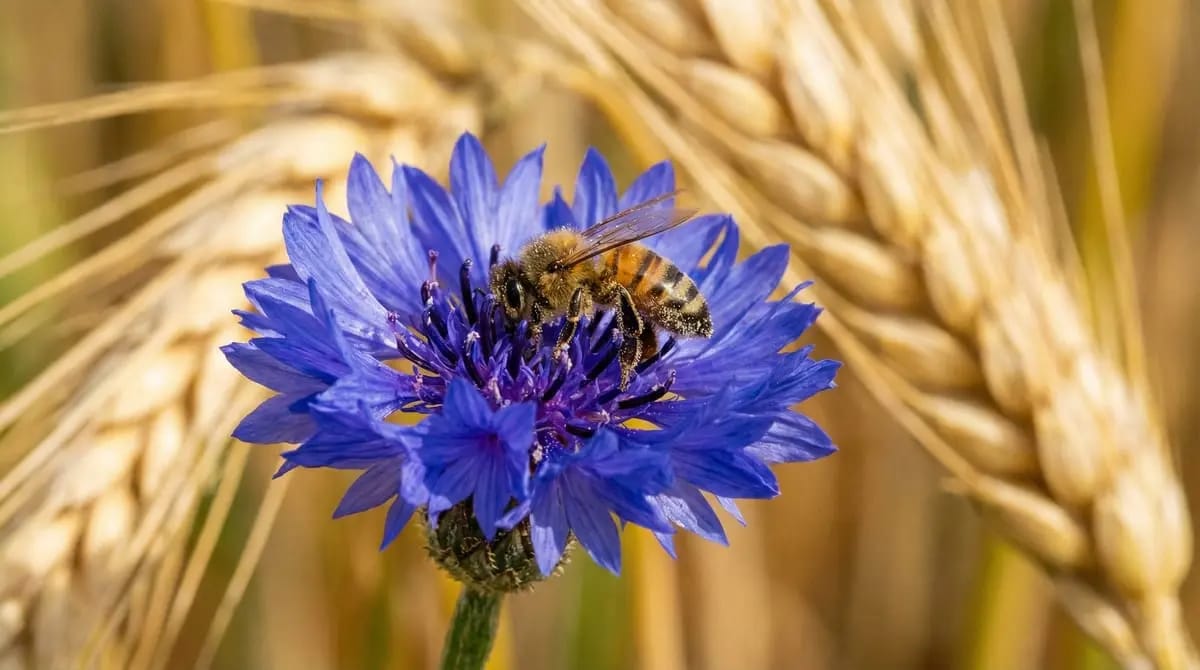
Many wild bee species are specialized in certain native plants. They often cannot use exotic ornamental plants. Particularly valuable native plants include:
- Viper's Bugloss (Echium vulgare) -- one of the very best bee flowers
- Meadow Sage (Salvia pratensis) -- important for bumblebees
- Cornflower (Centaurea cyanus) -- wild bees and honeybees
- Chicory (Cichorium intybus) -- blooms in midsummer
- Wild Carrot (Daucus carota) -- important for specialized wild bees
Tip 5: Create a Strip of Wildflower Meadow
You don't have to dig up the entire lawn. Just a strip 2-3 meters wide along the garden edge is enough. Here's how:
- Remove the turf or scarify heavily
- Roughen the soil and possibly add sand to lean it out (wildflowers prefer poor soil)
- Sow a regional seed mix (e.g., from specialist wildflower seed suppliers)
- Lightly press down, keep moist
- Let it grow in the first year, only mow once or twice a year starting from the second year
Tip 6: Plant Early Bloomers for the Season Start
In early spring (February/March), food supply is particularly scarce. Plant bulbs in autumn:
- Crocus (various varieties for staggered blooming)
- Winter Aconite
- Grape Hyacinth
- Squill
- Snowdrop (more relevant for bumblebees)
Tip 7: Use Climbing Plants
Climbing plants offer large flowering areas with the smallest ground footprint -- ideal for fences, walls, and balconies:
- Ivy -- blooms in September/October when little else is blooming (extremely important!)
- Clematis -- various varieties for different bloom times
- Honeysuckle -- fragrant, nectar-rich
- Wisteria -- impressive blooms, good for bumblebees
Tip 8: Plant Fruit Trees and Berry Bushes
Fruit trees are fantastic bee forage and you benefit from the harvest. Especially recommended:
- Apple (different varieties pollinate each other)
- Cherry
- Plum
- Currant and Raspberry
- Blackberry (blooms in summer when little else is blooming)
Water and Habitat (Tips 9-13)
Tip 9: Set Up a Bee Water Station
Bees need water -- for cooling the hive, diluting honey, and for brood care. A bee water station is quickly built:
- Shallow dish or saucer
- Stones, marbles, or corks
- Fresh water
Fill a shallow dish with stones, marbles, or corks and add water -- but only so much that the stones still protrude. Bees cannot swim and need landing spots. Place the water station in a sunny, wind-sheltered spot and change the water every 2-3 days.
Tip 10: Preserve Dead Wood and Open Soil Patches
About 75% of all wild bee species nest in the ground! Open, sandy patches in the garden are vital for them. Dead wood is also important: some species nest in old beetle tunnels or decaying wood.
- Leave a corner of the garden untidy
- Leave old tree stumps standing
- Don't fill in sandy patches
- Dry stone walls provide nesting spots in the crevices
Tip 11: Don't Mow Every Square Meter
A perfectly mowed lawn is a green desert for bees. Leave partial areas uncut -- even just a strip is enough. Clover, daisies, and dandelions in the lawn are not weeds but valuable bee food!
Tip 12: Rainwater Instead of Tap Water
Bees actually prefer stale, mineral-rich water over fresh tap water. A rain barrel with a flat exit aid (floating corks or a plank) is ideal.
Tip 13: Create Stone Piles and Dry Stone Walls
Stone piles and dry stone walls provide shelter not only for wild bees but also for lizards and other beneficial organisms. Various wild bee species nest in the cracks and crevices.
Restraint and Protection (Tips 14-17)
Tip 14: Completely Avoid Pesticides
Even products labeled as "bee-friendly" can harm bees -- particularly the neonicotinoid group. Three of them are banned outdoors in the EU (Clothianidin, Imidacloprid, Thiamethoxam), but others remain available. The safest approach: completely avoid chemical pesticides.
Alternatives to pesticides:
- Encourage beneficial insects (ladybugs against aphids)
- Plant mixed crops
- Use plant slurries (nettle, horsetail)
- Mechanical pest control
- Tolerance -- a few aphids aren't the end of the world
Tip 15: Don't Buy Peat
Peat harvesting destroys bogs -- important habitats for rare wild bee species and other insects. Use peat-free potting soil. The alternatives (compost, coir, wood fiber) work just as well.
Tip 16: Limit or Avoid Robotic Mowers
Robotic mowers keep the lawn permanently short -- clover and other flowering plants have no chance. If you don't want to completely forgo them:
- Only let the robot mow on partial areas
- Leave flowering strips untouched
- Don't mow daily, but every 5-7 days
- Set the mower as high as possible
Tip 17: Water in the Evening Instead of Morning
Bees fly during the day. If you water in the morning, wet blossoms become unattractive to bees and can even act as traps. Water in the evening instead -- then the flowers can dry overnight and be fresh for the bees in the morning.
Nesting Aids and Extras (Tips 18-20)
Tip 18: Hang Up a Proper Insect Hotel
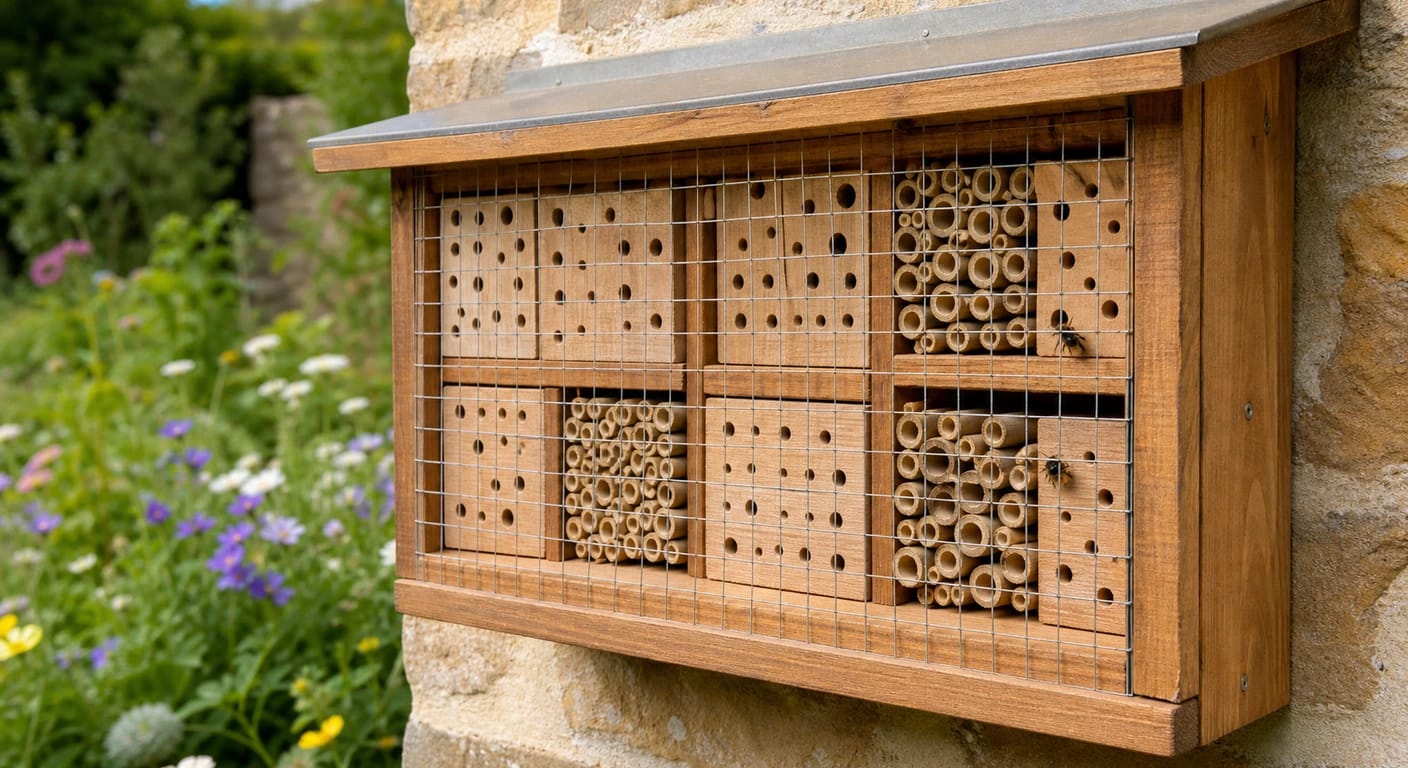
Unfortunately, many commercial insect hotels are useless or even harmful. Here's what to look for:
Checklist: Good Insect Hotel
Tip 19: Leave Pithy Stems Standing
Many wild bee species nest in pithy plant stems -- for example in old blackberry, elderberry, or mullein stems. Don't cut these off at ground level in autumn but leave 50 cm standing. The bees gnaw into the pith from above and create their brood cells there.
Tip 20: Inspire Your Neighbors
One bee-friendly garden is good -- an entire bee-friendly neighborhood is better. Share your knowledge, give away seeds or plant cuttings, and talk to your neighbors about bee-friendly gardening. The more gardens participate, the better the network of habitats.
Bee-Friendly Balcony: Is That Even Possible?
Yes, absolutely! Even on the smallest balcony, you can do something for bees:
- Window boxes planted with lavender, thyme, sage, and chives
- Pots with sunflowers, phacelia, or cosmos
- A small bee water station on the balcony
- Hanging strawberry plants or nasturtium
- A mini insect hotel on the wall
Even a single window box with lavender can be visited by hundreds of bees on a summer day. Bees have a flight radius of up to 3 kilometers and will find your balcony window on the 4th floor.
The Top 10 Bee Plants for the Garden
If you only have space for a handful of plants, choose from this list:
| Rank | Plant | Bloom Time | Special Feature |
|---|---|---|---|
| 1 | Lavender | Jun-Aug | Long-blooming, fragrant, easy care |
| 2 | Phacelia | May-Sep | "Bee's friend" -- the name says it all |
| 3 | Viper's Bugloss | Jun-Sep | Up to 4 bee visits per minute |
| 4 | Thyme | Jun-Aug | Bee magnet, kitchen use |
| 5 | Borage | Jun-Sep | One of the most nectar-rich plants |
| 6 | Sunflower | Jul-Sep | Pollen and nectar, decorative |
| 7 | Crocus | Feb-Mar | Vital early bloomer |
| 8 | Ivy | Sep-Oct | Blooms when little else does |
| 9 | Stonecrop | Aug-Oct | Late bloomer, easy care |
| 10 | Wild Mallow | Jul-Sep | Uncomplicated, self-seeding |
Common Mistakes in Bee-Friendly Gardening
Even with good intentions, mistakes can happen:
- Only planting early bloomers: Food is then missing in summer and autumn
- Buying exotic "bee flowers": "Bee-friendly" on the packaging doesn't always mean native species benefit
- Too much tidiness: A manicured garden offers less habitat
- Choosing double varieties: Look pretty but are worthless for bees
- Buying insect hotels from hardware stores: Often poorly made and useless
- Only thinking about honeybees: Wild bees often have different needs than honeybees
Conclusion: Every Square Meter Counts
You don't need to be an expert to help bees. Even small changes in the garden or on the balcony make a difference: a pot of lavender here, a bee water station there, a piece of unmowed lawn over there. When many people participate, a network of bee-friendly oases emerges that benefits both honeybees and wild bees alike.
Just start -- with the tip that best fits your garden. The bees will thank you.
Read also: Helping Wild Bees - Building Insect Hotels and Nesting Aids Properly Background: Bee Decline - Facts, Causes, and What You Can Do Start beekeeping: Beekeeping for Beginners - Your Introduction to Keeping Bees- Forage Plants and Bee Pasture -- Lesson 5: Creating a Bee Pasture
- Beekeeping for Beginners -- Lesson 5: Finding the Perfect Location
Less paperwork. More time with your bees.
Hivekraft is free for up to 10 hives. Register in 30 seconds.