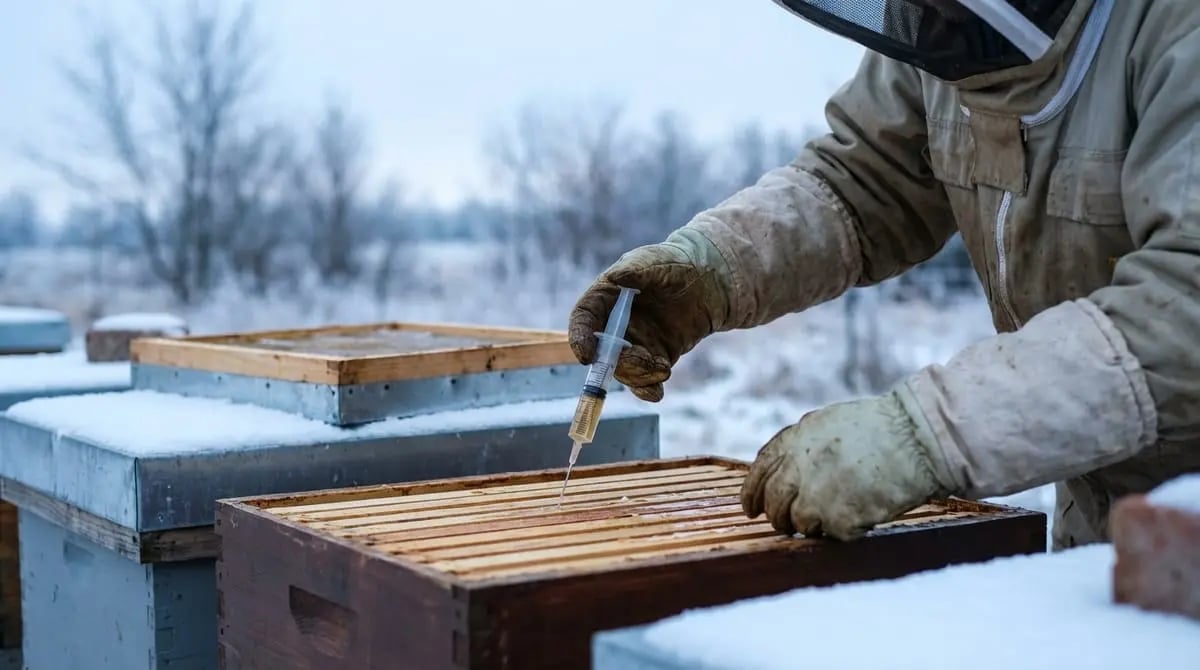
Winter Treatment with Oxalic Acid - Complete Guide for Beekeepers
The winter oxalic acid treatment is crucial for healthy colonies. Trickling vs. vaporizing, product comparison, broodlessness check, and EU documentation requirements - everything you need to know.
The winter treatment with oxalic acid is one of the most important dates in the beekeeping year. During the broodless phase, the acid achieves the highest efficacy against the Varroa mite. Those who hit the right timing and work cleanly lay the foundation for healthy colonies in spring.
This article is your complete guide: From the broodlessness check through the comparison of application methods to the EU documentation requirements - everything you need to know as a beekeeper.
Note: The approved products, dosages, and legal requirements described in this article are specific to Germany and the EU. If you keep bees in a different country, check your local veterinary medicine regulations for approved Varroa treatments.
Why Oxalic Acid in Winter?
The Varroa mite reproduces in capped brood. In winter, when the queen takes a brood break, all mites are on the bees - so-called phoretic mites. Only then can oxalic acid effectively reach them, as it works exclusively through contact and does not penetrate capped brood cells.
The difference is dramatic:
- Efficacy broodless: 90-95%
- Efficacy with brood: only 30-50%
- Conclusion: The timing is more critical than the method
The winter treatment is the foundation of Varroa management. It cannot replace the summer treatment, but without it, colonies start spring with a mite load that can lead to catastrophe by summer.
Understanding Varroa - Why the Winter Treatment Is So Important
To grasp the significance of the winter treatment, a look at the Varroa reproduction cycle helps:
Exponential Reproduction
A single mite in January can become hundreds of mites by August. The reproduction rate is approximately factor 2-3 per brood cycle (21 days). This means:
| Month | Mite Count (Example) | Damage |
|---|---|---|
| January | 50 mites (after treatment) | No visible damage |
| April | 100-200 mites | Still inconspicuous |
| June | 500-1,500 mites | First weakness possible |
| August | 3,000-8,000 mites | Critical, shortened lifespan |
| October | 5,000-15,000 mites | Colony can collapse |
Every mite you do not catch in winter will multiply in spring. That is why the 90-95% efficacy during broodlessness is so decisive - compared to only 30-50% when brood is present.
Even after a perfect winter treatment, your colony can have high mite numbers again by summer. The reason: Reinvasion through drifting bees from heavily infested neighboring colonies. In densely populated beekeeping areas, 2,000-3,000 mites per season can reinvade. That is why the winter treatment alone is not sufficient - it is the most important building block of an overall concept.
The Right Timing
The treatment should take place during the broodless phase. Hitting the exact timing is the biggest challenge.
Regional Differences
| Region | Typical Period | Particularities |
|---|---|---|
| Northern Germany | Mid-November to mid-December | Earlier brood break due to cold |
| Central Germany | Late November to late December | Classic period |
| Southern Germany | December to early January | Milder winters, later brood break |
| Alpine foothills | November to December | Early, reliable brood break |
| Urban beekeeping | December to January | Heat islands delay brood break |
Signals for Broodlessness
- At least 3 weeks after the last feeding
- Ideally after the first extended frost period (several days below 0 degrees)
- The shortest days of the year (around the winter solstice) are often a good indicator
- Climate change note: In mild winters, the brood break can be very short or not occur at all - monitoring is therefore essential
Broodlessness Check in Detail
Verifying broodlessness without disturbing the colony is crucial. Here are three methods from minimally invasive to definitive:
Method 1: Debris Analysis (Non-Invasive)
The most reliable method without interfering with the colony:
- 1
Insert monitoring board
Slide the monitoring board (debris tray) under the colony. For open mesh floors, simply insert the slide-in tray. If not permanently present, insert it now.
- 2
Wait 3-5 days
Leave the board for at least 3 days. During this time, enough debris accumulates for a meaningful assessment. The colony is not disturbed.
- 3
Analyze debris
Carefully pull out the board and analyze the debris pattern: Few light wax particles mean little or no brood. Many dark wax particles (cell caps) indicate brood activity. Chalkbrood mummies show that brood was present.
- 4
Simultaneously assess mite drop
Count the fallen mites on the board and divide by the number of days. This gives you the natural daily mite drop - an important indicator of infestation level before treatment.
The debris on the board reveals much about the colony's condition. Light, fine wax crumbs come from feeding activity - that is normal. Darker, coarser pieces indicate brood activity. If you find small, light-brown caps (brood cappings), brood is definitely still present. Also note the distribution: A clearly defined sitting area shows a compact winter cluster.
Method 2: External Observation
Complementing debris analysis:
- Compact bee cluster visible (through mesh floor or window) = brood break likely
- No pollen intake for weeks = no brood to supply
- Outside temperature several days below 5 degrees Celsius = brood break very likely
- No flights even on mild days = colonies in tight winter cluster
Method 3: Mirror Check (Minimally Invasive)
For definitive confirmation:
- Briefly open the lid (under 30 seconds)
- Shine a flashlight and mirror between the frame gaps
- Brood cells visible? Then wait.
- Only loosely sitting bees on the frame tops? Broodless.
Only open the colony when the outside temperature is above 0 degrees and you are truly quick. Every disturbance of the winter cluster costs the bees energy. Never open the colony in strong wind. Ideally check on a mild, calm day in the late morning.
Application Methods Compared
There are three established methods of oxalic acid application. Each has advantages and disadvantages:
| Criterion | Trickling | Vaporizing | Spraying |
|---|---|---|---|
| Efficacy | 90-95% | 95-99% | 80-90% |
| Bee-friendly | ★★★☆☆ | ★★★★★ | ★★☆☆☆ |
| Equipment | Syringe (5 EUR) | Vaporizer (80-300 EUR) | Spray bottle (10 EUR) |
| Protective equipment | Gloves + goggles | Gloves + goggles + P3 respirator | Gloves + goggles |
| Time per colony | 2-3 minutes | 3-5 minutes | 5-8 minutes |
| Temperature range | Above 0 degrees | 2 to 10 degrees (per Varroxal approval) | Above 5 degrees |
| Repeat possible | ✗ | ✓ | ✗ |
| Recommendation | Standard method | Larger operations | Rarely recommended |
Trickling Method in Detail (Most Common)
The most proven method for hobby beekeepers. It is simple, reliable, and requires minimal equipment:
- 1
Prepare solution
Use a ready-made, approved solution (e.g., Oxuvar or Bienenwohl) or prepare the solution according to package instructions: 3.5% oxalic acid dihydrate in sugar water (1:1). The solution must be body warm (not above 35 degrees) so it distributes well and does not startle the bees. In winter, keep the bottle warm in your jacket pocket.
- 2
Calculate dosage
5 ml per occupied frame gap, maximum 50 ml per colony. Count the occupied gaps from above: If the colony sits on 8 gaps, you need 40 ml. Prepare the right amount in the syringe (50 ml syringe without needle). Mark a dosing guide on the syringe.
- 3
Put on protective equipment
Wear acid-resistant nitrile gloves and sealed safety goggles. Long sleeves protect against splashes. Keep a canister of water ready in case solution contacts the skin.
- 4
Perform treatment
Briefly open the lid, fold back the cover cloth or inner cover. Trickle the solution evenly into the occupied frame gaps - as directly onto the bees as possible. Start from the outside and work inward. Work quickly (under 1 minute per colony). Close the lid immediately.
- 5
Document
Note immediately: Colony number, date, product (including batch number), dosage, treating person, supplier. When using Hivekraft: Record directly in the app - all EU required fields are pre-filled. The data automatically flows into your digital colony record book.
Important: The trickling method may only be applied once per winter. A repeat damages the bees through the additional sugar load and acid contact.
Vaporization Method in Detail
For larger operations with specialized equipment - the highest efficacy with the least bee stress:
- Principle: Oxalic acid crystals are heated to approx. 157 degrees and sublimate into a fine vapor in the hive (not above 189 degrees, otherwise the acid decomposes)
- Approved product: In Germany, only Varroxal 0.71 g/g (Andermatt BioVet) may be vaporized - approved since September 2023. Other oxalic acid products (Oxuvar, Bienenwohl) are not approved for vaporization.
- Devices: Only the vaporizers Varrox (gas-powered, ~100 EUR) and Varrox Eddy (battery-powered, ~250 EUR) are recommended per the approval
- Dose: 2 g Varroxal per colony (per package insert)
- Temperature range: Outside temperature between 2 and 10 degrees Celsius (per Varroxal approval)
- Advantage: Can be repeated after 7 days if needed (for incomplete broodlessness). External treatment possible, very bee-friendly.
- Disadvantage: Respiratory protection with P3 filter is mandatory - oxalic acid vapor is corrosive to the lungs
Oxalic acid vapor is strongly irritating to the lungs. ALWAYS wear a respiratory mask with P3 filter during vaporization. People nearby (5-meter radius) must also be protected. Without respiratory protection, you risk serious health damage. Keep children and pets away from the apiary.
Spray Method
The least common method. It is barely recommended in Germany anymore:
- Principle: 3.5% oxalic acid solution is sprayed on both sides of every occupied frame
- Disadvantage: Every frame must be pulled individually and sprayed - enormous effort and massive disturbance of the winter cluster
- Efficacy: Lower than trickling or vaporizing
- Use case: Only for special management methods (e.g., brood removal in summer with subsequent spray treatment)
Post-Treatment: Monitoring Success
After treatment, monitoring the treatment success is essential:
Debris Check After Treatment
- Insert monitoring board immediately after treatment
- Count mite drop after 3, 5, and 7 days
- Assessment:
| Mite Drop (total 7 days) | Assessment | Action |
|---|---|---|
| Under 50 mites | Good | No further action |
| 50-500 mites | Acceptable | Plan early spring monitoring |
| 500-1000 mites | Critical | Monitor colony intensively in spring |
| Over 1000 mites | Alarming | Possible reinvasion, investigate cause |
EU Documentation Requirements
The winter treatment is a veterinary medicine application and must be documented without gaps according to EU Regulation 2019/6.
Required Entries in the Colony Record Book
For every winter treatment, the following information must be recorded:
- Date of treatment
- Product name - e.g., "Oxuvar 5.7% ad us. vet."
- Batch number of the product (on every package)
- Dosage - e.g., "5 ml/frame gap, 35 ml total"
- Application method - trickling or vaporizing
- Treated colonies - numbers or names
- Name of the applicant - who performed the treatment?
- Supplier - where was the product purchased?
- Invoice number from the supplier
- Withdrawal period - as per package insert
Retention Period
- Records must be kept for 5 years
- Digital or analog - both are permitted
- During an inspection, the colony record book must be immediately presentable
Even though there is no honey harvest in winter and the withdrawal period is practically irrelevant: The documentation requirement applies fully nonetheless. Enter the treatment immediately - directly at the apiary with your smartphone. A violation can be penalized with fines up to 30,000 EUR (Section 89 Para. 6 TAMG).
Common Mistakes to Avoid
| Mistake | Consequence | Solution |
|---|---|---|
| Treatment with brood present | Only 30-50% efficacy | Check broodlessness thoroughly |
| Overdosing | Bee losses, increased winter mortality | Exactly 5 ml per gap, max. 50 ml |
| Solution too cold | Shock for the bees, poor distribution | Warm solution to body temperature |
| Double trickling treatment | Massive bee damage | Trickle only ONCE per winter |
| No documentation | Fine up to 30,000 EUR (Section 89 Para. 6 TAMG) | Enter into colony record book immediately |
| Technical oxalic acid used | Violation of veterinary medicine law | Use only approved veterinary medicines |
| No respiratory protection when vaporizing | Lung damage | Always wear P3 mask |
| Treatment in strong wind | Uneven vaporization, applicant endangered | Wait for calm weather |
| Treated too late (January/February) | Queen may have resumed laying | Optimal: December, after first frost period |
| Product stored incorrectly | Reduced efficacy | Store cool, dry, frost-free |
The Winter Treatment in the Overall Concept
The oxalic acid winter treatment is only one building block of integrated Varroa management. The overall concept throughout the year:
- Spring (April-May): Drone brood removal as a biotechnical measure
- Summer (July-August): Main treatment with formic acid after the last harvest
- Autumn (September): Monitor natural mite drop, follow-up treatment if needed
- Winter (November-January): Final mite removal with oxalic acid during the broodless phase
- Year-round monitoring: Regular debris checks, document mite drop in the Varroa dashboard
An integrated Varroa concept is like a gear system: Each measure meshes with the next. Those who view the winter treatment as an isolated action miss the crucial point. It is about the interplay of all building blocks throughout the entire year.
With a consistent Varroa strategy, you have the best chances for healthy and strong colonies in the new year.
Oxalic acid treatment is only part of Varroa management:
- Varroa Management Masterclass -- Lesson 5: Oxalic acid treatment in detail
- Understanding Bee Health -- Holistic approach for healthy colonies
- Beekeeping for Beginners -- Lesson 10: Autumn, Varroa treatment and feeding
Document varroa treatments and stay on top of your hive health.
Hivekraft is free for up to 10 hives. Register in 30 seconds.