

Lesson 4 of 6
Registering Your Beekeeping: Veterinary Office and Tax Office
20 min
From mandatory registration with the veterinary authority to tax returns: All official procedures for beekeepers explained step by step. Trade or agriculture?
Anyone starting beekeeping must register with various authorities. This sounds like a lot of bureaucracy but in most cases can be completed in just a few hours. In this lesson, we guide you step by step through all necessary registrations -- from the veterinary office to the tax office to the occupational insurance body.
We also clarify the most important question for many beekeepers: When does a hobby become a business? And what does this mean for taxes?
4 authoritiescan be relevant for beekeepers: veterinary office, tax office, trade office and SVLFG
Step 1: Veterinary Office -- Registration Obligation for All Beekeepers
Legal Basis
The registration obligation arises from Section 1a of the Bee Disease Ordinance (BienSeuchV) in conjunction with Section 26 of the Animal Health Act (TierGesG):
"Anyone who wishes to keep bees shall notify the competent authority, stating the number of bee colonies and their location."
This registration obligation applies from the very first bee colony -- there is no minimum colony count and no exemption for hobby beekeepers.
What Is Reported?
How Do I Register?
- 1
Find your local veterinary office
The veterinary office is usually part of the district authority (Landratsamt) or the independent city administration. Search online for "veterinary office [your district]" or call the district authority.
- 2
Complete the registration form
Many veterinary authorities offer forms for download. Some also accept a simple written notification by letter or email. Some federal states have an online registration portal (e.g. HI-Tier/TSN).
- 3
Animal Disease Notification System (TSN)
In most federal states, your registration is recorded in the Animal Disease Notification System (TSN). You receive a registration number that uniquely identifies your beekeeping operation. You will need this number later for the colony record book.
- 4
Keep the confirmation
Keep the registration confirmation and your registration number carefully. You will need them for inspections, when moving colonies, and during disease investigations.
Free of chargeRegistration with the veterinary office is free of charge in all federal states
Change Notifications
You must also notify the veterinary office of changes:
- Location changes: When you move colonies to a new location (especially for migratory beekeeping)
- Significant changes in colony numbers: When your colony count changes substantially (some authorities require annual reporting)
- Ceasing beekeeping: When you no longer keep bees
- Change of address: When you move
Step 2: Tax Office -- Hobby, Agriculture or Trade?
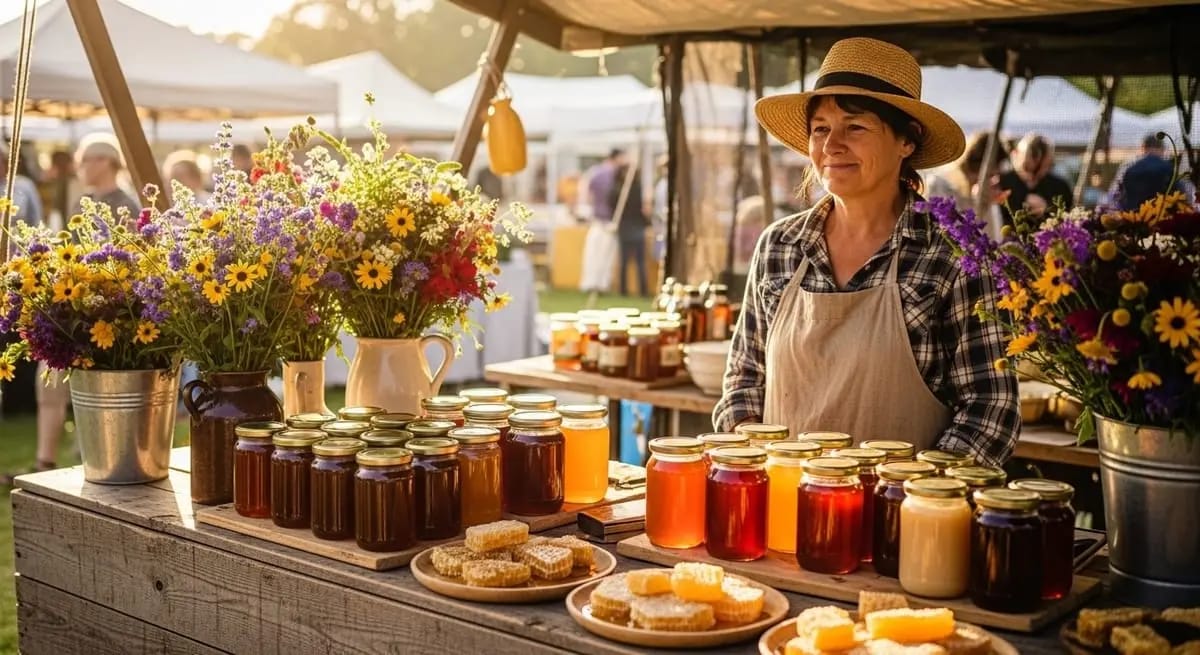 AI-generated. This image was created with AI. It does not show a real apiary.
The tax classification of beekeeping is one of the most common questions -- and the answer depends on how extensively you keep bees and whether you generate income.
Three Possible Classifications
| Classification | Criteria | Tax Consequence |
|---|---|---|
| Hobby (Liebhaberei) | No profit-making intention, persistent losses, few colonies, minimal sales | No tax obligation, no input tax deduction |
| Agriculture (part-time farming) | Profit-making intention, regular honey sales, from approx. 20-30 colonies | Income from agriculture and forestry (Section 13 EStG), flat-rate assessment possible |
| Trade | Honey is bought in and resold, commercial services (pollination), commercial processing | Income from trade (Section 15 EStG), trade tax from EUR 24,500 |
Hobby: When Is Beekeeping Purely a Pastime?
Most hobby beekeepers with few colonies who give honey to friends and acquaintances or sell small quantities fall under hobby status (Liebhaberei). The tax office examines:
- Profit-making intention: Do you intend to make a profit in the long term? If costs (equipment, feed, treatment products) permanently exceed income, it constitutes a hobby.
- Loss period: If the beekeeping makes losses over several years and you make no effort to change the situation.
Advantage of hobby status: No tax obligation, no filing requirement. Disadvantage of hobby status: No input tax deduction, losses cannot be offset against other income.
Agriculture: Beekeeping as Part-Time Farming
Once your beekeeping reaches a certain level of professionalism and seriousness, the tax office classifies it as a part-time agricultural operation. Income is then taxed as income from agriculture and forestry (Section 13 EStG).
Income from Agriculture and ForestryFeatures of agricultural classification:
- You operate the beekeeping with profit-making intention
- You regularly sell honey and/or bee products
- You operate the beekeeping systematically (annual planning, investments)
- You typically have more than 20-30 colonies
Tax advantages of agricultural classification:
Trade: When Does Beekeeping Become Commercial?
A beekeeping operation is classified as a trade by the tax office when it goes beyond primary production:
- Buying in honey for resale (not self-produced)
- Commercial services: pollination service for payment, bee shipping
- Commercial processing: production of mead, cosmetics, candles on a larger scale
- Retail: selling beekeeping supplies
Step 3: Tax Office -- Registration and Forms
- 1
Questionnaire for tax registration
When you inform the tax office that you earn income from agriculture and forestry, you receive the questionnaire for tax registration. Fill it out and return it. Since 2021, submission via ELSTER (electronic) is possible and recommended.
- 2
Receive tax number
The tax office assigns you a tax number (if you don't already have one). Your beekeeping income is recorded under this number.
- 3
Choose profit determination method
Choose the method of profit determination: flat-rate assessment under Section 13a EStG (simple, for small operations) or income surplus calculation (EUER) under Section 4(3) EStG (more precise, if you have high operating expenses).
- 4
Clarify VAT
Decide whether to use the small business regulation (Section 19 UStG), VAT flat-rate scheme (Section 24 UStG) or standard taxation. For most hobby beekeepers, the small business regulation or flat-rate scheme is simplest.
- 5
Annual tax return
Declare your income annually in Annex L (agriculture and forestry) of your income tax return. With flat-rate assessment under Section 13a, the effort is minimal.
Small Business Regulation (Section 19 UStG)
Small Business RegulationThe small business regulation is attractive for many small beekeeping operations:
- Requirement: Total turnover in the previous year not exceeding EUR 25,000 and not exceeding EUR 100,000 in the current year (since 2025, Annual Tax Act 2024)
- Advantage: You do not have to charge VAT on your invoices and do not have to file a VAT return
- Disadvantage: You have no input tax deduction (cannot reclaim VAT on purchases)
EUR 25,000Turnover threshold for the small business regulation under Section 19 UStG (previous year, since 2025)
Step 4: Trade Office -- When Do I Need a Trade Licence?
A trade licence is only required if your beekeeping is classified as a trade (see above). Agricultural businesses are exempt from trade registration -- and most beekeeping operations are classified as agriculture.
When to visit the trade office?
| Activity | Trade registration required? | Reason |
|---|---|---|
| Beekeeping with own honey sales | No | Agricultural primary production |
| Creamed honey from own honey | No | First processing stage = agriculture |
| Mead production and sales | Yes | Commercial processing |
| Buying and reselling honey | Yes | Trading |
| Pollination service for payment | Yes | Commercial service |
| Offering beekeeping courses | Depends | Freelance (lecturer) or commercial |
| Selling bee products (candles, soap) | Yes, if regular | Commercial processing |
Step 5: SVLFG -- Occupational Insurance for Beekeepers
SVLFGThe Social Insurance for Agriculture, Forestry and Horticulture (SVLFG) is the statutory occupational insurance body for beekeepers. It provides accident insurance for agricultural businesses.
When Am I Required to Join the SVLFG?
| Colony Count | SVLFG Obligation | Contribution (approx.) |
|---|---|---|
| 1-25 colonies | No compulsory membership | Voluntary insurance possible |
| 26-99 colonies | Compulsory member (accident insurance) | Approx. EUR 70-150/year |
| 100+ colonies | Compulsory member (full social insurance possible) | Depends on operation size |
What Does the SVLFG Cover?
The SVLFG accident insurance covers:
- Occupational accidents during beekeeping (fall from a ladder, injuries from tools)
- Occupational diseases (e.g. severe allergic reactions to bee stings)
- Commuting accidents (on the way to the apiary)
- Rehabilitation measures after accidents
- Pensions in case of permanent reduced earning capacity from an occupational accident
Step 6: Food Safety Authority -- When Selling Honey
If you sell honey commercially (i.e. regularly and not just occasionally to friends), you must register with the food safety authority.
Registration Under EU Base Regulation 178/2002
Food Business OperatorUnder Article 6 of Regulation (EC) No 852/2004, food business operators must register their business with the competent authority. As a beekeeper who sells honey, you are a food business operator.
What is registered:
- Name and address
- Type of activity (honey production and marketing)
- Location of food production (extraction room, storage)
Exception for occasional private supply: Purely private, occasional supply of small quantities to end consumers (neighbours, friends) does not fall under the registration obligation. However, as soon as you regularly sell at the weekly market or operate an online shop, registration is required.
Hygiene Requirements for the Extraction Room
Overview: All Registrations at a Glance
- 1
Veterinary office (MANDATORY for all)
When: Before or at the start of beekeeping Cost: Free Documents: Name, address, location, colony count Result: Registration number in TSN
- 2
Tax office (with regular income)
When: When you first earn income from honey sales Cost: Free Documents: Questionnaire for tax registration (ELSTER) Result: Tax number, choice of profit determination method
- 3
SVLFG (from more than 25 colonies)
When: Automatically from more than 25 colonies (from the 26th colony) Cost: Approx. EUR 70-150/year (accident insurance) Documents: Business data notification Result: Accident insurance cover
- 4
Food safety authority (when selling honey)
When: With regular commercial honey sales Cost: Free (registration), inspections free of charge Documents: Business registration Result: Registration number as food business
- 5
Trade office (only for commercial activity)
When: Only if the beekeeping is classified as a trade Cost: Approx. EUR 20-60 (depending on municipality) Documents: Trade registration Result: Trade licence
Special Cases and Frequently Asked Questions
The registration obligations for beekeepers are manageable and quickly completed. The most important: the notification to the veterinary office. It protects not only your own colonies in case of disease but all bees in the region. We recommend every beginner also join their local beekeeping association -- there you will find practical help with all formalities.
Summary
Registering your beekeeping is no bureaucratic monster. The key points:
- Registration with the veterinary office is mandatory for every beekeeper -- from the 1st colony, free of charge
- The tax office becomes relevant when you regularly earn income -- most hobby beekeepers fall under hobby status
- Agriculture vs. trade: Pure honey production is agriculture, processing (mead, cosmetics) is a trade
- The small business regulation (Section 19 UStG) is usually the best option for small operations
- From more than 25 colonies (from the 26th colony), you are automatically insured with the SVLFG
- With regular honey sales, you must register with the food safety authority
- A trade licence is only needed if you go beyond primary production