Bee Decline: Facts, Causes and What You Can Do
Understanding bee decline: Colony Collapse Disorder, Varroa, pesticides and habitat loss — facts, figures and what beekeepers can do about it.
Bee decline has been a topic in the media, politics and public discourse for years. But what is really behind it? Are bees truly going extinct? And if so, which bees — honey bees, wild bees or both? In this article we separate facts from myths, examine the actual causes and show what you can do as a beekeeper and as a private individual.
Fact Check: How Are Bees Really Doing?
Honey Bees: Not Endangered
The good news first: The honey bee (Apis mellifera) is not globally endangered. The number of managed honey bee colonies has actually increased worldwide — from about 50 million colonies in the 1960s to over 90 million today. In Germany, the number of bee colonies rose from a low around 2007 (approx. 700,000) to over 1 million in 2023.
However: Winter losses remain considerable. In bad years, German beekeepers lose 20 to 30 percent of their colonies. That is 200,000 to 300,000 colonies per year that must be replaced through breeding. The honey bee survives only thanks to intensive care by beekeepers — without Varroa treatment, most colonies would die within 2 to 3 years.
Wild Bees: The Real Crisis
The actual catastrophe affects wild bees. In Germany there are approximately 585 wild bee species — and over half of them are on the Red List of endangered species:
| Conservation Status | Proportion of Wild Bee Species | Number of Species |
|---|---|---|
| Not endangered | 37% | ~215 |
| Near threatened | 10% | ~60 |
| Endangered | 26% | ~150 |
| Severely endangered | 15% | ~90 |
| Critically endangered | 7% | ~40 |
| Extinct/Missing | 5% | ~30 |
Around 53 percent of all German wild bee species are endangered, severely endangered, critically endangered or already missing. Unlike honey bees, wild bees have no beekeeper to care for them. Their survival depends entirely on intact habitats.
The Pollination Service
Why is bee decline even relevant? Because bees are indispensable pollinators:
- 80 percent of crops and wild plants in Europe depend on insect pollination
- The economic value of pollination services in Germany is estimated at 2 to 3 billion euros per year
- Without pollination, fruit yields drop by 40 to 90 percent
- Wild plants and entire ecosystems depend on pollination
The Main Causes
Bee decline does not have a single cause, but several that reinforce each other. Scientists refer to it as a multifactorial phenomenon.
1. Varroa destructor
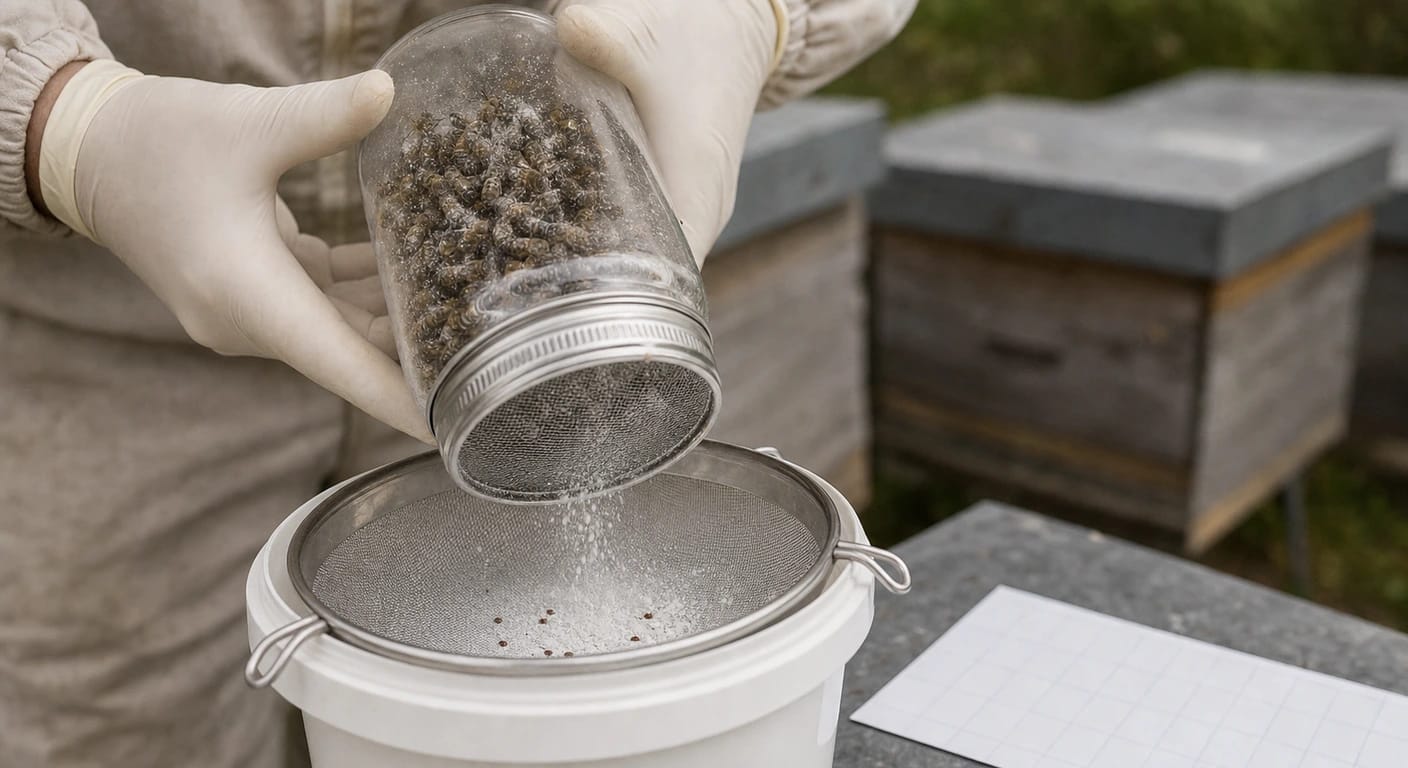
The Varroa mite is the number one killer of honey bee colonies. The parasite was transferred from the Asian honey bee (Apis cerana) to the European honey bee in the 1970s and has since spread worldwide.
What the mite does:
- Feeds on the fat body of pupae and adult bees
- Transmits deadly viruses (DWV, ABPV, Sacbrood)
- Weakens the immune system of bees
- Shortens the lifespan of winter bees
- Untreated colonies die within 2 to 3 years
2. Pesticides
Plant protection products, especially insecticides, harm bees directly and indirectly:
Neonicotinoids:
- Act on the nervous system of insects
- Three active ingredients (Clothianidin, Imidacloprid, Thiamethoxam) have been banned in the EU for outdoor use since 2018
- Effective even in tiny doses: disorientation, reduced learning ability, lower reproduction
- Residues persist in soil for years
Glyphosate:
- The world's most widely used herbicide
- Does not kill bees directly, but destroys their gut flora
- Eliminates flowering plants (food source)
- Approved in the EU until 2033
Fungicides:
- Often classified as bee-safe
- New studies show: Fungicides damage the gut flora of bees and amplify the effects of other pesticides (synergy effects)
In reality, bees are not exposed to a single pesticide but to a cocktail of different active ingredients. The interactions of these substances are barely researched, but the studies so far are alarming: combinations often act far more toxic than individual substances.
3. Habitat Loss and Monoculture
Modern agriculture has radically changed the landscape:
- Monoculture: Huge fields with a single plant species provide food for only a few weeks — then there is desert
- Land consolidation: Hedgerows, field margins and flower strips have disappeared
- Over-fertilization: Nitrogen displaces flowering wild herbs in favor of grasses
- Land sealing: Every day in Germany, 55 hectares of land are sealed (roads, buildings)
- Manicured gardens: Gravel gardens, short lawns and exotic plants offer bees nothing
4. Diseases and New Parasites
Besides Varroa, other diseases and parasites threaten bees:
- American Foulbrood (AFB): Notifiable bee disease that destroys brood
- Nosema: Gut parasite that weakens colonies especially in winter
- Small Hive Beetle (Aethina tumida): Present in southern Italy since 2014, spread northward is feared
- Asian Hornet (Vespa velutina): Spreading from France into Germany, hunts honey bees at the hive entrance
- Viruses: DWV (Deformed Wing Virus), ABPV, CBPV — often lethal in combination with Varroa
5. Climate Change
Climate change disrupts the delicate interplay between bloom times and bee activity:
- Earlier blooming: Some plants bloom 2 to 3 weeks earlier than 30 years ago
- Asynchronous development: Bees and flowers no longer develop in sync
- Extreme weather events: Late frosts destroy blossoms, heat waves dry out nectar sources
- Shifted seasons: Mild winters prevent the brood break, Varroa reproduces longer
What Beekeepers Can Do
As a beekeeper, you have direct influence on the health of your honey bee colonies. But you can also make a difference beyond that:
For Your Own Colonies
- 1
Consistent Varroa Management
Treat your colonies according to an integrated concept: drone frames in spring, formic acid in summer, oxalic acid in winter. Monitor treatment success and act immediately when infestation is high. An untreated colony is a mite bomb for all colonies in the area.
- 2
Promote Strong Colonies
Strong colonies are more resistant to diseases and parasites. Unite weak colonies instead of dragging them along. Breed from your best queens — vitality and disease resistance are hereditary.
- 3
Comb Hygiene
Replace one third of brood combs annually with fresh foundation. Old comb is a reservoir for pathogens and pesticide residues.
- 4
Site Selection
Avoid sites near intensive agriculture (rapeseed monoculture, orchards with spraying). Prefer diverse landscapes with forest, meadows and gardens. Talk to farmers in your area about bee-friendly management.
For the Environment
What Everyone Can Do
CCD: Colony Collapse Disorder — What Do We Know Today?
Colony Collapse Disorder (CCD) — the mysterious bee die-off where entire colonies suddenly vanish — made headlines worldwide starting in 2006. The bees flew out and never returned. In the US, some operations lost 50 to 90 percent of their colonies in a single season.
What We Know Today
CCD was not a single phenomenon, but the result of several interacting factors:
- Varroa + Viruses as the main drivers (especially DWV in combination with high mite loads)
- Pesticide exposure from intensive agriculture (Neonicotinoids)
- Stress from migratory beekeeping (in the US, colonies are transported thousands of miles)
- Malnutrition from monoculture (almond pollination in California: only one pollen source)
- Nosema ceranae as an additional stressor
The massive CCD phenomenon of the US did not occur in Europe in this form. European winter losses are primarily due to Varroa, inadequate treatment and unfavorable weather conditions. However, the causal complexes overlap considerably.
The Role of Agriculture
Agriculture is both part of the problem and part of the solution:
Problems
| Factor | Impact on Bees |
|---|---|
| Monoculture | One-sided nutrition, nectar flow gaps |
| Pesticide use | Poisoning, immune suppression, disorientation |
| Land consolidation | Loss of nesting habitats and flowering areas |
| Grassland conversion | Fewer meadows = less food |
| Early mowing | Flowering meadows are mowed before seed maturity |
Solutions
- Agri-environmental programs: Flower strips, fallow land and hedgerows are financially supported
- Integrated pest management: Fewer pesticides, biological alternatives
- Flower strip programs: More and more farmers are creating flower areas
- Beekeeper-farmer cooperation: Direct arrangements about spraying times and flower strips
What Does the Future Hold?
Some developments give hope:
Varroa-tolerant bees: Breeding programs are working on bee lines that can defend themselves against Varroa (VSH bees, SMR behavior). First successes are visible, but the breakthrough is still pending.
Insect Protection Act: Germany passed an Insect Protection Act in 2021. It bans herbicides and insecticides in protected areas and mandates buffer zones near water bodies.
Flower strip funding: The EU's Common Agricultural Policy (CAP) increasingly focuses on eco-schemes that promote flower areas and fallow strips.
Urban beekeeping: More and more people keep bees in cities. Cities often offer a more diverse flora than rural monocultures — paradoxically, bees find more food in large cities.
Bee decline is the most visible symptom of a comprehensive crisis in the insect world. If we want to save the bees, we need to change the entire landscape — and that can only happen with a fundamental shift in agriculture.
Conclusion
Bee decline is real — but more nuanced than the headlines suggest. Honey bees are not acutely threatened thanks to dedicated beekeepers, but depend on intensive care. The real crisis affects wild bees and the entire insect world. The causes are diverse: Varroa, pesticides, habitat loss and climate change work together.
As a beekeeper, you bear responsibility — for your own colonies and for the insect world as a whole. Treat consistently against Varroa, promote biodiversity in your surroundings and talk to farmers and neighbors. Every flowering area, every pesticide avoided and every healthy bee colony counts.
Read also: Climate Change and Beekeeping - Adaptation Strategies for Beekeepers Take action: Helping Wild Bees - Building Insect Hotels and Nesting Aids Correctly Creating habitats: 20 Simple Tips for Bee-Friendly Gardening- Bee Health Complete Course -- 10 Lessons on Bee Health
- Varroa Management Masterclass -- Fighting the Greatest Threat
Document varroa treatments and stay on top of your hive health.
Hivekraft is free for up to 10 hives. Register in 30 seconds.