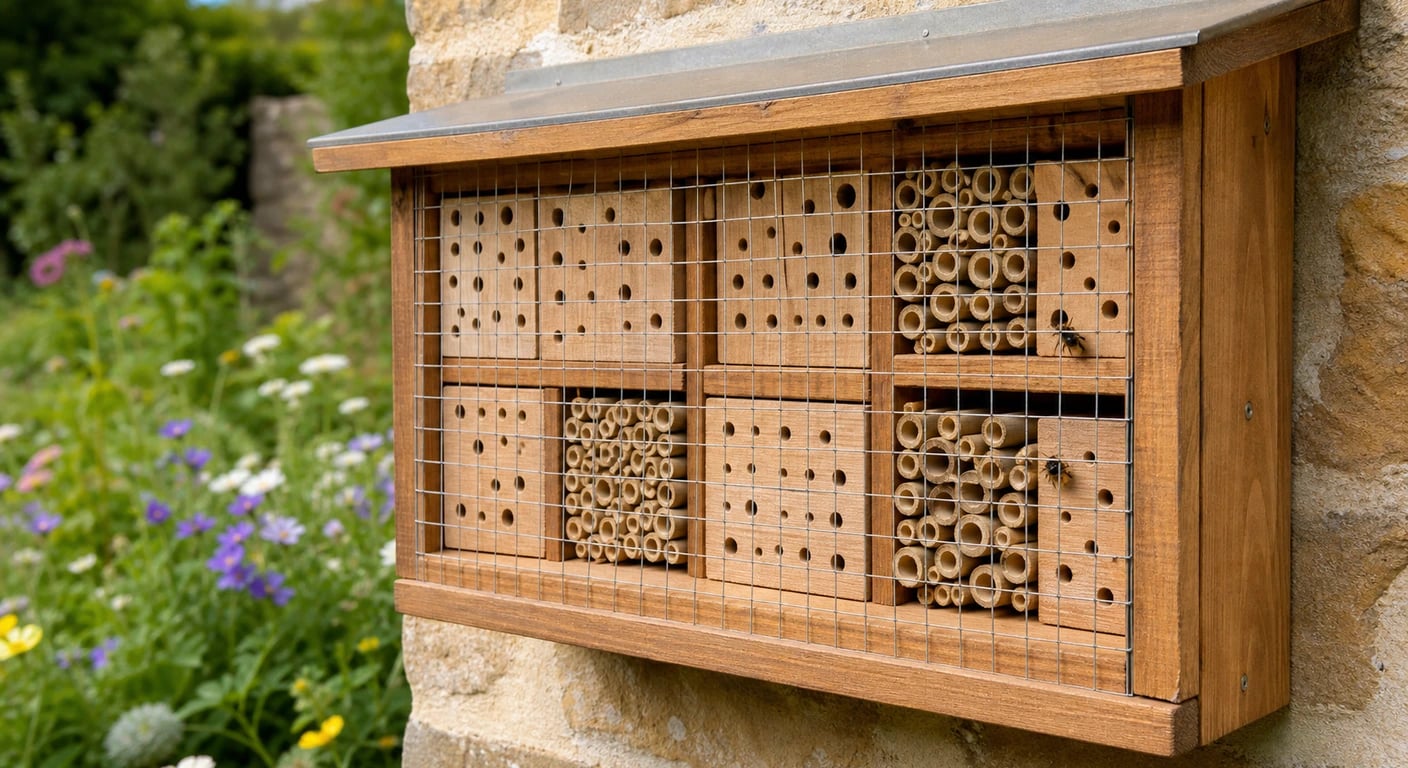
Helping Wild Bees: Building Insect Hotels and Nesting Aids Properly
Building insect hotels properly: Which nesting aids wild bees actually need, common mistakes, and building instructions for the garden.
Wild bees are quiet heroes: They pollinate our fruit trees, vegetable plants, and wildflowers -- often even more efficiently than honey bees. Yet more than half of the approximately 604 wild bee species in Germany are endangered. A major problem: missing nesting sites. With a properly built insect hotel and other nesting aids, you can help them directly -- in the garden, on the balcony, or even on the windowsill.
But beware: Not every insect hotel is useful. Many hardware store models are poorly constructed and rarely occupied. In this article, you will learn what wild bees really need, which mistakes to avoid, and how to build effective nesting aids yourself.
Wild Bees: What You Should Know
Wild bees are not feral honey bees -- they are independent species with very different lifestyles.
| Property | Honey Bee | Wild Bees |
|---|---|---|
| Species in Germany | 1 (Apis mellifera) | 604 different species |
| Lifestyle | Colony-forming (up to 50,000) | Mostly solitary (loners) |
| Stinging behavior | Stings in defense | Can barely sting (stinger too weak) |
| Nesting | Beehives (cavities) | Ground, wood, stems, walls |
| Flight radius | Up to 3 km | Often only 100-300 m |
| Pollination | Generalist, many blossoms | Often specialist, more targeted and efficient |
This means: Most wild bees don't benefit from an insect hotel that provides above-ground nesting opportunities. But for the remaining 25% -- the cavity-nesting species -- nesting aids are a real blessing.
The Most Common Garden Wild Bees
You will quickly be able to observe some species with a nesting aid in your garden:
- Red mason bee (Osmia bicornis): The most common nesting aid resident, flies in March/April
- Horned mason bee (Osmia cornuta): Active even earlier, readily uses bamboo tubes
- Leafcutter bees (Megachile): Cut round pieces from leaves and wallpaper their nesting tunnels with them
- Heriades bees (Heriades): Very small, use tubes from 3 mm
- Scissor bees (Chelostoma): Specialized on bellflowers
The Ideal Insect Hotel: How to Build It Right
Most commercial insect hotels contain materials that wild bees cannot use or that even harm them: Pine cones, straw, perforated bricks, bark -- all of this at best attracts earwigs and lacewings, but not wild bees. Holes drilled into end grain also crack and are not occupied.
Materials That Work
- 1
Hardwood Blocks with Drilled Holes
Use hardwood (beech, oak, ash -- no softwood!). Drill holes of 3 to 10 mm diameter in various sizes, 8 to 15 cm deep. Drill into the side grain (lateral surface), never into the end grain (cut surface) -- end grain cracks when drying and the larvae develop mold. Drill holes must be smooth and splinter-free -- sand with sandpaper or run through once with a pipe cleaner.
- 2
Hollow Plant Stems
Bamboo, reed, or Japanese knotweed -- cut to 10--15 cm lengths. Important: The tubes must be closed at the back (natural node or sealed with clay/plaster). The opening must be smooth and splinter-free (sand with sandpaper). Bundle tubes vertically and place in a tin can or frame.
- 3
Pith-Filled Stems
Blackberry, elderberry, mullein, or thistle stems placed vertically (20--50 cm long). The bees gnaw into the pith from above and create their brood cells there. These stems can simply be stuck into the ground or attached to a frame.
- 4
Channel Bricks and Nesting Stones
Special nesting stones made of fired clay with holes of various diameters are durable and well accepted. Important: Do not use normal perforated bricks -- their holes at 2--3 cm diameter are far too large.
Building Instructions: Simple Insect Hotel
- 1 hardwood block (beech/oak, approx. 30x20x15 cm)
- Bundle of bamboo tubes (approx. 50 pieces, various diameters)
- Bundle of reed stems
- Wooden frame or old wine crate
- Drill with wood bits (3, 4, 5, 6, 7, 8, 10 mm)
- Sandpaper (120 grit)
- Roofing felt or metal strip for rain protection
- Prepare the wood block: Drill holes of various diameters (3--10 mm) into the side grain. Depth approximately 8--15 cm. Spacing between holes at least 2 cm. Deburr drill holes and clear shavings with compressed air or a pipe cleaner.
- Prepare bamboo tubes: Cut to 10--12 cm (behind a node, so one side is closed). Sand the open side smooth with sandpaper.
- Prepare reed stems: Bundle and seal the back side with clay or plaster.
- Assemble: Place the hardwood block, bamboo tubes, and reed stems into the wooden frame or crate. Everything must fit snugly so nothing falls out.
- Attach a roof: A small overhang of roofing felt or metal protects against rain -- the most important prerequisite for a long lifespan.
- Hang it up: South or southeast facing, at least 50 cm above the ground, sheltered from wind and rain. The location should be sunny -- wild bees love warmth.
Nesting Aids for Ground-Nesting Wild Bees
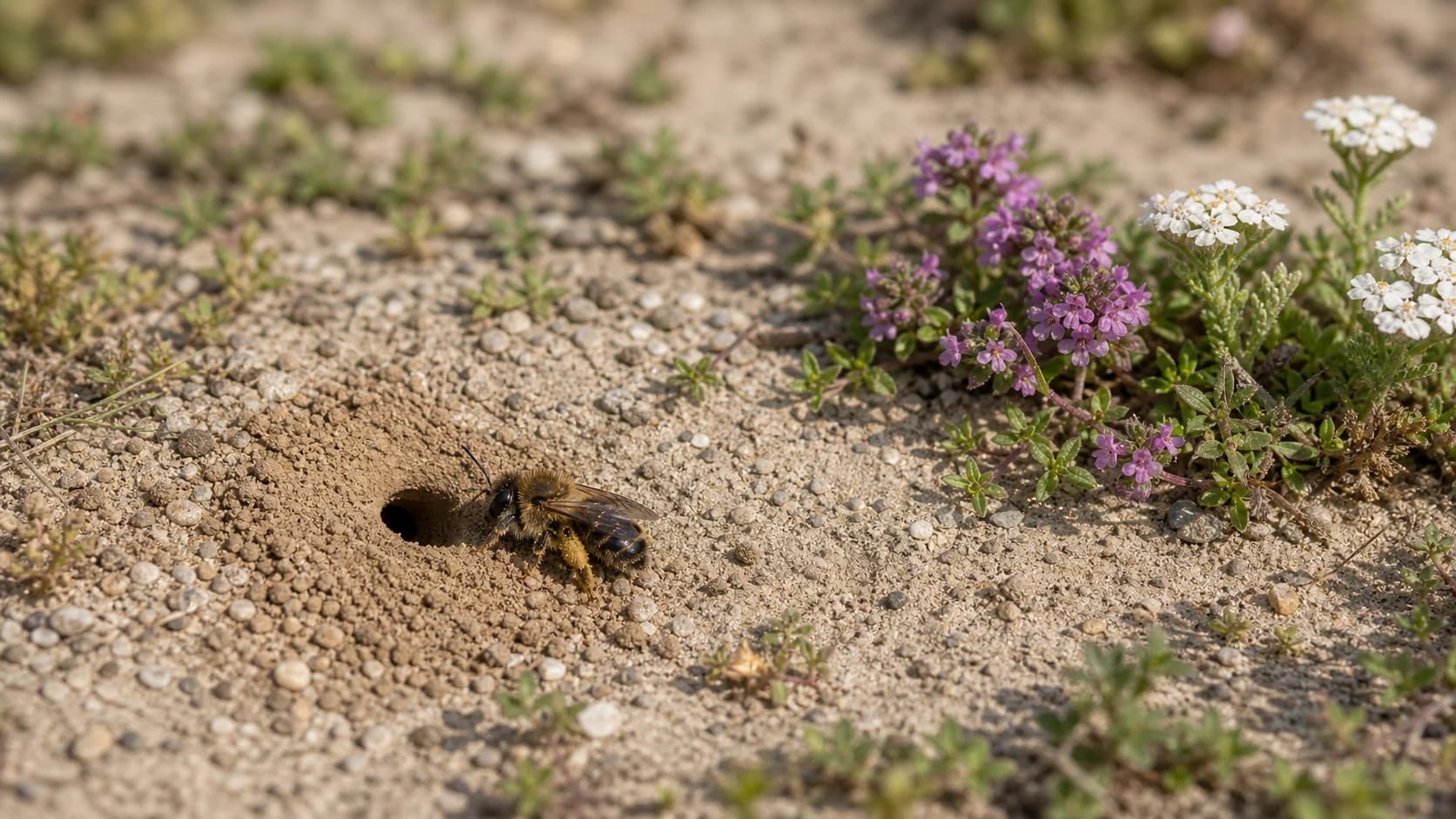 AI-generated
Since 75% of wild bees nest in the ground, above-ground insect hotels are only part of the solution. For ground nesters, you can do the following:
Creating a Sand Nesting Area
Many species prefer sandy, vegetation-free soil in sunny locations:
- Clear an area of at least 1 x 1 meter
- Excavate 30--50 cm deep and fill with unwashed sand (containing clay!)
- Lightly compact the surface but don't roll it flat
- The spot must be sunny all day and sheltered from rain (a slight slope helps)
- Do not plant -- the area must remain open
Steep Banks / Cliff Edges
Some wild bees (e.g., mining bees) nest in vertical earth walls. If you have an embankment or slope edge in your garden, leave it open -- don't stabilize it with plants or stones.
Open Joints in Walls and Dry Stone Walls
Dry stone walls made from natural stone with unfilled joints offer many wild bees nesting opportunities. Don't grout them!
The Biggest Mistakes with Insect Hotels
| Mistake | Problem | Do It Right |
|---|---|---|
| Drilling into end grain | Wood cracks, moisture enters, larvae die | Drill into side grain (lateral surface) |
| Using softwood (spruce, pine) | Resin, splinters, clogs tunnels | Hardwood: Beech, oak, ash |
| Installing perforated bricks | Holes far too large (2-3 cm), not occupied | Nesting stones with 3-10 mm holes |
| Pine cones, straw, bark | Only attracts earwigs and lacewings, no bees | Use hardwood, bamboo, reed |
| Not deburring drill holes | Splinters damage bee wings | Sandpaper or pipe cleaner |
| Shady north side | Too cold -- wild bees need warmth | South or southeast facing, sunny |
| Bamboo tubes open at back | Larvae lie unprotected, no seal | Seal back with clay or plaster |
| Plastic wrap as rain cover | Condensation, mold risk | Overhang with airflow (roofing felt, metal) |
When and How to Clean?
Nesting aids are not cleaned. The sealed nesting tunnels contain larvae that develop over months. In spring, the new bees hatch and the empty tunnels are reoccupied by the next generation.
You should only intervene for:
- Mold infestation: Remove affected elements and replace
- Bird damage: Attach wire mesh (3 cm mesh size) as protection
- Parasites: Fruit flies or parasitic wasps are natural enemies and part of the ecosystem
It may take a few weeks or even a season before your insect hotel is colonized. The bees need to discover it first. Make sure there are blooming plants nearby -- without food in the vicinity, no insect hotel will be occupied, no matter how perfectly it is built.
Observing Wild Bees: What Happens at the Insect Hotel?
Observing the nesting aid is almost as exciting as beekeeping. Watch for the following signs:
Recognizing Occupied Tunnels
- Clay seal: Mason bees seal their nesting tunnels with clay -- a sure sign of colonization
- Leaf pieces: Leafcutter bees wallpaper their tunnels with precisely cut leaf pieces
- Resin seal: Heriades bees seal with tree resin
Annual Calendar of Wild Bees
| Month | Activity |
|---|---|
| March--April | Mason bees hatch, mating, nest site searching |
| April--June | Nesting tunnels are filled and sealed |
| July--August | Scissor bees and leafcutter bees active |
| September | Last species active, ivy bee |
| October--February | Resting phase -- larvae develop in the tunnels |
Additional Measures for Wild Bees
An insect hotel alone is not enough -- wild bees also need food and building materials:
Supporting Wild Bees Holistically
Wild Bees and Honey Bees: Competition?
This question is asked frequently. The short answer: It's complicated. In areas with abundant bloom, both coexist without problems. In flower-poor landscapes, a high density of honey bee colonies can intensify food competition for wild bees.
As a responsible beekeeper or nature enthusiast, you can promote both:
- Don't place too many honey bee colonies in a small area
- Actively improve the bloom supply in the surrounding area
- Create habitats for wild bees (nesting aids, open ground)
- Get involved in local nature conservation
Conclusion: Small Help, Big Impact
A properly built insect hotel, combined with a nature-friendly garden, can make a real difference for the wild bee population in your area. The construction time is manageable, the costs are low, and the joy of watching the first mason bees build their nests in spring is priceless.
Start small -- even a hardwood block with a few clean drill holes on the south wall of your house is a good beginning. And don't forget: The best nesting aid is useless without blooming food plants nearby.
Bee-Friendly Plants: The Best Blossoms for Your Garden Bee Sponsorship: Giving Nature Conservation as a Gift Explaining Bees to Children: Tips and Activities for Parents- Forage Plants and Bee Pasture -- Lesson 5: Creating a Bee Pasture
- Forage Plants and Bee Pasture -- Lesson 6: Planting Trees for Bees
Less paperwork. More time with your bees.
Hivekraft is free for up to 10 hives. Register in 30 seconds.